
Most Americans learn an immigration story shaped by Ellis Island.
There is truth in that story: ships crossing the Atlantic, families arriving in New York Harbor, names checked, health inspections completed, and a new life beginning on American soil. For millions of European immigrants, Ellis Island became a symbol of entry.
But on the other side of the country, in San Francisco Bay, another immigration station told a different story.
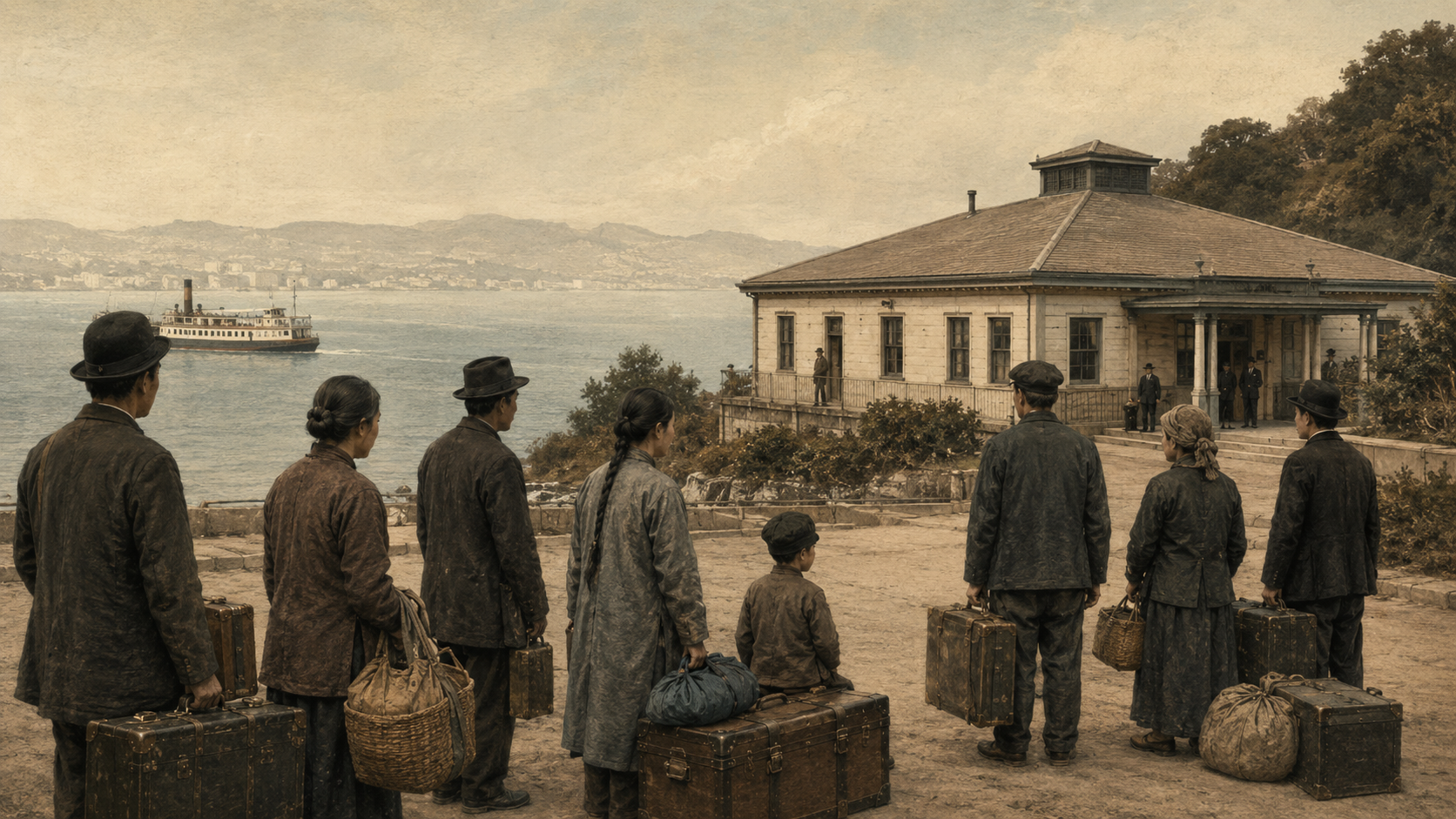
Angel Island was also a gate to America. But for many Asian immigrants, especially Chinese immigrants, it was less a symbol of welcome than a place of questioning, delay, separation, and exclusion. People arrived after long journeys across the Pacific only to be detained on an island within sight of the mainland. Some waited days. Others waited weeks, months, or even longer while officials investigated whether they would be allowed to enter.
Angel Island helps us understand that immigration history was never one single story. The meaning of “arrival” depended on who you were, where you came from, what laws applied to you, and how the federal government chose to define belonging.
Angel Island did not appear by accident.
By the late 1800s, the United States was building a national immigration system. At the same time, anti-Chinese politics had become especially powerful in California and the West. Chinese immigrants had come during the Gold Rush, worked in mining, agriculture, domestic service, small businesses, and railroad construction, and helped build the economy of the American West. Yet they were increasingly framed by politicians and labor leaders as economic threats and racial outsiders.
In 1882, Congress passed the Chinese Exclusion Act. It barred most Chinese laborers from entering the United States and denied Chinese immigrants the ability to become naturalized citizens. It was the first major federal law to restrict immigration based on race and nationality.
The law did not stop Chinese migration completely. Some people still had legal paths to enter, including merchants, students, teachers, diplomats, clergy, and certain family members. But exclusion changed the entire process. Chinese immigrants were no longer treated simply as people seeking entry. They were treated as people whose identities had to be doubted, tested, and investigated.
San Francisco became a major port of entry for immigrants crossing the Pacific. Before Angel Island opened, immigration inspections and detentions happened at facilities on the San Francisco waterfront. Those facilities were crowded and unsanitary. Federal officials eventually chose Angel Island as the site for a new station.
The location mattered. Angel Island was close to San Francisco but separated by water. Officials believed the isolation would make it easier to control detainees, prevent escape, and limit communication with relatives or supporters on the mainland.
When Angel Island Immigration Station opened in 1910, it became part of a larger system: not just processing immigrants, but enforcing exclusion.
Angel Island worked through inspection, separation, detention, interrogation, and appeal.
The process differed by race, class, nationality, gender, and travel status. First-class passengers and many European immigrants were often processed more quickly, sometimes aboard ship. Asian immigrants, especially those traveling in steerage or under categories affected by exclusion laws, were more likely to be sent to the island.
That difference is central to the story.
Angel Island was not just a building where paperwork happened. It was a place where the federal government sorted people by suspicion.
After ships arrived in San Francisco Bay, passengers could be divided by class, race, nationality, and legal category. Some were quickly cleared. Others were taken by ferry to Angel Island.
Once there, immigrants underwent medical inspections and administrative processing. Men and women were housed separately. Families could be separated during detention. Detainees slept in dormitories, waited for hearings, and lived under rules they did not control.
For people who had just completed a difficult ocean crossing, the experience could feel deeply disorienting. The mainland was visible, but not yet reachable.
Interrogation was one of Angel Island’s defining features.
Under Chinese exclusion laws, immigration officials had to decide whether a Chinese applicant truly belonged to one of the exempt categories. Was the person really the child of a U.S. citizen? Was the claimed merchant status legitimate? Did the documents match the person’s story?
Officials often asked detailed questions about family, village life, household layout, neighbors, ancestors, festivals, doorways, sleeping arrangements, and daily routines. Applicants could be questioned separately from witnesses. If answers did not match, officials might accuse the applicant of fraud and deny entry.
This system was especially intense after the 1906 San Francisco earthquake and fire destroyed many local records. Some Chinese immigrants used the gap in documentation to claim citizenship or family ties. Some identities were real; others were built through what became known as “paper sons” or “paper daughters,” in which a person entered using purchased or arranged family papers.
It is important to understand why this happened. Paper identities were not created in a neutral system. They emerged inside a legal regime that excluded most Chinese laborers while leaving only narrow categories for entry. When law makes ordinary migration nearly impossible, people may search for the few openings the law leaves behind.
Detention at Angel Island could last far longer than many people expected.
Some immigrants were held for days or weeks. Others waited months. A smaller number experienced even longer detentions while their cases moved through hearings, investigations, or appeals.
Detention was not only inconvenient. It shaped people’s bodies, emotions, finances, and family relationships. People worried about rejection, deportation, illness, lost work, missed family obligations, and the shame or fear of being returned after the cost and risk of migration.
The detention barracks became one of the most powerful physical records of the experience. Chinese detainees carved poems into the wooden walls. The poems recorded homesickness, anger, fear, frustration, hope, and the pain of being confined within sight of America.
Those poems matter because they interrupt the official paperwork. Immigration files show how the state saw detainees. The poems show how some detainees saw the state, the island, and themselves.
Chinese exclusion was the foundation of Angel Island’s system, but the station’s history was broader than Chinese immigration alone.
People from Japan, Korea, India, the Philippines, Russia, Mexico, Latin America, Europe, Australia, New Zealand, and Pacific Island communities also passed through or were detained there. Japanese immigration was affected by the Gentlemen’s Agreement of 1907. South Asian immigrants faced exclusionary policies and racial barriers. Filipino migrants occupied a complicated legal status because the Philippines was under U.S. colonial rule after 1898. During World War I, Angel Island also detained people classified as enemy aliens or political radicals.
That broader history matters. Angel Island was not only a Chinese American story, though Chinese immigrants were central to its meaning. It was part of a developing immigration system that used race, nationality, empire, labor fears, political suspicion, gender, health rules, and paperwork to decide who could enter and who could be kept out.
Angel Island Immigration Station closed in 1940 after a fire damaged the administration building. For years afterward, the site’s meaning was not widely recognized.
Then, in 1970, a California state park ranger noticed Chinese writing carved into the barracks walls. Preservationists, former detainees, scholars, community members, and Asian American activists helped save the site and recover its history. The station later became a National Historic Landmark.
That preservation effort changed public memory. Without it, Angel Island might have remained a footnote. Instead, it became a place where the physical evidence of exclusion, detention, and resilience could still be seen.
Angel Island most directly affected Asian immigrants entering through the Pacific Coast, especially Chinese immigrants living under the Chinese Exclusion Act and its later extensions.
Chinese men were often the largest and most scrutinized group. Many came from Guangdong Province and other parts of southern China, where poverty, political disruption, family obligations, and overseas labor networks shaped migration. Some hoped to join relatives, earn money, or build a future in the United States. Instead, they encountered a system designed to doubt them.
Chinese women also experienced the station in specific ways. U.S. immigration law and enforcement often treated Asian women through assumptions about morality, dependency, marriage, and sexuality. Women could face intrusive questioning and suspicion about whether they were legitimate wives, daughters, or travelers. The separation of men and women in detention added another layer of isolation.
Children could be questioned too. Some arrived as claimed sons or daughters of citizens or merchants. Their ability to answer detailed questions could determine whether they would be admitted or sent away. For young people, the burden of memorizing family histories and surviving interrogation could be enormous.
Japanese immigrants, Korean immigrants, South Asian immigrants, Filipino migrants, and other Pacific arrivals also encountered Angel Island’s bureaucracy. Their experiences differed depending on the laws and diplomatic arrangements that applied to them, but many faced racial suspicion and unequal treatment.
The station also affected families already living in the United States. Relatives on the mainland might wait anxiously while a husband, wife, child, sibling, or parent was detained. Communities raised money, hired lawyers, served as witnesses, and developed strategies for surviving a system that turned family belonging into a matter of government investigation.
Angel Island’s history reminds us that immigration enforcement does not affect only the person at the border. It reaches into households, kinship networks, neighborhoods, ethnic communities, and generations of memory.
Angel Island helps explain why immigration history is often remembered differently across communities.
For some families, America’s immigration story is a story of entry, welcome, and opportunity. For others, it is also a story of detention, surveillance, exclusion, suspicion, and paperwork that could decide the future of an entire family.
That difference does not mean one story cancels the other. It means the national story is incomplete unless both are included.
Angel Island also helps readers understand how legal categories shape lived experience. A person could be a student, worker, merchant, spouse, child, refugee, colonial subject, citizen’s descendant, or suspected fraud. Those categories were not abstract. They determined whether someone slept in a barracks, faced interrogation, appealed a denial, or stepped onto the mainland.
The site also speaks to the relationship between immigration and race. The United States did not simply ask, “Who wants to come?” It asked, “Which groups do we consider desirable, assimilable, useful, dangerous, or permanently foreign?” Those judgments were written into law and enforced through institutions like Angel Island.
Finally, Angel Island shows why records and public memory matter. The interrogation files, medical records, photographs, oral histories, and carved poems preserve a history that could have disappeared. The station’s survival allows later generations to see immigration enforcement not as an abstract policy debate, but as a human experience shaped by waiting rooms, barracks, questions, fear, hope, and endurance.
Angel Island matters because it widens the American immigration story.
It reminds us that there was not one gate to America. There were many gates, and they did not open the same way for everyone.
Ellis Island and Angel Island can both be true. One became a symbol of mass European arrival. The other became a symbol of Pacific migration under exclusion. Together, they show that immigration policy has always reflected more than logistics. It reflects national ideas about race, labor, security, family, citizenship, and belonging.
Angel Island also teaches a quieter lesson about bureaucracy. Harm does not always arrive through a single dramatic act. Sometimes it comes through forms, waiting, repeated questions, separated rooms, delayed decisions, and rules that appear neutral until we ask who they burden most.
And yet Angel Island is not only a place of harm. It is also a place of memory, resistance, and survival. The poems on the walls, the families who endured questioning, the communities that preserved the site, and the descendants who continue to tell these stories all show that exclusion did not erase identity.
The other gate to America is still part of America.
To understand the country more fully, we have to stand at both gates and ask what each one reveals.
Angel Island Immigration Station was a federal immigration facility in San Francisco Bay that operated from 1910 to 1940. It processed, detained, and interrogated immigrants arriving through the West Coast, especially Asian immigrants.
Both were major immigration stations, but they represented different experiences. Ellis Island is often remembered as a gateway for European immigrants. Angel Island is remembered more for detention, interrogation, and exclusion, especially under anti-Asian immigration laws.
Chinese immigrants were detained because U.S. exclusion laws severely restricted Chinese immigration. Officials used interrogations and document checks to determine whether applicants fit one of the few legal categories allowed to enter.
“Paper sons” and “paper daughters” were people who entered using claimed or purchased family identities, often as children of U.S. citizens or exempt residents. This practice developed because exclusion laws left very few legal paths for Chinese immigrants.
Chinese detainees carved poems into the walls of the detention barracks. These poems preserve emotional testimony about confinement, exclusion, homesickness, anger, hope, and resilience. They help readers understand the human experience behind immigration records.
National Park Service — U.S. Immigration Station, Angel Island
https://www.nps.gov/places/u-s-immigration-station-angel-island.htm
Angel Island Immigration Station Foundation — History of Angel Island Immigration Station
https://www.aiisf.org/history
Angel Island Immigration Station Foundation — Main Site
https://www.aiisf.org/
National Archives — The EARS Have It
https://www.archives.gov/publications/prologue/2003/fall/spotlight-ears
National Archives — When the “Enemy” Landed at Angel Island
https://www.archives.gov/publications/prologue/2009/summer/angel.html
Angel Island Conservancy — United States Immigration Station
https://angelisland.org/history/united-states-immigration-station-usis/
Smithsonian Center for Folklife and Cultural Heritage — Echoes of History: Chinese Poetry at the Angel Island Immigration Station
https://festival.si.edu/blog/echoes-of-history-chinese-poetry-and-the-angel-island-immigration-station