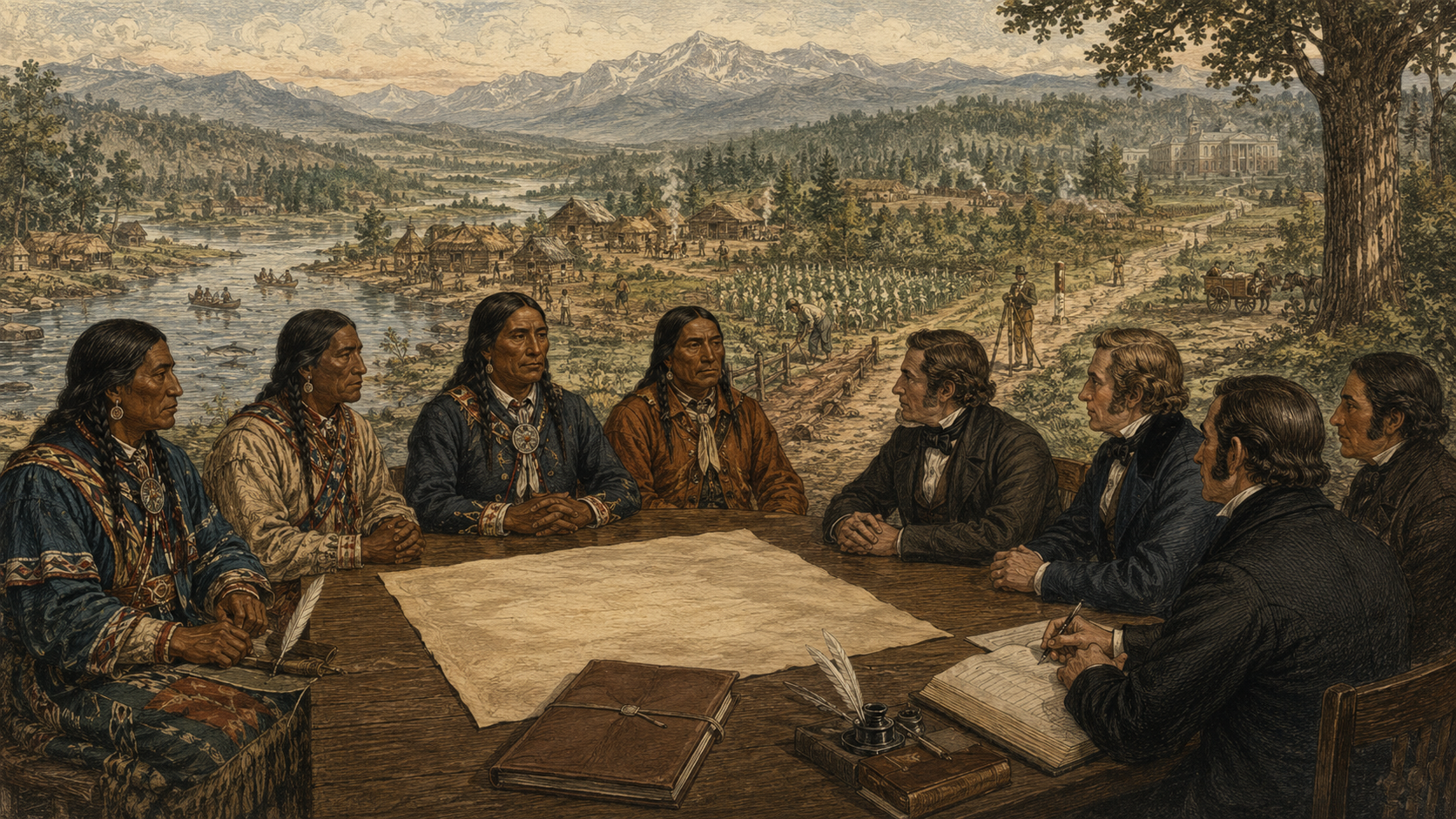
A treaty is not a favor granted by one government to another. It is an agreement between governments.
That distinction is essential to understanding the relationship between Native Nations and the United States.
From the nation’s founding through 1871, the United States negotiated hundreds of treaties with Native Nations. These agreements established peace, defined boundaries, transferred land, reserved homelands, recognized hunting and fishing rights, promised payments or services, and set terms for relations between political communities.
Treaties were often negotiated under severe inequality. Some followed warfare or forced removal. Some were signed by representatives whose authority was disputed. Promises were frequently delayed, narrowed, ignored, or contradicted by later federal action. Settlers entered protected lands, Congress imposed new policies, and federal officials interpreted agreements through institutions controlled by the United States.
Yet describing treaties only as broken promises can hide another part of their meaning.
The United States negotiated treaties because Native Nations possessed land, political authority, and the power to enter agreements. Treaties did not create tribal sovereignty. They recognized nations that already governed themselves.
Many treaty obligations remain legally significant today. They shape jurisdiction, land use, fishing and hunting rights, water access, federal services, and the government-to-government relationship between federally recognized tribes and the United States.
The history of broken treaties is therefore not only a history of past betrayal. It is also a history of sovereignty that survived conquest, removal, allotment, termination, and repeated attempts to reduce Native Nations to racial or cultural groups rather than governments.
Native Nations had long traditions of diplomacy, alliance, trade, peacemaking, territorial negotiation, and conflict resolution before European colonization.
Those diplomatic systems varied widely. Haudenosaunee political traditions were not the same as those of the Cherokee Nation, the Lakota, the Pueblo peoples, the Ojibwe, or the Coast Salish nations. Native Nations had distinct governments, territories, languages, laws, and methods of authorizing agreements.
European empires and, later, the United States entered a political landscape that already contained sovereign communities.
Early American officials understood this reality in practical terms. The new United States lacked the military power, administrative reach, or population to simply govern Native communities as ordinary counties or groups of individual citizens. It negotiated with Native Nations because they controlled territory, maintained political institutions, and could enter binding agreements.
The Smithsonian’s National Museum of the American Indian describes treaties as solemn agreements between sovereign nations and notes that the United States ratified approximately 374 treaties with Native Nations. Although many were coerced or violated, the treaties continue to define mutual rights and obligations.
Treaties were one of the principal legal mechanisms through which the United States expanded.
Native Nations ceded millions of acres, often in exchange for reserved homelands, payments, goods, education, medical assistance, protection, or continued rights to hunt, fish, gather, and travel in larger traditional territories.
These agreements were not all identical.
Some sought military peace. Some established borders. Some provided for removal. Some reserved access to resources outside reservation boundaries. Some created obligations involving schools, agricultural equipment, food, or federal agents. Others confirmed a nation’s right to remain in or return to a homeland.
The 1868 treaty with the Navajo Nation, for example, allowed the Diné to return from forced confinement at Bosque Redondo to a portion of their homeland. That agreement illustrates why treaty history cannot be reduced to land cession alone. Treaties could also contain protections that Native Nations fought to secure under extraordinary pressure.
The Constitution gives the federal government authority over treaties and places treaties, along with the Constitution and federal statutes, within the “supreme Law of the Land.”
The Senate’s advice and consent was required for ratification. Once ratified, a treaty was not merely a statement of goodwill. It became a binding federal legal commitment.
This did not create an equal relationship in practice. The United States increasingly possessed greater military, economic, and administrative power. But the treaty process formally recognized that Native Nations were political entities capable of negotiating with the federal government.
That recognition remains important because treaty rights do not rest solely on modern generosity or public policy preference. They arise from negotiated exchanges in which Native Nations surrendered land or other claims while retaining specified rights and securing federal obligations.
In the early 19th century, Supreme Court decisions began describing tribes as “domestic dependent nations.”
That language acknowledged a continuing political status while also placing Native Nations within a relationship of dependence on the federal government. Tribal sovereignty was recognized, but constrained by Congress, federal courts, and the expanding territorial power of the United States.
The National Archives notes that earlier treaties were framed more like agreements with independent foreign nations. By the 1830s, federal law increasingly described tribes as domestic dependent political communities.
This created a lasting tension.
Native Nations retained inherent authority over internal government, citizenship, land, and community life. At the same time, the United States claimed broad power to regulate tribal affairs and determine the limits of that authority.
Much of federal Indian law developed inside that unresolved contradiction.
Treaty language is sometimes misunderstood as though the United States generously granted Native Nations permission to fish, hunt, govern, or occupy land.
In many cases, the legal logic ran in the opposite direction.
Native Nations already possessed broader territorial and political rights. Through treaties, they transferred some rights while explicitly retaining others. A reserved fishing right, for example, was not necessarily a new benefit created by the United States. It was a right the nation had not surrendered.
The Medicine Creek Treaty and related agreements in the Pacific Northwest ceded large areas to the United States while reserving the signatory nations’ rights to fish at their usual and accustomed places and to continue certain hunting and gathering practices.
This is why treaty rights are often described as retained or reserved rights.
They were part of the price the United States agreed to pay for land and peace.
The existence of a treaty does not prove that the negotiations were fair.
Many agreements followed military defeat, hunger, displacement, disease, destruction of food supplies, or the arrival of overwhelming numbers of settlers. Federal negotiators could threaten force or the withdrawal of assistance. Interpreters did not always communicate legal concepts accurately across languages. Written English versions could differ from what Native leaders believed had been discussed.
Questions of authority also mattered.
Native political systems did not always empower one leader to permanently transfer communal land. Federal officials sometimes selected or recognized signers who were willing to accept American terms, even when other leaders or communities rejected their authority.
Some treaties were never ratified by the Senate. Others were altered during ratification. Some contained promises that federal appropriations later failed to fund adequately.
The signed document was therefore only one part of the relationship. Its legitimacy also depended on how agreement was reached, whether the signers represented the nation, and whether the United States fulfilled the obligations it had accepted.
After ratification, Native Nations often depended on the United States to administer its own promises.
Federal agents delivered annuities, distributed goods, supervised schools, handled funds, managed reservation boundaries, and communicated with other branches of government. Congress controlled appropriations. Federal surveyors interpreted maps. Courts decided how treaty language should apply.
This created a structural imbalance.
One party to the treaty also controlled much of the system for determining whether the treaty had been fulfilled.
Payments could arrive late or in inadequate form. Goods could be poor quality. Agents could be corrupt or incompetent. Promised services could be underfunded. Reservation boundaries could remain unsurveyed while settlers entered the land.
Treaty violations were therefore not always announced through a formal declaration that an agreement no longer mattered. They could happen incrementally through administrative delay, inadequate funding, permissive enforcement, or interpretations that consistently favored federal expansion.
Treaty protections were often weakened by settlement before Congress or the courts formally changed the law.
Miners, ranchers, railroads, land speculators, and territorial governments entered areas that treaties had reserved for Native use. Federal officials then faced political pressure to protect the newcomers rather than remove them.
This pattern can make treaty violation look inevitable in hindsight. It was not.
The federal government repeatedly chose whether to enforce boundaries, remove intruders, fund obligations, or renegotiate under pressure. Settler presence became an argument for changing a treaty even when that settlement had occurred in violation of the agreement.
Illegal occupation could therefore create the political conditions for its own later legalization.
The 1868 Treaty of Fort Laramie established the Great Sioux Reservation and recognized the Black Hills as reserved for the “absolute and undisturbed use and occupation” of the Sioux Nation.
The treaty also required the approval of three-fourths of adult male tribal members before additional reservation land could be ceded.
After gold was discovered in the Black Hills, miners entered the protected territory. The federal government failed to keep them out. Following war and mounting pressure for the land, Congress confiscated the Black Hills in 1877 without obtaining the consent required by the treaty. The land remains the center of a longstanding legal and political dispute.
This history illustrates several mechanisms operating together:
The treaty was not simply forgotten. Its protections were overridden when they conflicted with American demand for land and resources.
In 1871, Congress declared that the United States would no longer recognize Native Nations as independent nations with which it would make new treaties.
Afterward, the federal government continued to make agreements and enact statutes governing tribal affairs, but it did so through legislation and executive action rather than the constitutional treaty process.
The change strengthened congressional control. It also reduced the formal diplomatic role of the Senate and made it easier for the federal government to alter policy without negotiating a treaty in the same form.
The 1871 law did not cancel treaties that had already been ratified. Existing treaty rights and obligations continued to carry legal force.
That distinction remains important.
The end of treaty-making is sometimes mistaken for the end of Native sovereignty or the expiration of all earlier agreements. Neither conclusion follows from the law.
The General Allotment Act of 1887, commonly called the Dawes Act, authorized the division of communally held reservation land into individual parcels.
Supporters described allotment as a path toward farming, private ownership, and assimilation into American society. In practice, the policy weakened tribal land bases and opened land classified as “surplus” to non-Native settlement.
Allotment imposed an American model of individual property on nations whose land systems were often communal, clan-based, or governed through other traditions. It also subjected individual allotments to federal supervision and, eventually, taxation and sale.
The policy could undermine treaty commitments without formally erasing the treaty document. A homeland promised to a nation might remain visible on a map while its internal land system was broken into individual parcels and transferred out of tribal ownership.
This demonstrates that treaty rights could be weakened by changing the structure of ownership rather than openly declaring the treaty void.
American law developed the principle that Congress could alter or abrogate treaty rights through later legislation.
Courts have also said that Congress must show a clear intention before a treaty right is treated as extinguished. Treaty rights are not supposed to disappear through vague or accidental statutory language.
This creates another lasting tension.
Treaties are binding law, but Congress claims authority to change their legal effect. Courts may enforce treaty language, yet they also operate within a constitutional system in which federal legislative power over Native affairs has been interpreted broadly.
The question is therefore often not whether the treaty existed. It is whether Congress clearly displaced it, how courts interpret the relevant language, and whether a right survived later policy changes.
During the 1950s and 1960s, federal termination policy sought to end the government-to-government relationship with selected tribes.
Termination withdrew federal recognition, ended trust protections, and discontinued services associated with the federal relationship. Tribal lands could lose protected status, while tribal citizens were expected to become subject to state and local systems without the same federal obligations.
The policy was presented as an extension of equality and independence. In practice, it often produced land loss, economic disruption, and the weakening of tribal governments.
Some terminated nations later regained federal recognition, but restoration did not automatically reverse every consequence.
Termination reveals how federal policy repeatedly tried to redefine Native Nations as collections of individual citizens rather than continuing political communities.
Despite repeated violations, treaties did not become meaningless.
Native Nations preserved treaty texts, oral histories, political traditions, fishing practices, land claims, and legal arguments. Tribal governments pursued cases in federal courts, negotiated with agencies, organized public campaigns, and continued exercising rights that had never been surrendered.
In United States v. Washington, federal courts enforced treaties reserving fishing rights to tribes in Washington State. The decisions recognized treaty tribes’ right to a fair share of harvestable fish, generally up to 50 percent, subject to the needs defined by the litigation. Later proceedings extended the principles to shellfish and habitat-related obligations.
The controversy was not about granting tribes a new advantage over other fishers. It was about enforcing rights that had been reserved when tribes ceded most of the surrounding land.
In the 2020 case McGirt v. Oklahoma, the Supreme Court held that Congress had never disestablished the Muscogee Creek Reservation for purposes of the federal Major Crimes Act.
Oklahoma had exercised authority for generations as though the reservation no longer existed. But the Court concluded that historical practice could not replace the legal requirement that Congress clearly dissolve the reservation.
Justice Neil Gorsuch’s majority opinion summarized the principle directly: because Congress had not said otherwise, the government had to be held to its word.
The ruling did not transfer privately owned land to the Muscogee Nation or settle every question of state, federal, and tribal jurisdiction. Its immediate legal issue concerned criminal jurisdiction under federal law.
Its broader significance was that the passage of time, demographic change, and long-standing government assumptions did not by themselves erase a treaty-based reservation.
The primary parties affected by broken treaties were Native Nations themselves.
Treaty violations weakened governments, reduced territorial control, interfered with jurisdiction, and limited the ability of nations to support their citizens. The effects were political as well as economic.
When a homeland was reduced, the nation lost more than acreage. It could lose access to sacred places, water, fisheries, hunting grounds, agricultural land, travel routes, and sites central to governance and community identity.
When federal officials ignored a treaty government’s authority, they also changed who could make decisions about land, family life, criminal law, education, and economic development.
Treaty promises reached everyday life.
A reserved fishing right could support food security, trade, ceremonial practice, and employment. A land boundary could protect homes, burial places, gathering areas, and water. A federal obligation involving health or education could determine whether services existed in isolated communities.
When these commitments were neglected, the effects appeared in household economics, nutrition, displacement, schooling, health, and the ability to remain near extended family.
Treaty policy was therefore not abstract diplomacy. It shaped whether communities could continue living on their own lands under their own governments.
Some treaties reserved rights beyond the boundaries of a reservation.
Fishing, hunting, gathering, and travel often depended on larger seasonal territories. A nation might cede title to land while retaining access to rivers, forests, or traditional harvesting areas.
Those rights became especially vulnerable when states issued licenses, private owners blocked access, dams altered rivers, or commercial industries depleted resources.
A reservation map alone may therefore show only part of the treaty relationship. The legal geography can extend into waterways, public lands, and privately owned areas where specific rights were retained.
Not every negotiated agreement became a ratified treaty.
In California, federal commissioners negotiated numerous treaties with Native communities in the early 1850s. The Senate declined to ratify them and kept them secret for decades. Lands that Native signers believed had been reserved were opened to American settlement.
These communities experienced the consequences of negotiations without receiving the legal protection they had been led to expect.
Their history shows that treaty-making could produce harm even before a treaty formally entered law.
Treaty violations affected people differently within communities.
Land loss and forced relocation could alter women’s agricultural authority, family economies, and community responsibilities. Federal schools separated children from languages, relatives, and systems of knowledge. The conversion of communal land to male-headed individual allotments could impose outside gender and inheritance rules.
The effects also accumulated across generations.
A parcel lost in the 19th century could not support housing or economic development in the 20th. A damaged fishery could undermine food systems decades later. A boundary dispute could affect jurisdiction long after the people who signed the treaty had died.
Treaties were often written to bind future generations. Their violation also created consequences that outlived the officials who made the decisions.
There is no single Native treaty experience.
Some nations signed many treaties. Others signed one or none. Some retained large land bases; others were removed far from their homelands. Some treaty rights concern fisheries, while others involve land, water, payments, education, health, or jurisdiction.
A broad history can explain common mechanisms, but it should not flatten distinct nations into one story.
The most accurate approach is to ask which nation, which treaty, which language, which historical circumstances, and which later federal actions shaped a particular dispute.
Ratified treaties remain part of federal law unless they have been lawfully altered or extinguished.
Federal courts still interpret treaty language. Agencies still administer treaty-related responsibilities. Tribal governments continue to negotiate with the United States on a government-to-government basis.
The Bureau of Indian Affairs describes the federal trust responsibility as a legal obligation to protect tribal treaty rights, lands, assets, and resources and to carry out federal law governing the relationship with tribes.
This does not mean the United States acts as a simple guardian with unlimited authority. The trust relationship has also been used to justify federal control over Native property and decision-making.
It does mean that federal obligations are not merely historical gestures. They remain embedded in present law and administration.
The United States currently recognizes 575 tribal entities as possessing a government-to-government relationship with the federal government.
Federally recognized tribes retain inherent powers of self-government, including authority over many internal political, legal, and property matters, though that authority has been limited by Congress and federal courts.
Treaty questions continue to appear in disputes involving:
The existence of modern litigation does not necessarily mean the treaty language is unclear. Disputes may arise because governments disagree about enforcement, jurisdiction, resource scarcity, or the practical consequences of honoring the agreement.
Treaty rights are sometimes described as special privileges given to people because of race.
That description misunderstands their legal basis.
Treaty rights arise from the political relationship between the United States and Native Nations. They belong to tribes and their citizens because those nations entered agreements with the federal government, often exchanging vast territories and resources for specified protections.
The Bureau of Indian Affairs distinguishes these political and legal obligations from racial classifications and explains that many treaty rights are retained rights rather than benefits newly granted by the United States.
That distinction does not settle every disagreement over the scope of a treaty. It establishes why the rights exist.
The phrase “broken treaties” can suggest a closed chapter in which the United States failed to keep old promises and the consequences now belong entirely to the past.
The historical record supports a different interpretation.
Treaties helped create the geographic and legal foundation of the modern United States. Their remaining provisions continue to define relationships among tribal, federal, and state governments. When courts enforce a fishing right or recognize that a reservation was never legally dissolved, they are not reviving an obsolete arrangement. They are applying commitments that helped make American expansion possible.
The modern issue is therefore not whether history should override the present.
The treaties are part of the present legal structure.
Broken treaties are central to American history because the United States acquired much of its territory through agreements with Native Nations.
The country cannot fully explain its borders, public lands, western settlement, natural-resource systems, or federal structure without them.
But the history matters for another reason.
Treaties reveal that Native Nations were never simply ethnic minorities waiting to be incorporated into the United States. They were—and remain—political communities with their own governments, laws, citizens, and territorial relationships.
Tribal sovereignty does not mean complete independence from every federal law. No government exercises unlimited sovereignty. States, cities, foreign countries, and the federal government all operate within overlapping legal constraints.
For Native Nations, sovereignty means the retained and inherent authority to govern their communities except where that authority has been lawfully limited.
Treaties both recognized and constrained that authority. They preserved some rights while transferring others. They created federal obligations while placing Native Nations within a political system that repeatedly claimed the power to revise the relationship.
This is why the language of promises alone is not enough.
A government can praise treaties ceremonially while failing to fund obligations, protect resources, respect jurisdiction, or consult the nations affected. It can acknowledge sovereignty in public statements while treating tribal governments as interest groups rather than political partners.
The test of a treaty is not whether it remains in an archive.
It is whether the governments bound by it continue to recognize the rights, responsibilities, and political relationships the agreement established.
Tribal sovereignty is the inherent authority of a Native Nation to govern itself. It includes powers involving citizenship, internal government, land, courts, community policy, and other matters, subject to limits imposed by federal law. Sovereignty existed before the United States and was not created by federal recognition.
Many are. Ratified treaties remain federal law unless Congress has clearly altered or ended a particular provision or the treaty itself provided for termination. Courts continue to enforce treaty-based rights involving land, resources, and jurisdiction.
No. Congress ended the practice of making new treaties with Native Nations. It did not automatically cancel treaties that had already been ratified. After 1871, the federal government managed tribal relations primarily through statutes, executive orders, and other agreements.
Treaty rights arise from political agreements between governments. Native Nations often ceded land and resources while retaining specific rights or receiving federal commitments in return. The rights are based on tribal political status and treaty relationships, not race alone.
Federal law recognizes that Congress can alter or abrogate a treaty right, but courts generally require clear evidence that Congress intended to do so. Treaty rights are not supposed to disappear through ambiguous legislation or administrative assumption.
Nation to Nation: Treaties Between the United States and American Indian Nations
Smithsonian National Museum of the American Indian
https://americanindian.si.edu/nationtonation/
An accessible overview of treaty diplomacy, coercion, Native sovereignty, and the continuing legal significance of approximately 374 ratified treaties.
American Indian Treaties
National Archives
https://www.archives.gov/research/native-americans/treaties
Introduces the federal treaty record and explains how the legal framing of relations with Native Nations changed between the founding era and 1871.
Federal Indian Law and Policy Overview
Bureau of Indian Affairs
https://www.bia.gov/bia/history/IndianLawPolicy
Explains the treaty era, the end of formal treaty-making, and the development of later federal policies governing tribal nations.
Treaty of Fort Laramie, 1868
National Archives
https://www.archives.gov/milestone-documents/fort-laramie-treaty
Provides the original treaty text and historical background on the Great Sioux Reservation, the Black Hills, settler intrusion, and later federal confiscation.
United States v. Washington
U.S. Department of Justice
https://www.justice.gov/enrd/indian-resources-section/us-v-washington
Explains the litigation enforcing Pacific Northwest treaty fishing rights and the legal meaning of a fair share of harvestable fish.
McGirt v. Oklahoma
Supreme Court of the United States
https://www.supremecourt.gov/opinions/19pdf/18-9526_9okb.pdf
The official 2020 opinion holding that Congress had not disestablished the Muscogee Creek Reservation for purposes of federal criminal law.