
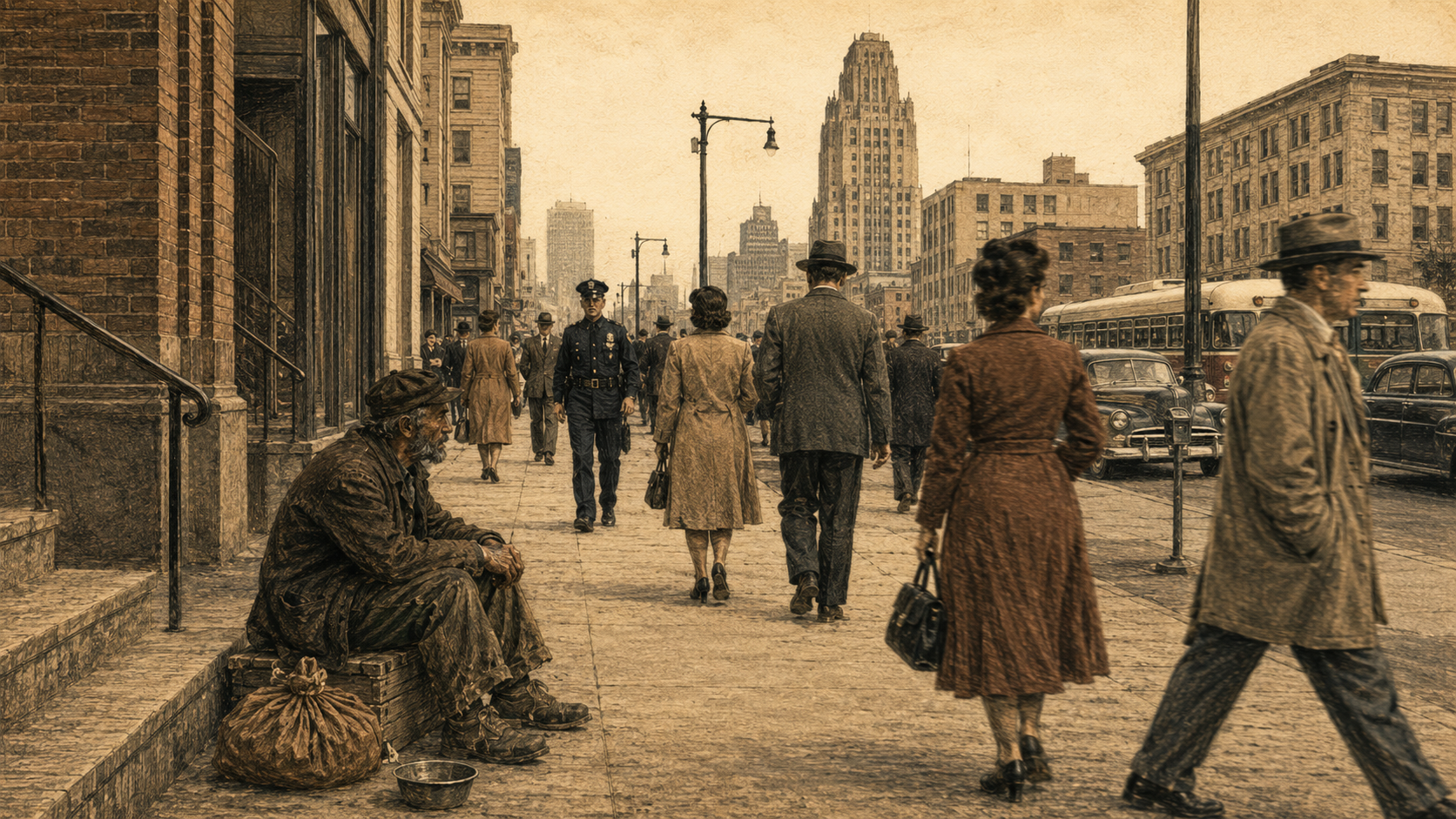
Some laws do not only regulate behavior. They teach a public lesson about who is allowed to belong.
The laws later known as “ugly laws” did exactly that. Beginning in the late 1800s, several American cities passed ordinances aimed at keeping visibly disabled, poor, disfigured, or begging people out of public view. These laws treated the street, sidewalk, park, and marketplace as spaces that should be protected from certain bodies.
That is what makes this history so important.
Ugly laws were not simply about appearance, and they were not just about disability in the narrow medical sense. They sat at the intersection of disability, poverty, policing, public order, urban growth, and social discomfort. They made public visibility itself the problem.
The wording could be blunt. Some ordinances targeted people described as “diseased, maimed, mutilated,” or visibly disfigured in ways officials considered improper for public streets. But the deeper mechanism was broader: the law gave cities a way to remove people whose presence challenged the image of a clean, orderly, prosperous public space.
In other words, ugly laws were about who had the right to be seen.
Ugly laws developed during a period of rapid urban change.
After the Civil War, American cities grew quickly. Industrialization drew more people into urban centers. Immigration, poverty, unemployment, injury, disease, and crowding were visible on city streets. Public spaces became busier, more diverse, and more difficult for officials to manage.
At the same time, many people acquired visible disabilities through war, industrial accidents, illness, childbirth injuries, workplace hazards, poverty, and limited medical care. A person might have an amputated limb, burn scars, facial differences, mobility impairments, blindness, chronic illness, or visible effects of disease.
For many poor disabled people, public space was also where survival happened. People sold small goods, performed music, asked for money, exchanged information, found day work, and relied on informal networks. The street was not just a place of movement. It was an economic space.
City leaders often framed this visibility as disorder. They worried about begging, vagrancy, sanitation, tourism, business districts, and the appearance of modern progress. Rather than address the reasons people were poor, injured, excluded from work, or without support, some cities chose a more direct tool: remove them from public view.
San Francisco passed one of the earliest ordinances in 1867. Chicago passed a well-known version in 1881. Other cities adopted similar measures. The laws varied by wording and enforcement, but they shared a basic idea: certain people could be treated as improper occupants of public space because of how they looked, how poor they were, or how others reacted to them.
That is why “ugly law” is a useful but imperfect label. The issue was not ugliness as a personal trait. The issue was power: who got to decide that a person’s body made them unacceptable in public?
Ugly laws worked through local ordinances, police discretion, public complaint, and the legal language of nuisance or order.
They did not need a large federal bureaucracy. They could operate through city codes, patrol officers, police courts, fines, jail time, warnings, or informal pressure to move along.
The system had several connected parts.
Ugly laws turned physical appearance into a reason for legal exclusion.
The ordinances often used language that mixed disability, disease, disfigurement, disgust, and improper presence. That language mattered. It did not simply describe people. It trained officials and the public to see some bodies as civic problems.
A person did not have to harm anyone to become a target. Being visible in the wrong place could be enough.
This is one of the most important lessons. Ugly laws treated public discomfort as if it were public harm. The problem was not what a person did, but how others were encouraged to interpret that person’s presence.
Ugly laws were not applied equally to all disabled people.
Disabled veterans, stage performers, injured workers with stable employment, or people with family wealth might be allowed to appear in public without being treated as legal problems. Poor disabled people, especially those who begged or worked informally on the street, were more vulnerable.
That tells us something important: the target was not disability alone. It was disability combined with poverty, dependence, visibility, and lack of social protection.
If a disabled person could fit into an acceptable role—worker, veteran, performer, family dependent—the public might tolerate or even admire them. If that same person needed to ask strangers for money on a sidewalk, the law could treat them as disorder.
The category was flexible enough to seem about appearance while functioning as a tool against poverty.
Ugly laws gave police authority to act on public discomfort.
A passerby, shopkeeper, city official, or officer could decide that a person’s presence disturbed the desired order of the street. The response could be arrest, a fine, jail, or pressure to leave the area.
This is why the policing piece matters. The laws did not merely express prejudice. They turned prejudice into enforceable action.
A person could be removed from the public realm not because they were dangerous, but because officials considered them visually unacceptable, economically inconvenient, or bad for the city’s image.
Ugly laws emerged alongside broader efforts to manage city life.
Cities regulated sanitation, sidewalks, street vending, public gathering, begging, and vagrancy. Some regulation was about genuine public health and safety. But ugly laws show how easily “order” could slide into exclusion.
The street became a stage on which the city wanted to project progress. Poverty, impairment, and visible need disrupted that image. Rather than ask why people lacked work, medical care, housing, or support, city governments could push them out of sight.
That made ugly laws part of a larger urban pattern: managing the appearance of social problems instead of addressing their causes.
Ugly laws are often associated with the 1800s, but some remained on the books far into the 20th century.
By the 1970s, disability rights activists were challenging older assumptions that people with disabilities should be hidden, institutionalized, pitied, or excluded. The continued existence of ugly laws became a striking example of state-sanctioned disability discrimination.
Chicago repealed the last of these laws in 1974. That date matters. It places the end of ugly laws within living memory and close to the modern disability rights movement.
The timeline helps correct a common misunderstanding. Disability exclusion was not only an old Victorian attitude. It was written into modern municipal law much later than many readers would expect.
The people most affected were visibly disabled people who were also poor, unhoused, unemployed, begging, or dependent on public space for survival.
This included people with mobility impairments, limb differences, facial differences, chronic illness, blindness, visible injuries, scars, or disfigurement. It also included people whose disabilities were made more visible by poverty: worn clothing, lack of medical care, lack of assistive devices, and the need to sit, stand, sell, perform, or ask for help in public.
The laws also affected people whose bodies carried the marks of industrial America. Workers injured in factories, mines, railroads, construction, and street labor could lose not only wages but public acceptance. A workplace injury might remove someone from formal employment and then make that person more vulnerable to policing if they sought help in the street.
Women could experience this exclusion in specific ways. A visibly disabled or poor woman in public might be judged through ideas about morality, dependency, respectability, and family failure. If she begged, sold goods, or appeared alone in public, she could be read not simply as poor but as improper.
Immigrants and racialized communities could also be affected where disability, poverty, language, and public suspicion overlapped. Ugly laws did not need to name every group to reinforce broader hierarchies. When police had discretion to decide who looked improper, existing biases shaped who was most likely to be targeted.
Children and families were affected too. A parent pushed out of public space could lose access to informal income. A child with visible disabilities could learn early that public life was conditional. Families could be pressured to hide disabled relatives, rely on institutions, or keep people out of sight to avoid shame or trouble.
This is why the history should not be reduced to “people were once cruel about appearance.” The laws shaped movement, income, family strategy, public belonging, and the daily geography of survival.
Ugly laws are gone, but the questions they raise have not disappeared.
Today, the Americans with Disabilities Act recognizes disability discrimination as a civil rights issue. It protects people with disabilities in employment, public services, transportation, businesses open to the public, telecommunications, and other areas of everyday life. Title II requires state and local governments to provide people with disabilities equal opportunity to participate in public programs, services, and activities.
That is a major legal transformation.
But the older pattern still helps readers ask better questions about public space.
Who is welcomed in public? Who is treated as a nuisance? Who is designed around, and who is designed out? When does a city respond to poverty or disability with support, and when does it respond with removal?
Modern laws are not ugly laws. It is important not to flatten the past into the present. But public debates still often turn on visibility, comfort, business districts, sidewalks, transit spaces, parks, homelessness, mental health, disability access, and public order.
The echo is not that the same ordinance has returned. The echo is the recurring temptation to treat visible need as a problem of appearance or enforcement rather than a problem of housing, healthcare, accessibility, income, and support.
The disability rights movement pushed a different idea into public life: disabled people are not civic embarrassments to be hidden. They are members of the public. Public space belongs to them too.
That idea remains central to access debates today.
Ugly laws matter because they reveal how exclusion can hide inside ordinary local rules.
These were not only dramatic national policies. They were city ordinances, police practices, and courtroom routines. They operated close to daily life, at the level of sidewalks, storefronts, street corners, and public parks.
That is part of their lesson.
A society can exclude people without building a wall. It can exclude them by defining them as improper, inconvenient, disorderly, or unpleasant to see. It can use law to make public comfort more important than human presence.
The history also reminds us that disability is not only a medical category. It is shaped by the built environment, labor markets, poverty, public attitudes, policing, and law. A person’s impairment may be part of their life, but exclusion is built by systems around them.
Ugly laws tried to make some people disappear from public view. Studying them does the opposite. It brings those people back into the story and asks what kind of public life a democracy owes to everyone who lives within it.
The question is simple, but it reaches far:
Who gets to be seen?
Ugly laws were local ordinances that restricted visibly disabled, disfigured, poor, or begging people from appearing in public spaces. They were used in several American cities beginning in the late 1800s.
The phrase “ugly laws” became a later shorthand for ordinances that treated certain bodies as unacceptable in public. The laws were not really about beauty. They were about disability, poverty, policing, and public control.
They most often targeted people who were visibly disabled and poor, especially those who begged or relied on public space for survival. They could also affect people who were unhoused, unemployed, injured, chronically ill, or otherwise judged as improper for public view.
Yes, though enforcement varied by city and period. Some were enforced through arrests, fines, jail time, warnings, or pressure to leave public spaces. Even when not constantly enforced, the laws gave officials a tool for removal.
Some ugly laws remained on the books into the 20th century. Chicago repealed the last of these laws in 1974, during the era of modern disability rights organizing.
National Museum of American History — Appearance
https://americanhistory.si.edu/explore/exhibitions/everybody/words/appearance
PubMed / Journal of Social History — Diseased, Maimed, Mutilated: Categorizations of Disability and an Ugly Law in Late Nineteenth-Century Chicago
https://pubmed.ncbi.nlm.nih.gov/20939141/
Harvard Civil Rights-Civil Liberties Law Review Amicus — Kicked to the Curb: Ugly Law Then and Now
https://journals.law.harvard.edu/crcl/wp-content/uploads/sites/80/2013/01/Schweik_Vol46_Amicus.pdf
Temple University Institute on Disabilities — Disability Rights Timeline
https://disabilities.temple.edu/resources/disability-rights-timeline
ADA.gov — Introduction to the Americans with Disabilities Act
https://www.ada.gov/topics/intro-to-ada/
ADA.gov — State and Local Governments
https://www.ada.gov/topics/title-ii/