
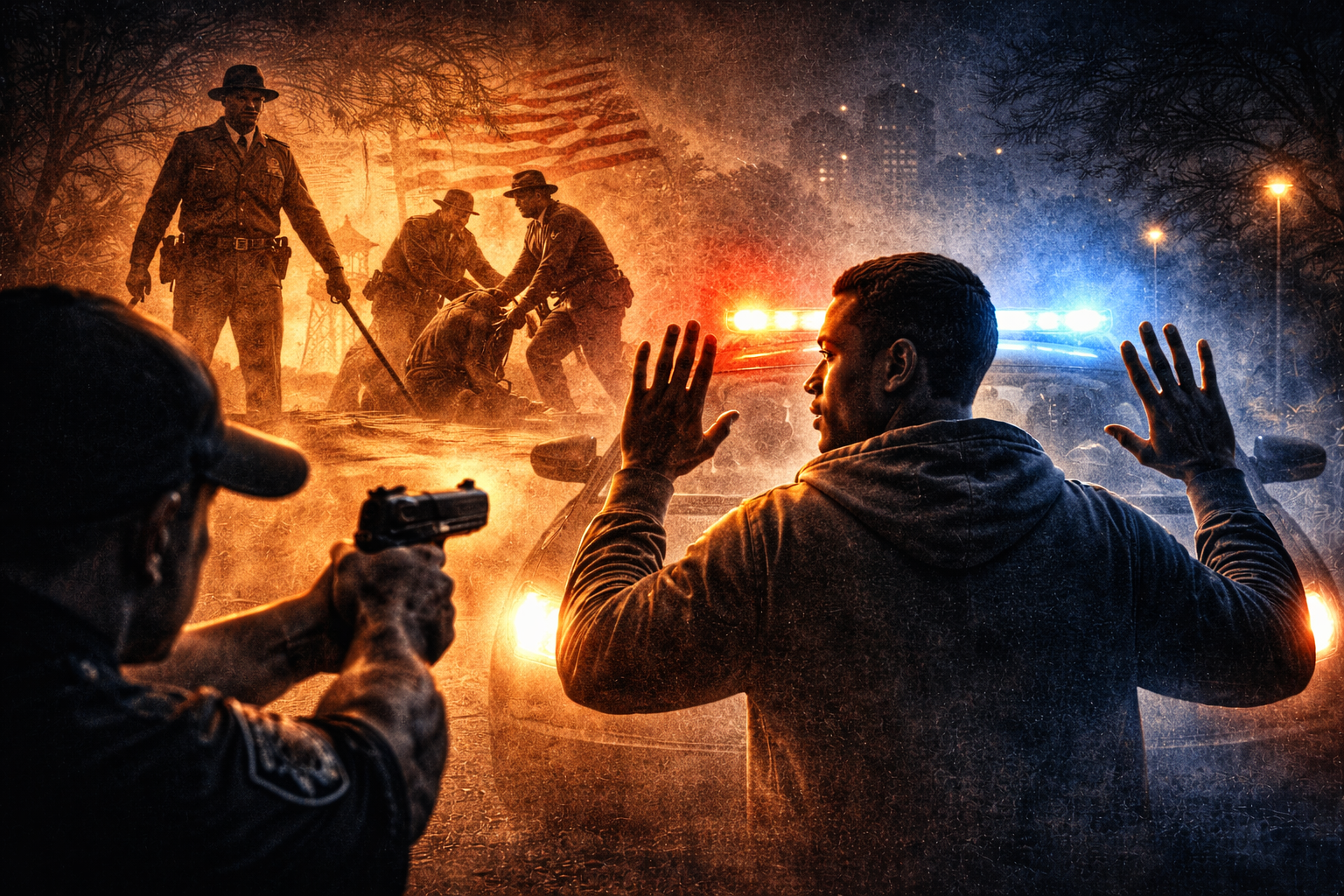
Police encounters are a routine part of life in the United States. Traffic stops, wellness checks, noise complaints, and calls for help happen millions of times each year. For most people, these encounters end uneventfully.
Yet the outcomes are not evenly distributed.
Black Americans are significantly more likely to experience police encounters that escalate into serious injury or death. This pattern persists across cities, regions, and decades—even as laws, technologies, and training programs change.
Understanding why requires moving beyond individual incidents and examining how systems, expectations, and incentives shape what happens in moments of contact.
Modern American policing did not emerge solely as a service to protect citizens equally.
In the South, early policing structures grew out of slave patrols designed to control movement, suppress resistance, and enforce racial hierarchy. In the North, police forces developed to manage labor unrest, immigration, and urban poverty.
From the beginning, policing was tied to maintaining order as defined by those in power—not to neutral enforcement. Certain populations were treated as potential threats to be managed rather than neighbors to be protected.
These origins mattered. They shaped who was watched, who was stopped, and how authority was exercised—long before body cameras or patrol cars existed.
As slavery ended and formal segregation laws were dismantled, the structure of policing changed—but its underlying assumptions often did not.
Black Codes, vagrancy laws, and later “broken windows” policing expanded police discretion. Officers were granted broad authority to stop, question, and detain based on perceived disorder or suspicion.
Over time, enforcement became increasingly proactive rather than responsive. Policing shifted from addressing specific crimes to managing risk—especially in neighborhoods labeled as “high crime.”
This approach created feedback loops:
Escalation became more likely not because individuals were more dangerous, but because encounters were more frequent, more tense, and more asymmetrical.
Black Americans experienced the cumulative effects of these systems most intensely.
Frequent police contact increased the chance of misunderstandings, fear-based reactions, and split-second decisions. Poverty and disinvestment compounded these risks by increasing police involvement in non-criminal situations—mental health crises, homelessness, domestic disputes, and school discipline.
Young Black men faced particular exposure, but women, elders, and children were not exempt. Geography mattered too: urban neighborhoods saw different forms of enforcement than rural areas, but similar disparities emerged.
Other groups—poor white communities, immigrants, people with disabilities—also experienced heightened risk. The difference was degree, not category. Race shaped how risk was interpreted and how force was applied.
Today’s policing operates within layers of historical inheritance.
Officers often enter encounters primed by training that emphasizes threat recognition and officer survival. When combined with implicit bias and unequal exposure, this framing can turn ordinary interactions into high-stress confrontations.
Data reinforces these dynamics. Areas with higher recorded enforcement are treated as inherently dangerous, shaping expectations before an encounter even begins.
Technology has added visibility without necessarily adding restraint. Body cameras document events, but they do not prevent escalation rooted in fear, mistrust, or misinterpretation.
The result is a system where lethal outcomes are not random—but patterned.
This history helps explain why conversations about policing often feel disconnected.
Some people see isolated incidents. Others see a long pattern reinforced over generations. Both perspectives exist within the same system—but they are shaped by different experiences of it.
Understanding the structural roots of deadly encounters allows us to ask better questions:
This is not about intent. It is about design, incentives, and accumulation.
If you want to explore how these dynamics developed and how they affect different communities, these resources offer additional context:
Deadly police encounters are often discussed as isolated failures or personal tragedies. But when patterns repeat across time and place, they point to something larger.
Every Chapter Counts exists to examine those patterns—not to simplify them, and not to assign blame, but to understand how systems shape outcomes long before any single encounter occurs.
When we understand the structure behind the moment, we gain the clarity needed to imagine something safer, fairer, and more durable for everyone.