
Artificial intelligence can feel almost weightless.
A question goes into a screen. An answer comes back in seconds. A picture appears. A summary forms. A document gets drafted. The experience feels clean, fast, and invisible.
But the idea that technology is weightless is one of the oldest misunderstandings in American infrastructure history.
Railroads looked like motion, but they required land, steel, timber, coal, labor, and right-of-way. Electricity looked like light at the flip of a switch, but it required dams, coal plants, wires, substations, mines, rivers, and public planning. Highways looked like freedom of movement, but they required land clearance, concrete, oil, and often the destruction or division of existing neighborhoods. The internet looked like information moving through the air, but it required cables, server rooms, energy, minerals, and cooling.
AI belongs to that longer story.
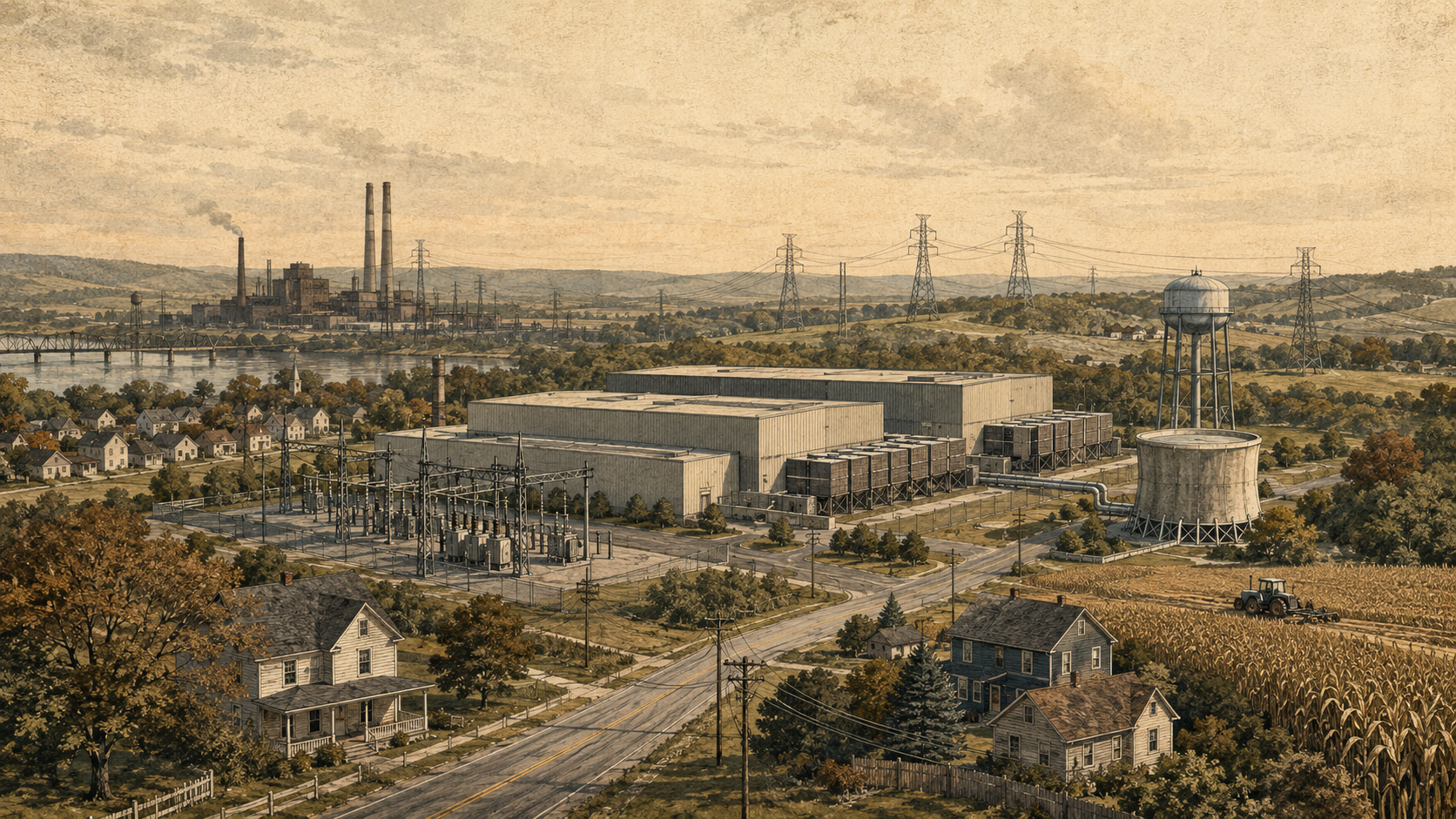
It may feel digital to the user, but it depends on physical infrastructure: data centers, servers, cooling systems, power lines, substations, backup generators, water systems, land deals, tax incentives, and local zoning decisions. The digital world has a physical address. It sits somewhere. It uses something. It affects someone.
That is why AI’s growth belongs in environmental justice history.
The question is not simply whether AI is useful. Many technologies are useful. The deeper question is older: when a new system promises progress, who hosts the infrastructure, who receives the benefits, who carries the costs, and who gets a voice before the landscape changes?
AI may be digital.
Its costs are not.
American history is full of technologies that were celebrated first and questioned later.
In the late 1800s, industrial growth transformed the country. Railroads tied regions together. Steel mills, mines, oil fields, factories, and electric utilities made new kinds of production possible. Cities expanded. Goods moved faster. Work changed. Time itself became more standardized.
But every improvement had a footprint.
Railroads required land grants, grading, tracks, bridges, timber, coal, and labor. Industrial cities required water, waste systems, housing, police power, and workers who often lived near pollution. Electric lighting changed homes and streets, but electricity was not created by the light bulb. It came from generating stations, fuel supplies, wires, substations, and later massive regional power systems.
That gap between the experience of technology and the infrastructure behind it is central to this story.
Electricity is a useful historical comparison. By the early 20th century, electric power had become a symbol of modern life. Cities lit streets. Factories extended hours. Homes gained appliances. Public imagination linked electricity with progress.
But electrification was uneven.
In many rural areas, private utilities did not see sparse farm regions as profitable enough to serve. The New Deal changed that through federal action. The Rural Electrification Administration helped finance rural electric cooperatives and power lines. The Tennessee Valley Authority used federal power to build dams, control flooding, improve navigation, and generate electricity in a region long associated with poverty and underdevelopment.
These projects changed millions of lives. They also show the central tension of infrastructure history: progress is real, but it is never abstract. It is built through land, water, labor, public authority, and tradeoffs.
A dam that brings electricity may also flood land. A power plant that supports growth may also pollute nearby communities. A transmission line that connects one region may cross another. A highway that speeds suburban commuters may divide an urban neighborhood. A warehouse network that makes delivery faster may increase truck traffic near homes and schools.
AI is not separate from that pattern.
It is the newest layer of it.
AI’s physical footprint works through systems that earlier generations would recognize: energy, land, water, public subsidy, and local power.
The technology is new. The civic questions are not.
The first historical mistake is to confuse convenience with absence.
When electric light replaced candles and gas lamps, the flame disappeared from the room. But energy production did not disappear. It moved elsewhere. When a highway made travel faster, the cost was not visible to every driver. It was concentrated in the neighborhoods, farms, wetlands, and downtowns cut by road construction. When the internet made communication instant, the cables, servers, minerals, warehouses, and energy systems became easy to overlook.
AI works the same way.
To the user, AI appears as a box on a screen. Behind that box are data centers filled with computing equipment. Servers process information. Networking equipment moves it. Storage systems hold it. Cooling systems keep machines from overheating. Backup power keeps operations running when the grid fails.
The point is not that data centers are unusual because they need infrastructure. The point is that they continue a familiar American habit: the cleaner the technology feels at the point of use, the easier it becomes to forget where its costs are located.
AI depends on electricity, and electricity has always been political.
Who gets power first?
Who pays for the grid?
Where are generating stations built?
Which communities host transmission lines?
Which regions receive public investment?
Which landscapes are treated as available for development?
These questions shaped rural electrification in the 1930s. They shaped dam building, coal mining, utility regulation, nuclear siting, oil and gas development, and interstate transmission. They also shape data-center growth today.
Data centers can require large amounts of electricity. A single facility may be manageable. A cluster can reshape regional utility planning. Utilities may need new substations, transmission lines, power-purchase agreements, generation capacity, or grid upgrades. Those costs do not exist only inside the data center company’s balance sheet. They can enter public utility planning and, in some cases, ratepayer debates.
This is where AI becomes a history story rather than just a technology story. The same basic pattern has appeared before: private growth depends on public systems, and the public must decide how much of the cost should be shared.
A community may welcome data centers because they promise tax revenue and investment. A state may recruit them as a symbol of economic modernization. A utility may see them as major new customers. But residents may ask a different set of questions:
Will our bills rise?
Will new generation be clean?
Will backup power pollute?
Will the grid serve households and small businesses as reliably as it serves large technology users?
Will the community have leverage once the project is approved?
Those are old power questions with new equipment.
Computers produce heat. Data centers must remove that heat to keep equipment working.
That makes cooling central to AI’s footprint. Some data centers use air cooling. Some use evaporative cooling that consumes water. Some use direct-to-chip liquid cooling or other newer systems. Some use reclaimed water instead of drinking water. Some are built in cooler climates. Some are built in hot or water-stressed regions where cooling choices carry greater consequences.
This links AI to a much older history of water as infrastructure.
American development has often treated water as both a public resource and an economic tool. Rivers powered mills. Canals moved goods. Dams generated electricity. Irrigation turned dry land into farmland. Cities drew water from distant watersheds. Industries used rivers for cooling, production, and disposal.
Those choices created benefits, but they also created conflicts. Communities fought over access, contamination, flooding, displacement, drought, and priority of use.
Data centers enter that history because water use is local. A facility using reclaimed water in a water-secure region is different from a facility drawing from stressed supplies. A cooling system that looks efficient on paper may still matter if it is placed where residents already worry about drought, aquifers, or municipal capacity.
The key historical lesson is simple: water decisions made in the name of progress often become long-term community decisions.
Infrastructure always lands somewhere.
A railroad line cut through specific farms and towns. A dam flooded specific valleys. A highway divided specific neighborhoods. A power plant stood near specific communities. A warehouse corridor changed traffic, noise, and air quality in specific places.
Data centers are part of that same land-use history.
They often require large sites near electricity, fiber, roads, and developable land. That can make rural counties, exurban areas, and industrial-edge communities attractive. Local officials may see opportunity: new tax revenue, construction jobs, attention from major companies, and a role in the technology economy.
Those benefits can be real. But land-use tradeoffs are also real.
A data center may take land that could have been used for housing, agriculture, small businesses, parks, conservation, or other industry. It may require substations, transmission lines, water infrastructure, road improvements, or noise controls. It may create fewer permanent jobs than residents expect after construction ends. It may change the feel of a rural or suburban landscape.
This is not unique to data centers. That is exactly the point. The history of infrastructure is partly the history of communities discovering that “development” is never just one building. It changes the options around it.
American infrastructure has often grown through public-private partnership.
Railroads received land grants and public support. Electric utilities depended on regulated monopolies, public rights-of-way, and public planning. Industrial parks, highways, ports, airports, and warehouse districts often relied on tax policy, bonds, zoning, and infrastructure spending.
Data centers fit this pattern through tax incentives, economic development deals, utility agreements, and fast-track approvals.
The public argument is familiar: offer incentives now, receive investment later. That argument may sometimes be true. But history shows that incentive deals need scrutiny because the benefits and costs are not always distributed evenly.
If a company receives tax relief while the public helps fund roads, water systems, grid upgrades, or emergency services, the community deserves to know the full exchange. If a project promises jobs, residents deserve clear numbers about temporary construction work versus permanent employment. If a company promises clean power or water efficiency, those promises should be specific, measurable, and enforceable.
The history of public subsidy teaches that vague promises age poorly.
Environmental justice emerged because communities noticed a pattern.
Polluting facilities, waste sites, industrial corridors, highways, refineries, ports, and other burdens were often concentrated near communities with less political power, including low-income communities, communities of color, tribal communities, and rural places with limited leverage. The issue was not only pollution. It was decision-making.
Who was informed?
Who was consulted?
Who could say no?
Who had lawyers, engineers, and time?
Who could move away?
Who was told the project was already decided?
AI infrastructure belongs in that discussion because it raises the same governance questions, even when the facility itself does not resemble an older smokestack industry.
A data center may not look like a refinery. But it can still affect water demand, power planning, land use, noise, tax revenue, local democracy, and public cost. Environmental justice is not only about visible smoke. It is about whether communities share fairly in decisions that shape their environment.
The people most affected by AI’s physical footprint are often not the people using the most AI.
They are the people living near the infrastructure that makes AI possible.
That includes residents near data-center corridors, rural communities facing rapid industrial-scale development, households in regions with rising electricity demand, people in water-stressed areas, and communities near power plants or transmission projects built to serve new load.
The pattern is historically familiar.
Industrial workers often lived near the factories that exposed them to smoke, waste, and injury. Rural communities hosted dams, mines, timber extraction, and power lines that served larger markets. Urban neighborhoods with less political power absorbed highways, warehouses, incinerators, rail yards, and industrial zoning. Tribal lands and rural regions were repeatedly treated as places where land and resources could be extracted for distant benefit.
AI infrastructure does not map perfectly onto every older example. It should not be forced into a one-to-one comparison. But the question is similar: are the people closest to the infrastructure given enough information, power, and protection?
Some host communities may benefit from data centers. They may gain tax revenue, construction work, upgraded infrastructure, or a stronger local budget. Others may find that the permanent jobs are limited, the land-use changes are large, and the public costs are hard to measure until later.
Ratepayers can also be affected. If grid upgrades are paid through utility rates, households, small businesses, schools, and local governments may share costs created partly by large new users. That does not mean every electricity price increase is caused by data centers. Utility bills are shaped by many forces. But in fast-growth regions, data-center demand has become part of the public conversation over who should pay for new capacity.
Water-stressed communities face another layer. A region already managing drought, groundwater decline, or aging municipal systems may see new water demand differently from a region with abundant supply and strong planning capacity.
The most affected communities, then, are not defined by one identity alone. They are defined by proximity, political leverage, rate burden, water stress, land-use pressure, and whether they can shape the terms before decisions become permanent.
The modern echo is not that AI is exactly like a railroad, a dam, a coal plant, or a highway.
The echo is that American progress has often been built by separating the visible benefit from the hidden cost.
The city received light while the coal town carried extraction.
The region received flood control while a valley was flooded.
The commuter received a highway while a neighborhood was split.
The consumer received fast shipping while a warehouse district absorbed truck traffic.
The user receives an AI answer while another community hosts the data center, substation, cooling system, and power demand.
That pattern does not mean all infrastructure is bad. It means infrastructure is civic. It should be debated honestly because it shapes daily life for decades.
For AI, the right historical questions are practical:
Where will the data center be built?
What land uses will it replace?
How much electricity will it require?
Who pays for grid upgrades?
What water source will it use?
What happens during drought?
How many permanent jobs will remain after construction?
What tax incentives are being offered?
Are clean-energy commitments local and additional, or only accounting claims?
Will residents see the agreement before approval?
Are community benefits enforceable?
Those questions are not anti-technology. They are the questions communities should have been able to ask before many earlier infrastructure decisions were made.
History gives us the advantage of pattern recognition.
AI’s physical footprint matters because it helps us see a familiar American story while it is still being written.
The cloud is not in the sky. It is in buildings. The answer on a screen is connected to a server rack. The server rack is connected to a cooling system. The cooling system is connected to water and electricity. The electricity is connected to a grid. The grid is connected to land, fuel, rates, regulation, and public decisions.
That chain is not new. It is the latest version of a long infrastructure chain that has shaped American life for more than a century.
The question is whether we learn from the earlier chapters.
Electrification brought enormous benefits, but it also required public choices about land, water, power, and cost. Highways connected places, but they also divided places. Industrial development created wealth, but it also concentrated pollution and risk. Digital technology expanded access to information, but it did not eliminate material needs.
AI can be useful and still require accountability. It can bring investment and still need guardrails. It can improve productivity and still raise questions about land, water, power, and public subsidy. It can feel invisible to the user and still be very visible to the host community.
That is the history-centered lesson.
Every technology has a geography.
Every geography has people in it.
And those people deserve more than promises made after the deal is done.
AI depends on physical infrastructure, including data centers, electricity, cooling systems, water, land, and transmission networks. Environmental history helps explain how technologies that seem clean or invisible to users can still create local demands on land, water, energy, and communities.
AI continues a pattern seen with railroads, electrification, highways, industrial development, and the internet. Each technology promised progress, but each required physical systems that shaped particular places and affected some communities more than others.
AI runs through data centers, which use significant electricity. The impact depends on model size, hardware efficiency, cooling design, frequency of use, and electricity source. The most important question is often local: clusters of data centers can create major new demand on specific regional grids.
Data centers produce heat, and some cooling systems use water to remove that heat. Water may also be used indirectly by power plants that generate electricity and in semiconductor manufacturing. The local impact depends on the water source, cooling method, climate, and existing water stress.
It becomes an environmental justice issue when the benefits of AI are widely shared but the physical costs are concentrated in specific communities. Those costs can include water demand, grid upgrades, land-use conflicts, higher utility bills, public subsidies, noise, or local infrastructure pressure.
Library of Congress — Lights, Power, Action!
https://blogs.loc.gov/picturethis/2024/05/lights-power-action/
A useful historical source on the Rural Electrification Administration, showing how electricity became a public infrastructure project rather than a purely private convenience.
National Archives — Tennessee Valley Authority Act (1933)
https://www.archives.gov/milestone-documents/tennessee-valley-authority-act
A primary-source government document that helps ground the article’s comparison between AI infrastructure and earlier public power, dam, land, and regional development projects.
Lawrence Berkeley National Laboratory — 2024 United States Data Center Energy Usage Report
https://eta.lbl.gov/publications/2024-lbnl-data-center-energy-usage-report
A major technical source for U.S. data-center electricity use and projected demand, useful for keeping the AI discussion evidence-based rather than speculative.
International Energy Agency — Energy Demand from AI
https://www.iea.org/reports/energy-and-ai/energy-demand-from-ai
A global source for understanding how AI and data centers are expected to affect electricity demand and energy-system planning.
Environmental and Energy Study Institute — Data Centers and Water Consumption
https://www.eesi.org/articles/view/data-centers-and-water-consumption
A clear explainer on how data centers use water directly and indirectly, especially through cooling systems and electricity generation.
World Resources Institute — 7 Ways Data Centers Affect US Communities
https://www.wri.org/insights/us-data-center-growth-impacts
A strong environmental-justice source on how data centers affect communities through energy demand, water use, land use, air quality, public costs, and governance.