
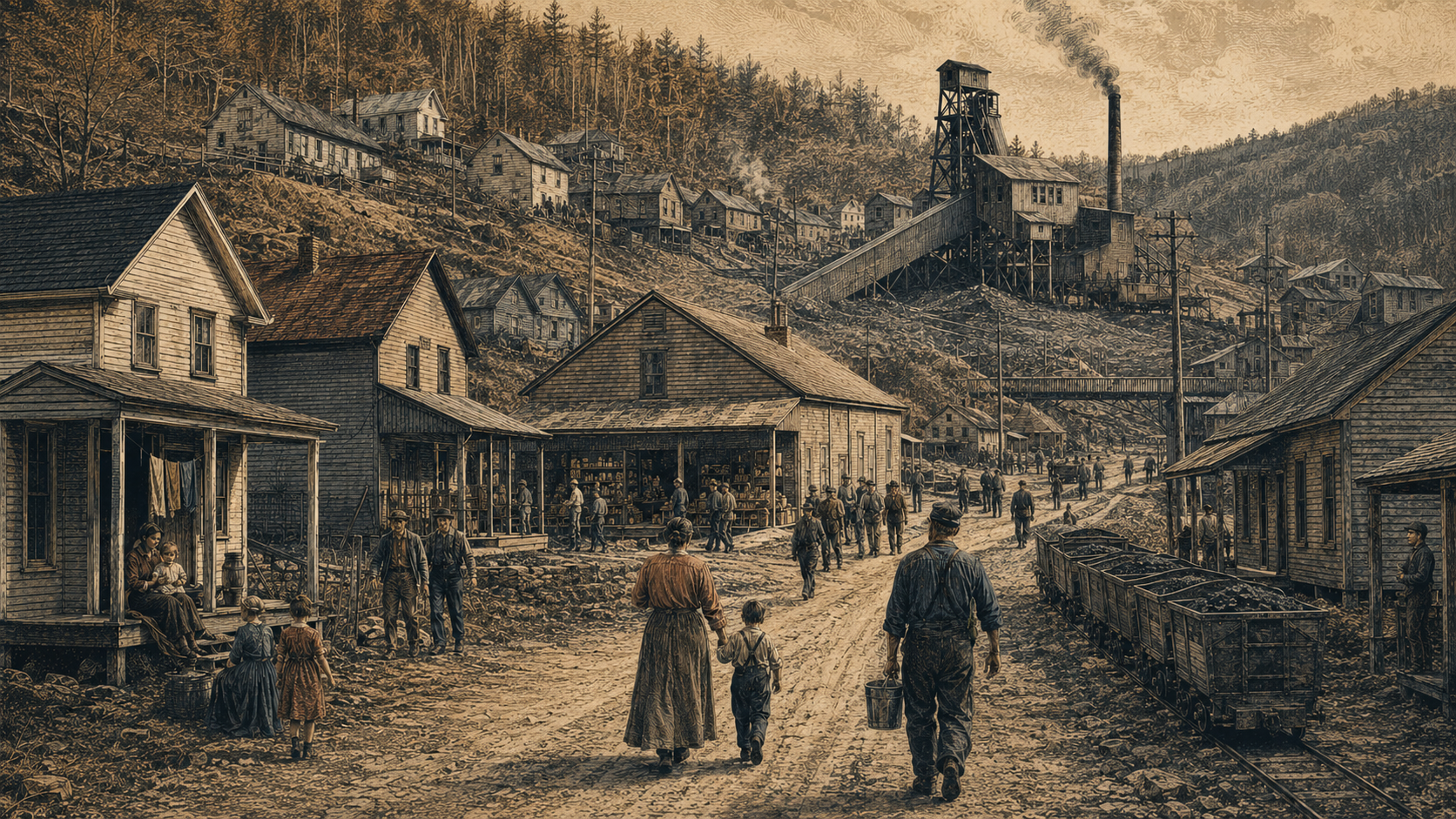
A company town could look like a community.
There might be houses, a school, a church, a store, a post office, and rows of families who knew each other well. Children played outside. Neighbors shared news. People built real lives there.
But the structure underneath was different from an ordinary town.
In many company towns, especially in coal, lumber, textile, steel, and mining regions, the employer did not just provide the job. The employer owned the house. The employer owned the store. The employer influenced the school, the church building, the doctor, the payroll office, and sometimes even the local political order. In isolated places, especially in Appalachia and other rural industrial regions, a worker’s paycheck could cycle right back to the company before it ever became real independence.
This history is not only about harsh bosses or bad stores. It is about what happens when economic power becomes civic power. Company towns show how work, housing, credit, geography, and law can combine into a system that limits a family’s choices while still appearing to offer stability.
Company towns grew with industrial America.
As factories, mines, mills, and railroads expanded in the 19th and early 20th centuries, employers needed workers in places where towns did not yet exist or where existing communities could not support a sudden industrial workforce. In remote coalfields, lumber camps, mining districts, steel centers, and textile regions, companies built housing and basic services near the worksite.
Sometimes this was presented as practical necessity. If a mine opened deep in the mountains, workers needed somewhere to live. If a textile mill grew in a rural area, families needed housing, food, and schools. If a new industrial site needed labor quickly, a company town could recruit and hold workers more easily than a temporary camp.
Some company towns were designed with genuine improvements over crowded urban slums. Pullman, Illinois, for example, included planned housing and amenities that reformers and visitors often admired. But even model company towns raised a deeper issue: who had power over daily life?
When the same employer controlled the job, the rent, the store, and the rules of the town, workers had limited independence. A dispute at work could become a housing crisis. A wage cut could become a debt problem. A strike could mean eviction. A family’s access to food, credit, and shelter could depend on staying in the company’s good graces.
In Appalachia, company towns became especially important because coal and timber extraction often happened in isolated mountain areas where companies controlled land, transportation, housing, and stores. The geography mattered. Distance from independent merchants, banks, courts, newspapers, and competing employers made company power stronger.
That is why company towns are not just labor history. They are also housing history, rural history, legal history, and community history.
Company towns worked by turning employment into an entire environment.
The worker did not simply sell labor for wages and then make independent choices in an open market. In many towns, the employer shaped the market itself.
In many company towns, workers rented homes owned by the employer. That arrangement could provide immediate shelter, which mattered in fast-growing industrial areas. But it also made housing conditional.
If a worker was fired, blacklisted, injured, or went on strike, the family could lose the house. This was especially powerful in rural regions where other housing was scarce. A worker was not just risking a job. He might be risking the roof over his family’s head.
Housing also helped employers organize the town. Workers could be grouped by job status, race, ethnicity, family size, or rank. Supervisors and skilled workers might receive better homes. Laborers might live in smaller or less maintained housing. The layout of the town could quietly reflect the company’s hierarchy.
The company store was often the commercial center of town. It sold groceries, clothing, tools, furniture, household goods, and mining supplies. In some places, it also contained the post office or payroll office.
When the store was the only practical option nearby, prices and credit terms mattered enormously. Families might buy on credit between paydays, especially if wages were low, work was irregular, or illness interrupted income. The store could feel like a convenience and a trap at the same time.
Not every company store operated identically. Some were reasonably stocked. Some company officials argued that stores were necessary in remote places. Some workers remembered them as social centers where people exchanged news. But the structure still gave the employer unusual power: the company could profit from both the worker’s labor and the worker’s purchases.
In many coal and mining towns, workers used company scrip. Scrip was a private form of money, often paper or metal tokens, usually redeemable at company-owned stores.
Scrip could function as an advance against wages. A miner who needed food before payday might “draw” scrip, then have the amount deducted later. That helped families survive short-term gaps. But it also kept purchasing power inside the company system.
If scrip could only be used at the company store, the worker’s choices were narrowed. If an independent merchant accepted it only at a discount, the worker lost value. If wages were already reduced by rent, tools, supplies, medical fees, or store credit, the final paycheck might be very small.
This is the meaning behind the old phrase “I owe my soul to the company store.” The phrase became famous through song, but the idea came from a real economic pattern: debt could turn wages into a loop.
Work produced pay. Pay went to rent, tools, food, and store credit. Those payments returned to the company. The worker remained dependent.
Company towns were strongest where alternatives were weakest.
In a city, a worker might rent from someone else, shop at a different store, seek a new employer, or organize with others across industries. In an isolated coal town, those options could be limited.
The mine or mill might be the only major employer. Roads might be poor. Rail lines might be controlled by the same industrial network. Independent stores might be far away. Local officials might be connected to company interests. Newspapers and outside organizers might struggle to reach the town.
This did not mean workers were passive. They organized, resisted, moved, struck, shared information, and built community institutions. But the structure made resistance risky.
Some company towns had limited independent local government. The company might own the land, operate services, influence policing, and control public gathering spaces. Even where formal government existed, company influence could be strong.
That mattered because ordinary town life depends on public accountability. Who decides road maintenance? Who runs the school? Who can gather in public? Who controls the local store? Who handles disputes? Who has authority during a strike?
In a company town, those questions often led back to the employer.
Company towns became flashpoints for labor organizing.
Miners and industrial workers wanted higher wages, safer conditions, fairer stores, the right to organize, and more control over their lives. Companies often resisted unions because unions threatened not only wage policy but the whole structure of control.
In West Virginia, labor conflict in the early 20th century became especially intense. Mine owners resisted unionization, workers organized through the United Mine Workers and other networks, and the struggle led to violent episodes during the West Virginia Mine Wars. The Battle of Blair Mountain in 1921 became one of the largest labor conflicts in American history.
Company towns did not cause every labor conflict. But they intensified the stakes. When the employer controlled work, housing, stores, and local authority, a union campaign was not just a workplace dispute. It was a challenge to an entire local order.
The people most directly affected were workers and families in rural and industrial communities where one employer controlled the local economy.
In Appalachia, coal miners and their families lived this structure intensely. Many coal towns were built around extraction: coal came out, profits moved outward, and families were left dependent on a system they did not control. The company town could provide work and community, but it could also limit mobility and wealth-building.
Poor white workers were deeply affected, especially in Appalachian coalfields, mill towns, and lumber regions. Many had few alternatives and entered company systems because cash income was necessary and local economies were limited.
Immigrant workers were also central to company town history. Mining, steel, rail, and industrial employers recruited or relied on workers from Ireland, Italy, Eastern Europe, Scandinavia, Mexico, China, and other communities, depending on the industry and region. Employers sometimes used language, ethnicity, race, and citizenship status to divide workers and weaken organizing.
Black workers were affected in several ways. In some regions, Black miners and industrial workers labored under dangerous conditions, faced job segregation, and were used by employers in ways that could deepen racial tension among workers. At the same time, Black labor organizers and workers also participated in broader struggles over wages, safety, dignity, and union inclusion.
Women carried much of the hidden burden. Even when men were the formal wage earners, women managed household budgets, stretched store credit, cared for injured workers, raised children in company housing, took in laundry or boarders, and navigated the social expectations of company-controlled communities. In some textile and industrial towns, women were also wage workers themselves.
Children were shaped by the system too. Their schools, housing, health, chores, and future job options were often tied to the company’s presence. In some families, children entered mines, mills, or related work early because the household needed income.
Company towns were never experienced in just one way. Some residents remembered strong community ties, mutual aid, churches, schools, ball teams, music, gardens, and pride. Those memories are real. But they existed inside a structure where the company held unusual power over the conditions of daily life.
Company towns declined as automobiles spread, roads improved, mail-order shopping expanded, labor protections grew, unions gained strength, and companies sold off housing. But the core question did not disappear:
What happens when one institution controls too many parts of a person’s life?
Modern life rarely repeats the company town exactly. Most workers are not paid in metal scrip. Most employers do not own the only store in town. But echoes appear whenever work, housing, debt, and local power become tightly linked.
A few patterns are worth noticing.
Employer-tied housing still matters in some industries. Migrant labor camps, seasonal worker housing, remote energy projects, and some institutional jobs can make housing dependent on employment. When losing a job also means losing shelter, workers have less leverage.
Single-industry towns still face vulnerability. When one employer dominates a local economy, the community may depend on decisions made elsewhere. A closure, merger, automation shift, bankruptcy, or policy change can affect schools, tax revenue, housing values, health systems, and family stability.
Debt still shapes labor mobility. A worker does not need company scrip to feel trapped. Medical debt, student loans, payday loans, employer-based health insurance, housing costs, and lack of savings can all make it harder to leave a bad job.
Workplace surveillance and control have also changed form. Instead of a company superintendent watching the town, some modern workers face algorithmic scheduling, productivity tracking, app-based ratings, or just-in-time labor systems. These tools are different from company stores, but they raise a familiar question: how much control should an employer have over a worker’s time, movement, and security?
The company town helps readers see that labor systems are never just about wages. They are about the surrounding conditions that determine whether a person can actually choose.
Company towns matter because they reveal how power can be built quietly.
A company did not need to own a worker outright to control much of that worker’s life. It could own the house, the store, the land, the credit system, and the local economy. It could make leaving expensive. It could make organizing dangerous. It could make debt feel normal.
That is the lesson.
Freedom in the workplace depends on more than having a job. It depends on having choices beyond the job. It depends on independent housing, fair pay, safe conditions, transportation, legal protection, community institutions, and the ability to organize without losing everything.
Company towns also complicate easy stories about rural communities. Many residents built real belonging in these places. They created churches, music, mutual aid, friendships, gardens, sports teams, and family traditions. The problem was not that people failed to make community. The problem was that the community was built under a structure of dependence.
Understanding company towns helps us ask better questions today:
Who owns the conditions people depend on?
Who profits when wages return to the same institution that pays them?
Who has the power to leave?
And what would it take for work to support community life instead of controlling it?
A company town was a community where a major employer owned or controlled much of local life, often including housing, stores, land, and services. Many company towns developed around mines, mills, factories, lumber operations, and other industrial worksites.
Many Appalachian coal and timber operations were located in remote areas where companies controlled land and transportation. Employers built towns near mines or logging sites to house workers, but that also gave companies power over rent, shopping, credit, and local institutions.
Company scrip was a private form of currency, often paper or metal tokens, issued by an employer. It was usually redeemable at company stores and could be used as an advance against wages. In practice, it often kept workers’ purchasing power inside the company economy.
No. Company towns varied. Some offered decent housing, stores, schools, or amenities compared with nearby alternatives. But even better-run company towns concentrated power in the employer’s hands, which could limit workers’ independence and make organizing or leaving difficult.
Company towns declined for several reasons, including better roads, automobile ownership, mail-order shopping, stronger labor protections, unionization, changing industrial patterns, and companies selling off worker housing. As workers gained more outside options, the company town model weakened.
National Park Service — Scrip—A Coal Miner’s Credit Card
https://www.nps.gov/biso/learn/historyculture/scrip.htm
National Park Service — The Prince Brothers General Store
https://www.nps.gov/neri/learn/historyculture/the-prince-brothers-general-store.htm
National Park Service — Introduction to the West Virginia Mine Wars
https://www.nps.gov/articles/000/introduction-to-the-west-virginia-mine-wars.htm
e-WV: The West Virginia Encyclopedia — Company Stores
https://www.wvencyclopedia.org/entries/1425
e-WV: The West Virginia Encyclopedia — Scrip
https://www.wvencyclopedia.org/entries/190
Federal Reserve Bank of Richmond — The Rise and Fall of Company Towns
https://www.richmondfed.org/publications/research/econ_focus/2023/q3_economic_history
VCU Social Welfare History Project — Company Towns: 1880s to 1935
https://socialwelfare.library.vcu.edu/organizations/labor/company-towns-1890s-to-1935/