
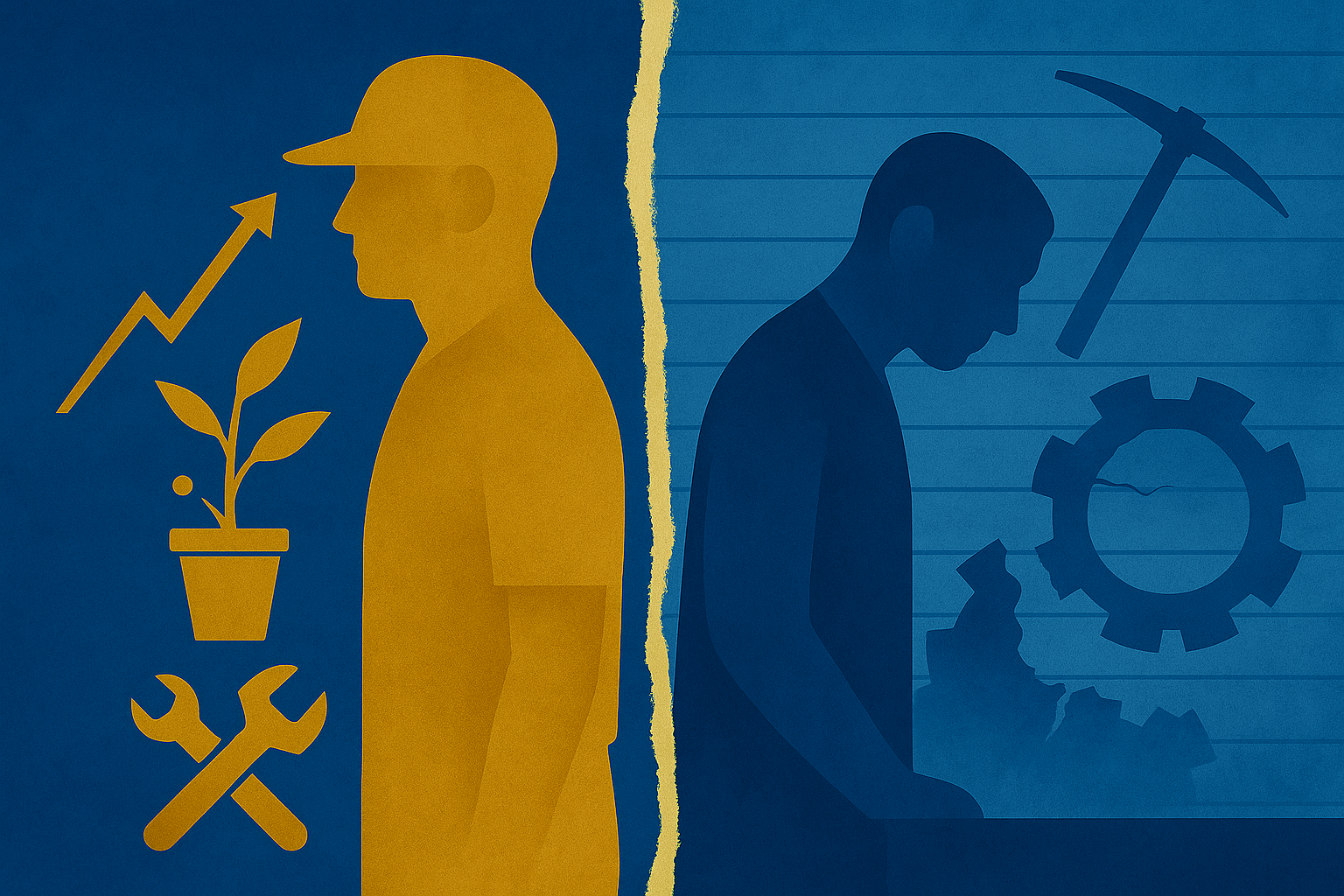
Most people think workplace conditions reflect individual employers: one company treats workers well, another cuts corners. But the patterns are deeper than any single workplace. For centuries, the American economy has included two competing visions of how to run a business: the high road—invest in workers, build skills, improve systems—and the low road—minimize labor costs, maximize output, and treat people as replaceable.
Today’s debates about gig work, low wages, unpredictable schedules, or high turnover aren’t new. They’re the latest version of a playbook America has used for generations.
To understand how we got here, it helps to look at the long history of employers choosing the low road—and who was most affected when they did.
A “low road” strategy is simple:
This approach doesn’t rely on innovation—it relies on scarcity, insecurity, and strict control. And while it appears economically efficient on paper, it has always carried hidden costs for workers, families, and entire regions.
In the earliest American labor systems, enslaved people were treated as inputs rather than workers—no rights, no mobility, and no investment. Maximum extraction with minimum cost. This is the foundation of the low-road model: cheap labor enforced by unequal power.
After emancipation, Black families—and many poor White families—entered systems where landowners controlled credit, tools, prices, and movement. Every harvest was structured to maintain debt and dependency. It was the low road disguised as opportunity.
Company towns, scrip wages, crowded housing, and dangerous conditions weren’t accidents—they were business strategies. Mining and mill owners often preferred workers who were isolated from political power: immigrant laborers from China, Mexico, Ireland, Italy, and Eastern Europe. High risk for workers meant higher profit margins for owners.
Women—particularly Black, Indigenous, and immigrant women—carried out labor that was essential but intentionally undervalued. Domestic workers were excluded from many key labor protections well into the 20th century. Low road practices here shaped wage inequality for generations.
Agriculture, meatpacking, and construction often relied on workers whose legal vulnerability made low-road conditions easier to maintain: high injury rates, low pay, little recourse.
Across all of these examples, low road strategies were tied not just to economics, but to race, class, gender, and the distribution of power.
Low road capitalism didn’t just happen—it was reinforced by the rules:
These policies shaped who could advance, who stayed stuck, and which regions prospered or declined.
Workers treated as contractors instead of employees—no benefits, no stability, no protections.
Some companies design jobs to be easily replaced rather than sustainable.
Just-in-time staffing shifts risk onto workers—especially caregivers.
Violations cluster where workers have the least bargaining power: immigrant communities, rural towns, low-wage service sectors.
Temporary workers kept in long-term roles without long-term security.
The forms look modern, but the logic is familiar: keep labor flexible, controlled, and inexpensive.
Low road systems land hardest on:
Different histories, same pattern: those with the least power face the least protection.
Low road strategies can generate short-term growth, but they often weaken:
High road models—where companies invest in workers—tend to create more durable prosperity. But they require policies and incentives that reward long-term thinking rather than short-term extraction.
Even with long roots, the low road is not the only road:
The landscape is shifting, slowly but noticeably.
Low road capitalism is often treated as the natural outcome of the market. It isn’t. It’s the outcome of choices—legal, political, and economic—made over generations.
Understanding its history makes today’s debates clearer:
What looks like individual hardship is often structural design.
What looks like worker failure is often employer strategy.
What looks inevitable is often the result of policy decisions that can change.
Economies aren’t just built by markets—they’re built by values.
Library of Congress — Labor and Industry Collections
https://loc.gov/
International Labour Organization — Labor Protections & Global Trends
https://ilo.org/
National Museum of American History — Work & Industry
https://americanhistory.si.edu/
NBER — Historical Labor Markets
https://nber.org/