For many Americans, Covid-19 felt like a sudden disruption: schools closed, offices went remote, supply chains broke, and “normal” life paused. But for millions of working-class people, the pandemic didn’t create new problems so much as expose old ones—problems that had been building for decades, often out of public view.
Covid-19 acted like a stress test. It showed which parts of the economy were resilient—and which relied on workers absorbing risk without protection.
It also revealed something else: “work” isn’t just about wages. It’s about who gets safety, flexibility, stability, and the benefit of the doubt.
The pandemic didn’t treat everyone the same, because society didn’t start from the same place. A virus may be biologically neutral, but exposure, vulnerability, and recovery are shaped by work, housing, healthcare access, and policy.
Covid revealed three big truths about working-class America:
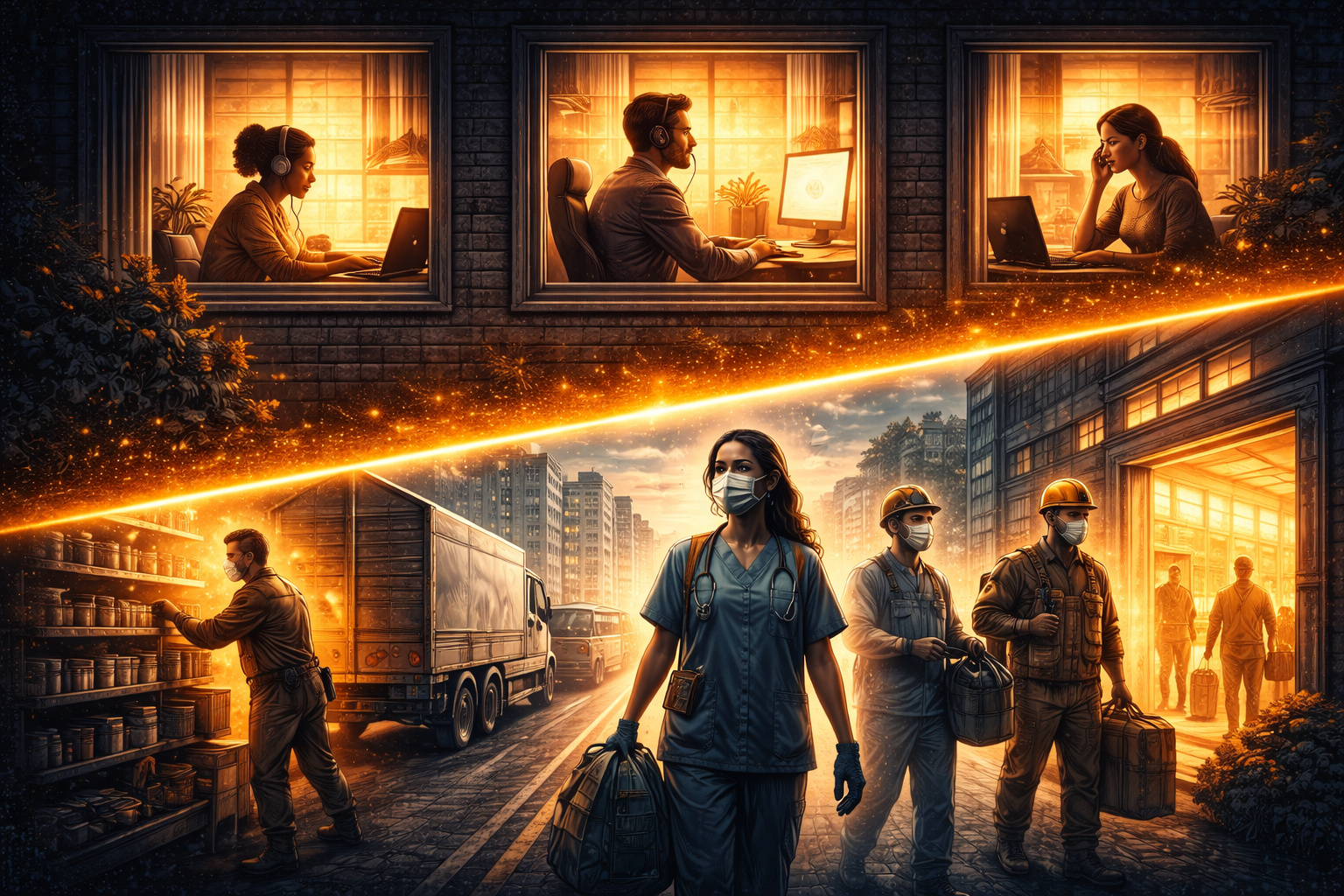
Early in the pandemic, many jobs were labeled “essential”: grocery clerks, warehouse workers, delivery drivers, nursing assistants, janitors, meatpacking workers, farmworkers, transit operators.
Society depended on these jobs. But the people doing them often had:
Covid highlighted a paradox: work that was essential to public life was often treated as most replaceable.
Remote work didn’t just change where people worked—it made a class boundary visible.
Workers who could go remote often had:
Workers who couldn’t go remote often had:
The pandemic didn’t invent this divide. It revealed it.
A major pattern in modern economics is risk-shifting: organizations design systems so instability is carried by workers rather than employers. Covid made this unmistakable.
Examples included:
When risk is private but benefits are corporate, crises land hardest at the bottom.
Covid’s effects weren’t evenly distributed, because job and housing patterns aren’t evenly distributed.
Black, Latino, and Indigenous workers have long been overrepresented in many essential sectors and underrepresented in jobs with flexibility and protection. Add unequal healthcare access and chronic stress from systemic inequality, and outcomes diverge quickly—even without anyone making a single overtly discriminatory decision in that moment.
Women—especially working-class women—carried disproportionate burdens:
Rural and deindustrialized communities faced:
Covid didn’t create these conditions, but it amplified them.
Covid didn’t only expose workplace issues. It exposed the fragility of the support systems working-class families depend on:
The pandemic showed that a community’s resilience is often determined by investments made long before a crisis.
Covid also revealed something hopeful: working-class leverage increases when the economy can’t run without workers.
We saw:
Even where reforms were temporary, the pandemic changed what many people consider “normal” or acceptable.
One of the most important lessons was structural: many public health outcomes depended on systems, not personal choices.
It’s hard to isolate if:
Covid didn’t eliminate personal responsibility—but it clarified that responsibility without protection is a setup.
Covid-19 will be remembered as a health crisis. But it was also a labor and inequality revelation.
It showed:
Understanding what Covid revealed helps communities ask stronger questions about what to rebuild—and what not to return to.
CDC — Covid-19 (data, guidance, and historical archive)
https://www.cdc.gov/
NIOSH — Workplace safety and worker health
https://www.cdc.gov/niosh/
U.S. Bureau of Labor Statistics — Employment, occupations, wages
https://www.bls.gov/