
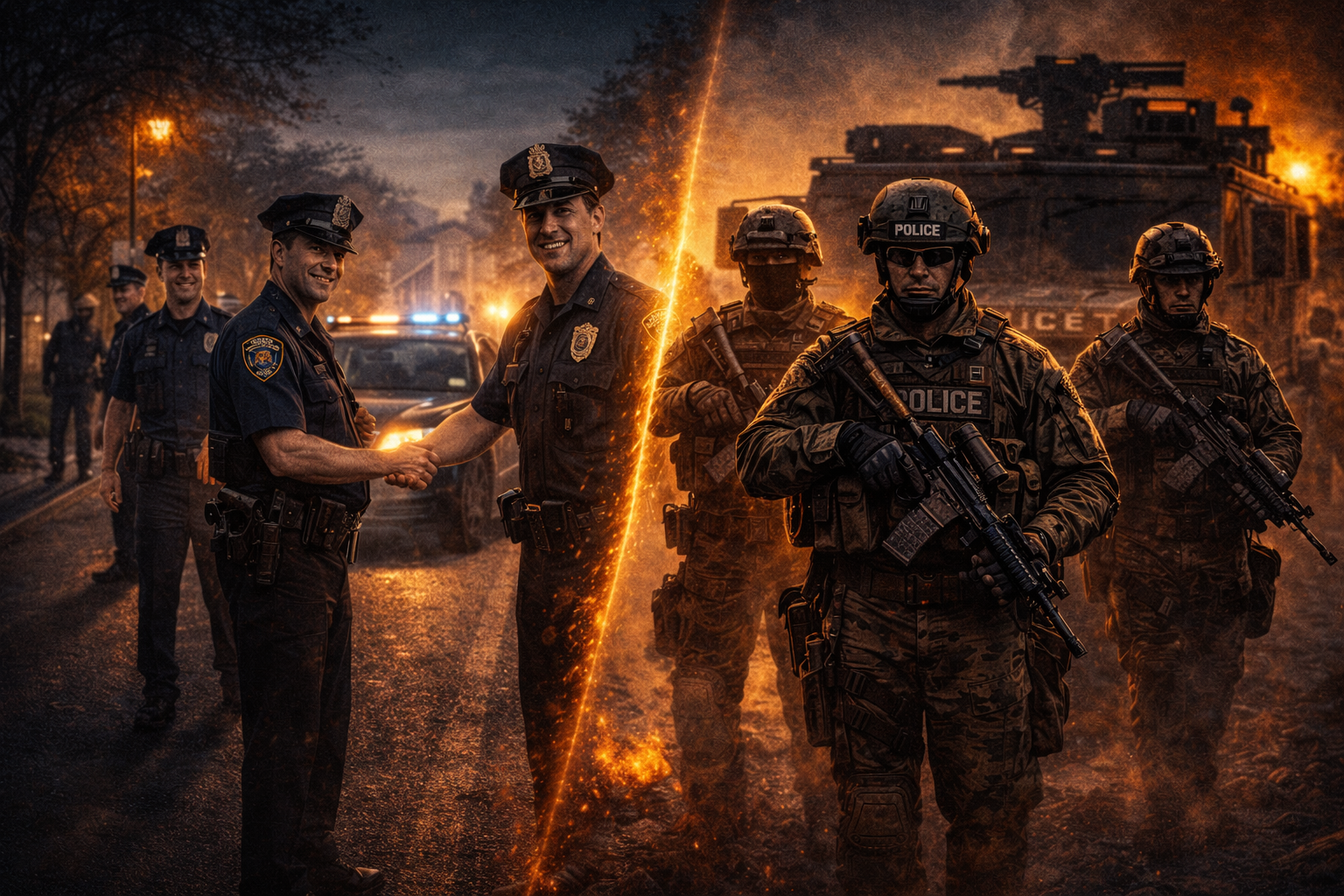
Police officers in the United States were not always equipped like soldiers. For much of the country’s history, policing emphasized visibility, familiarity, and routine presence. Officers carried basic weapons, wore simple uniforms, and were expected to be recognizable members of the communities they served.
Today, armored vehicles, camouflage gear, assault-style weapons, and battlefield language are no longer unusual sights in domestic policing. These changes did not happen overnight, and they were not driven by a single event.
Militarization emerged gradually—shaped by fear, policy decisions, funding incentives, and shifting definitions of what police were expected to confront.
In theory, American policing was meant to remain distinct from the military.
The Posse Comitatus tradition and early legal norms reflected concern about standing armies enforcing civilian law. Police authority was intended to be local, restrained, and accountable to civil institutions.
For decades, most departments reflected this separation. Equipment was limited. Tactics emphasized patrol and response rather than preemptive force. Even when violence occurred, police were not framed as combatants.
That distinction began to erode in the mid-20th century.
The modern push toward militarization accelerated during the late 1960s and 1970s.
Urban uprisings, political assassinations, and rising crime rates created widespread anxiety. Law enforcement leaders argued that traditional policing was insufficient for new threats. Special units—early SWAT teams—were introduced to respond to hostage situations and extreme violence.
Initially, these units were rare and narrowly deployed.
The real expansion came with the War on Drugs.
Federal policy reframed drug use and distribution as a national security threat. Policing shifted from response to prevention, from investigation to suppression. Tactical equipment became normalized, and military-style language entered everyday law enforcement.
The creation of federal programs—most notably the 1033 Program, which transferred surplus military equipment to local police—accelerated this shift. Departments were incentivized to acquire armored vehicles, assault rifles, and tactical gear, often regardless of actual need.
What began as exceptional capability became baseline readiness.
Militarized policing was not distributed evenly.
Deployments were concentrated in neighborhoods already subject to heavy enforcement—often low-income communities and communities of color. Drug raids, warrant service, and crowd control disproportionately occurred in the same areas, reinforcing a perception of occupation rather than protection.
Children grew up seeing armored vehicles in residential streets. Routine encounters increasingly involved tactical posture rather than conversation.
Other groups were affected as well:
The difference lay in frequency and intensity, not exclusivity.
Militarization changes more than equipment—it changes mindset.
Training that emphasizes threat dominance, rapid control, and officer survival frames encounters as potentially lethal before they begin. Visual cues—helmets, rifles, armored vehicles—signal danger to civilians, escalating fear and misinterpretation.
When police arrive looking like soldiers, civilians often respond accordingly: with panic, defensiveness, or flight. Those reactions are then interpreted as justification for force.
Technology and accountability measures have not reversed this dynamic. Body cameras record militarized encounters; they do not neutralize the posture that shapes them.
The system reinforces itself.
Militarized policing is often justified as a response to modern danger. But understanding its history reveals that many of the risks it claims to address were amplified by earlier policy choices.
This history helps explain why:
It also clarifies why reform efforts that focus solely on behavior or training often fail. When the structure and incentives remain unchanged, outcomes tend to repeat.
To explore how police militarization developed and how it continues to shape outcomes, these resources provide additional context:
Militarization did not begin with bad intentions. It emerged from fear, urgency, and a desire for control. Over time, those choices reshaped how policing looks, feels, and functions.
Every Chapter Counts examines these shifts not to argue against safety, but to understand how tools designed for rare emergencies became routine—and how that routine affects everyone involved.
When we understand how force becomes normalized, we can better ask whether it still serves the purpose it was meant to fulfill.