
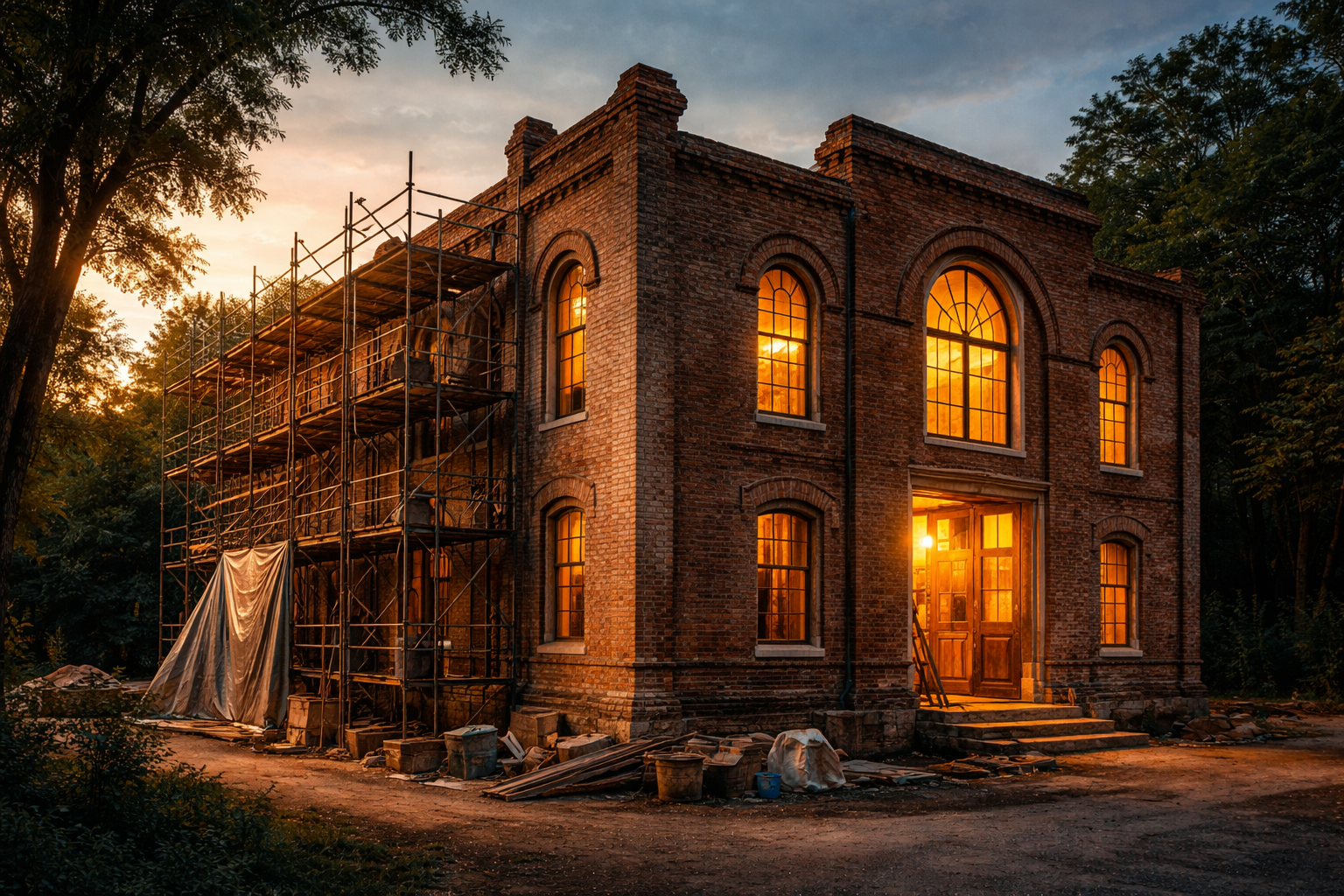
Historical sites are often discussed as landmarks or attractions—places to visit, photograph, and move past. But for many communities, historic sites function as anchors of memory. They hold evidence of who lived, labored, resisted, and endured in specific places, even when written records are incomplete or contested.
This article reframes historic preservation as more than architectural care. It examines restoration as a community process that shapes how societies remember harm, acknowledge resilience, and imagine futures grounded in truth rather than erasure. Preserving sites tied to difficult histories does not reopen wounds by default; in many cases, it stabilizes collective memory and creates conditions for repair and hope.
From the earliest preservation efforts in the United States, decisions about what to save reflected prevailing power structures. Homes of political leaders and battlefields tied to national triumph were preserved early and lavishly. Sites associated with enslavement, forced labor, displacement, and everyday survival were often ignored, demolished, or repurposed without acknowledgment.
As a result, many communities watched physical evidence of their histories disappear—sometimes intentionally, sometimes through neglect. In response, grassroots preservation movements emerged. Black churches, burial grounds, schools, labor halls, and Indigenous sacred sites were restored or protected not because institutions prioritized them, but because communities insisted they mattered.
Preservation thus became a form of historical intervention: a way to assert presence when documentation was thin and recognition delayed.
Who benefited
Who was harmed
Restoring historical sites affects communities through concrete mechanisms that connect place, memory, and wellbeing.
Physical sites provide evidence that does not rely solely on testimony. When preserved, they anchor historical claims in place, strengthening credibility for stories long questioned or minimized.
Sites shape how communities remember together. They offer shared reference points that support intergenerational storytelling, education, and mourning—processes linked to social cohesion.
Restoration signals recognition. When institutions invest in preserving difficult sites, they acknowledge that the histories tied to those places are worthy of care, study, and visibility.
Restored sites expand how history is learned. Experiential learning—walking through preserved spaces—helps visitors understand scale, proximity, and daily life in ways texts alone cannot.
Preservation is inherently forward-looking. Choosing to restore rather than erase reflects a belief that truth-telling strengthens communities rather than weakens them.
The effects of restoring historical sites extend across communities, though the histories involved differ.
Across these cases, restored sites function as memory infrastructure—supporting identity, dignity, and shared understanding.
Today, historic preservation intersects with urban development, tourism, and climate resilience. Decisions about which sites receive funding, protection, or interpretation continue to reflect values.
At the same time, communities increasingly frame restoration as a health and resilience strategy. Preserved sites support mental health by affirming belonging, reduce conflict by clarifying contested histories, and foster hope by demonstrating that loss is not the final word.
Communities need places where memory can live.
When historical sites vanish, memory becomes abstract and vulnerable. When they are preserved, history becomes tangible—something people can encounter, question, and carry forward.
Restoration does not resolve historical harm on its own. But it creates conditions where truth can be held collectively, where grief and pride coexist, and where future generations inherit evidence rather than silence.
National Park Service — Historic Preservation
https://www.nps.gov/subjects/historicpreservation/index.htm
U.S. Department of the Interior — Historic Preservation
https://www.doi.gov/pam/asset-management/historic-preservation
Advisory Council on Historic Preservation
https://www.achp.gov/
National Trust for Historic Preservation
https://savingplaces.org/
National Association of Tribal Historic Preservation Officers — What Is a THPO
https://www.nathpo.org/what-is-a-thpo/
Historic Santa Fe Foundation — Preservation Efforts
https://en.wikipedia.org/wiki/Historic_Santa_Fe_Foundation
Restoring historical sites is not about freezing the past in place. It is about giving memory somewhere to stand—so communities can face history honestly and move forward with clarity.