
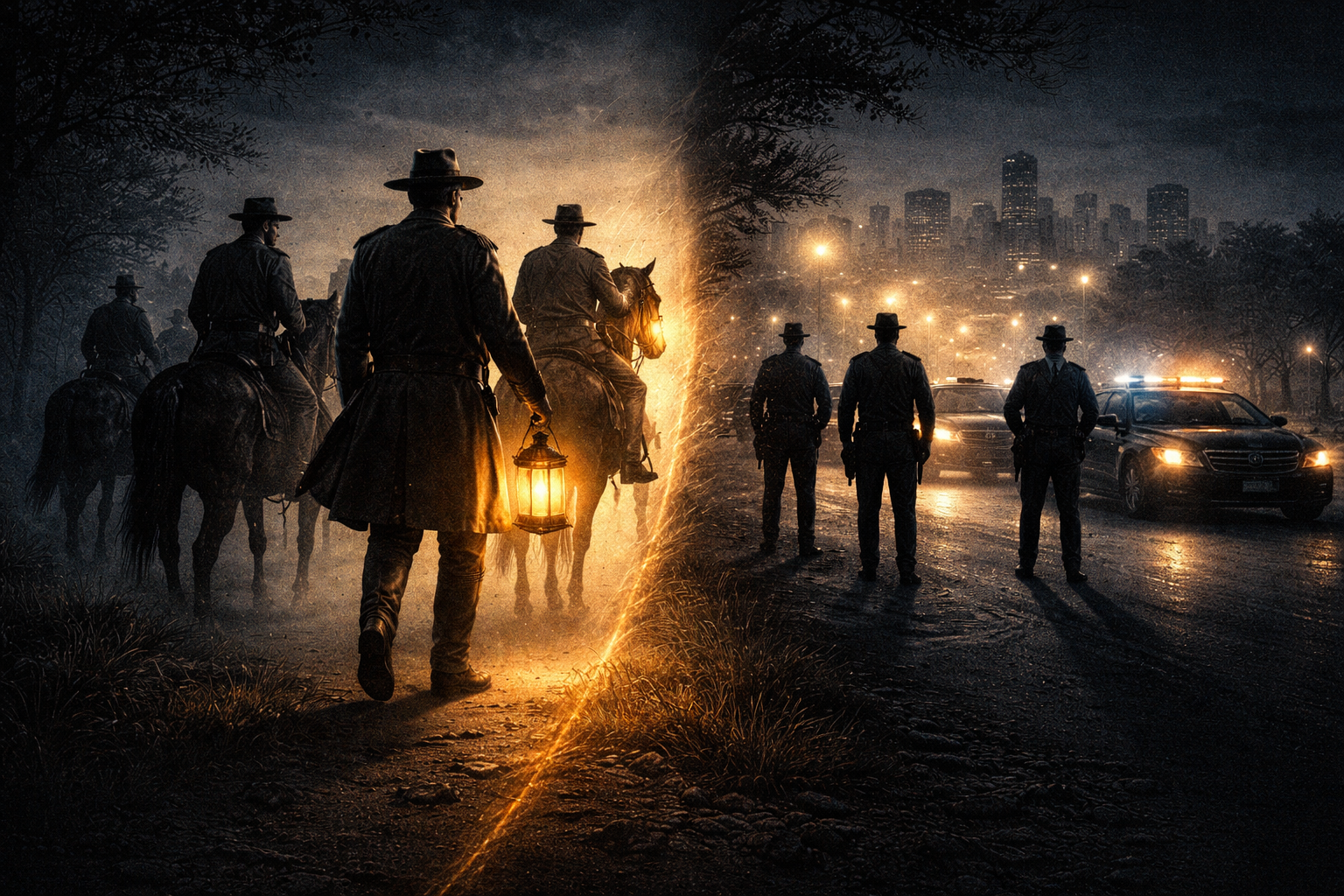
American policing did not emerge in a vacuum. Long before modern police departments existed, colonies and states developed organized systems to monitor, control, and discipline labor—especially enslaved labor.
One of the earliest and most influential of these systems was the slave patrol.
Understanding slave patrols doesn’t mean modern policing is identical to slavery-era enforcement. It means acknowledging that institutions inherit structures, priorities, and logics from their origins—even as laws and language change.
Slave patrols were organized groups of White men authorized by colonial and state governments to:
These patrols operated throughout the American South from the early 1700s until the Civil War.
They were publicly funded, legally sanctioned, and socially expected.
Slave patrols were not primarily about crime. They were about labor control.
Their core purposes included:
In a system where wealth depended on forced labor, surveillance was essential.
Slave patrols had many features that later appeared in formal policing:
These were not informal mobs. They were institutions.
After the Civil War, slavery ended—but the need to control labor did not disappear.
Slave patrols evolved into:
New laws—such as Black Codes and vagrancy statutes—criminalized unemployment, movement, and minor infractions, allowing authorities to reassert control over Black labor through arrest and incarceration.
The target shifted from “enslaved” to “criminal.”
The function remained similar.
Throughout the late 19th and early 20th centuries, policing played a key role in:
Policing often acted as the enforcement arm of economic hierarchy.
Modern policing serves many functions today, including public safety. But historical foundations shape institutional behavior.
Research shows that:
These patterns didn’t emerge randomly. They follow institutional memory.
Acknowledging slave patrols as a foundation does not mean:
It means systems inherit frameworks unless they are actively redesigned.
History explains patterns. It does not assign individual guilt.
Slave patrols help explain why policing in America developed with such a strong emphasis on surveillance, control, and enforcement—especially in relation to Black communities.
Understanding origins allows for clearer conversations about:
You cannot redesign a system without understanding how it was built.
National Museum of African American History & Culture — Policing History
https://nmaahc.si.edu/
Library of Congress — Slavery & Law Enforcement
https://loc.gov/
Equal Justice Initiative — Policing & Racial History
https://eji.org/
Vera Institute of Justice — Policing & Reform
https://www.vera.org/