
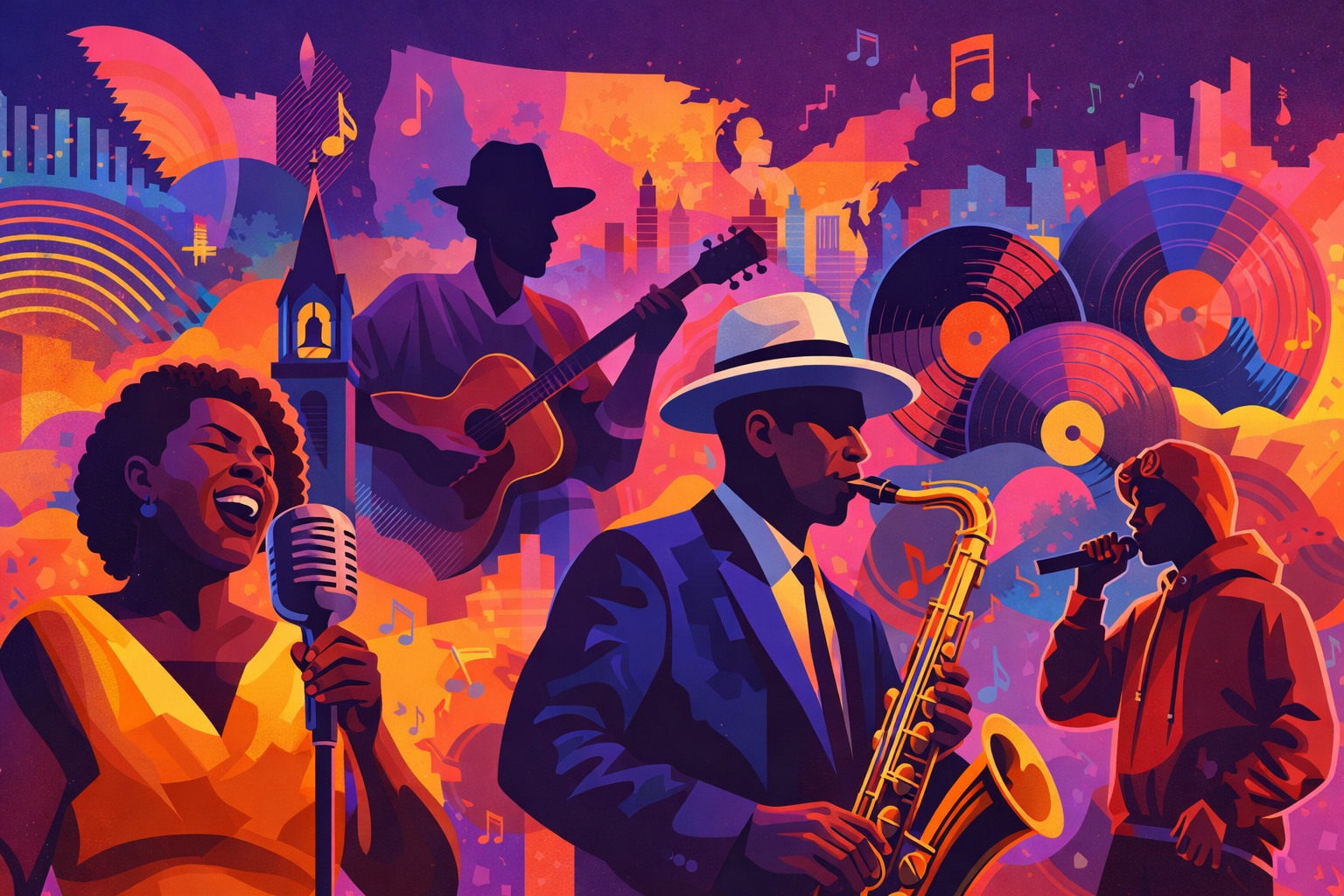
Many of the sounds that feel most “American” today—syncopated rhythms, call-and-response, blues progressions, gospel harmonies—arrived to us already shaped by history. They play in cars, churches, films, stadiums, and everyday life, often without comment.
That familiarity raises a quieter question: how did these sounds form, travel, and endure across centuries of upheaval?
Understanding the cultural genealogy of Black music means tracing not just musical styles, but the systems that shaped how creativity survived, moved, and was absorbed into a national culture.
Black music in America emerged under conditions that denied freedom, property, and authorship.
Enslaved Africans brought with them diverse musical traditions—polyrhythms, improvisation, communal participation, and music as a form of memory-keeping. These traditions persisted because they did not rely on written language or formal institutions. Music could carry meaning, coordination, belief, and history without leaving a paper trail.
At the same time, music existed within systems of control. Certain forms were tolerated or encouraged when they aligned with labor discipline or public display. Others were restricted when expression appeared to foster autonomy or resistance.
Over time, Black musical practices were reclassified as “folk,” “work,” or “spiritual” music—labels that normalized the sound while obscuring the conditions under which it formed.
The evolution of Black music was shaped by access as much as artistry.
Who could own instruments.
Who could gather publicly.
Who controlled venues, recording equipment, contracts, and copyright.
As migration reshaped the country—particularly during the Great Migration—musicians carried sounds from rural areas into growing cities. New forms emerged as traditions adapted to new environments: blues electrified, gospel expanded, jazz formalized improvisation, rhythm and blues accelerated tempo and structure.
A recurring pattern took hold:
Innovation developed in community spaces.
Intermediaries translated those sounds for mass audiences.
Ownership and compensation flowed unevenly.
Genres were renamed, segmented, or detached from origin.
The system rewarded circulation more reliably than authorship.
The effects of these systems were uneven but consistent.
Black musicians faced restricted access to capital, segregated venues, exploitative contracts, and limited control over intellectual property—even as their work shaped entire genres.
Women played foundational roles as composers, performers, teachers, and organizers, while often receiving less recognition and fewer recording opportunities.
Migrant communities adapted music to new cities and regions, sustaining innovation while remaining economically vulnerable.
No single experience defines this history. What unites it is structure: cultural creation occurred closest to constraint, while institutional reward accumulated farther away.
Today’s music systems often appear neutral.
Streaming platforms rely on algorithms.
Royalties scale with reach.
Discovery depends on visibility and contracts.
Yet these systems reflect earlier dynamics. Control over distribution, catalog ownership, and promotion still shapes who benefits most from musical influence.
At the same time, continuity remains audible. Sampling, remixing, and live performance echo older practices of improvisation and communal exchange. The lineage persists, even when the history is not always named.
Tracing the genealogy of Black music helps explain more than cultural influence.
It clarifies how creativity moves through systems that reward circulation over origin. It explains why questions of credit, ownership, and recognition recur across generations. And it shows how culture can function as historical record when other forms of documentation are denied.
Music is not separate from history. It is one of the ways history survives.
American Folklife Center (Library of Congress)
https://www.loc.gov/programs/american-folklife-center/
Digitization and preservation of vernacular music, oral traditions, and field recordings.
Slave Narratives Collection (U.S. National Archives)
https://www.archives.gov/research/african-americans/slave-narratives
First-person WPA interviews that include references to music, spirituals, and communal expression.
PBS — Jazz (Ken Burns)
https://www.pbs.org/kenburns/jazz/
A long-running public history project examining jazz within racial, economic, and institutional systems.
African-American Music (overview)
https://en.wikipedia.org/wiki/African-American_music
Used here for high-level orientation and lineage, not as sole authority.
Listening closely can be a way of learning—hearing not just melodies, but movement, memory, and adaptation. Each familiar sound carries a longer story, shaped by constraint and creativity alike.
Every Chapter Counts traces these genealogies not to assign blame or praise, but to deepen understanding of how culture moves through history—and why it still matters.