
December 14, 2025

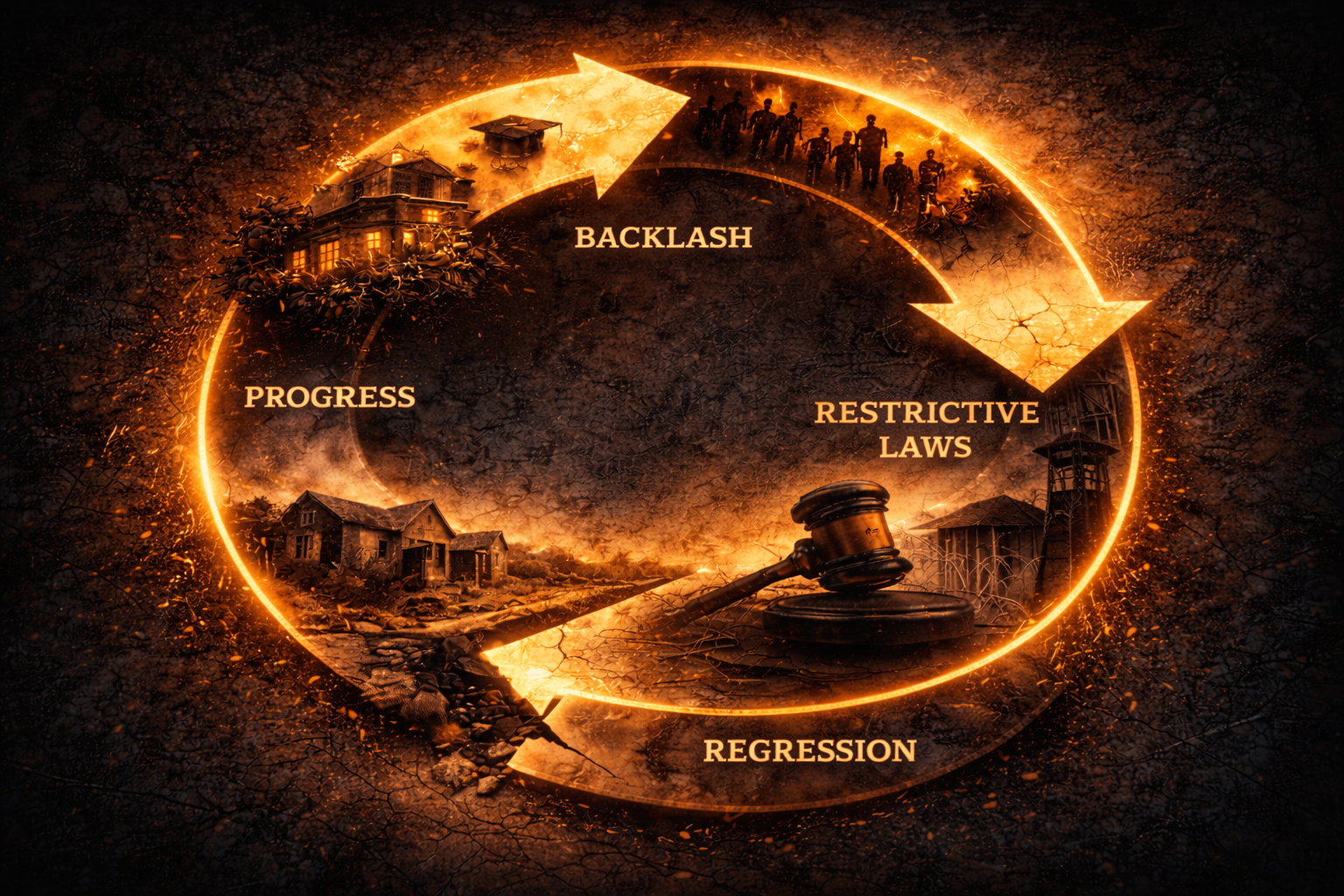
The Cycle: Black Progress → Backlash → Restrictive Laws

The Cycle: Black Progress → Backlash → Restrictive Laws

Throughout American history, moments of Black progress have often been followed by periods of backlash.

This pattern is not coincidental. It is cyclical.

When Black communities gain political power, economic footholds, or social autonomy, those gains frequently trigger responses designed to limit, contain, or reverse them—often through law.

Understanding this cycle helps explain why progress in the United States has rarely moved in a straight line.

Progress Has Never Been Passive

Black progress has taken many forms:

  • political participation
  • land ownership
  • business creation
  • educational access
  • labor organizing
  • cultural influence

These gains were rarely granted freely. They were built through organizing, risk, and collective effort.

And they often reshaped local power dynamics.

Backlash Is a Predictable Response

Backlash typically emerges when progress threatens existing hierarchies.

It often includes:

  • moral panic
  • exaggerated claims of disorder
  • media narratives about danger or decline
  • appeals to “tradition” or “stability”

Backlash reframes progress as a problem to be managed.

Restrictive Laws Translate Backlash Into Policy

Fear and resentment become durable only when codified.

Historically, backlash has produced:

  • Black Codes after emancipation
  • voting restrictions after Reconstruction
  • segregation laws after political participation expanded
  • zoning and housing barriers after urban migration
  • criminal statutes after civil rights gains

These laws rarely mention race explicitly. Instead, they target behavior, access, or eligibility.

The result is constraint without naming exclusion.

Examples Across Time

This cycle repeats across eras:

  • Reconstruction → Black political power → Jim Crow laws
  • Great Migration → economic mobility → housing segregation
  • Civil Rights Movement → legal equality → mass incarceration and voter suppression
  • Electoral gains → expanded participation → new voting restrictions

Progress shifts the system. Backlash attempts to stabilize it.

Why Law Is the Final Stage

Laws outlast emotions.

Once enacted, restrictive policies:

  • appear neutral
  • are enforced selectively
  • shape opportunity quietly
  • normalize inequality

Legal frameworks allow backlash to persist long after public attention fades.

The Cycle Isn’t Automatic — It’s Chosen

This pattern is not inevitable. It reflects decisions.

At each stage, institutions decide:

  • whether to expand inclusion
  • whether to share power
  • whether to redefine fairness

Backlash is not destiny. It is policy.

Why This History Matters

Understanding the cycle helps explain why:

  • progress is often followed by retrenchment
  • reforms feel fragile
  • gains require protection
  • inequality adapts rather than disappears

It also clarifies why vigilance matters even during moments of advancement.

Progress without safeguards invites reversal.

Questions to Reflect On

  • Where have you seen progress followed by restriction?
  • Which laws were framed as neutral but had unequal effects?
  • What prevents progress from becoming permanent?

Dig Deeper Sources

National Museum of African American History & Culture — Reconstruction & Civil Rights
https://nmaahc.si.edu/

Library of Congress — Voting Rights & Backlash
https://loc.gov/

Brennan Center — Voting Laws & Restrictions
https://www.brennancenter.org/

Brookings Institution — Race, Policy, and Power
https://www.brookings.edu/

What to Read Next

How Fear Shaped Policing Policy for Centuries
An exploration of how fear — not just crime — shaped policing policy, enforcement priorities, and surveillance across American history.
How Redlining Designed Modern Cities
An explanation of how redlining shaped housing, wealth, infrastructure, and opportunity—and why modern cities still reflect those designs.