
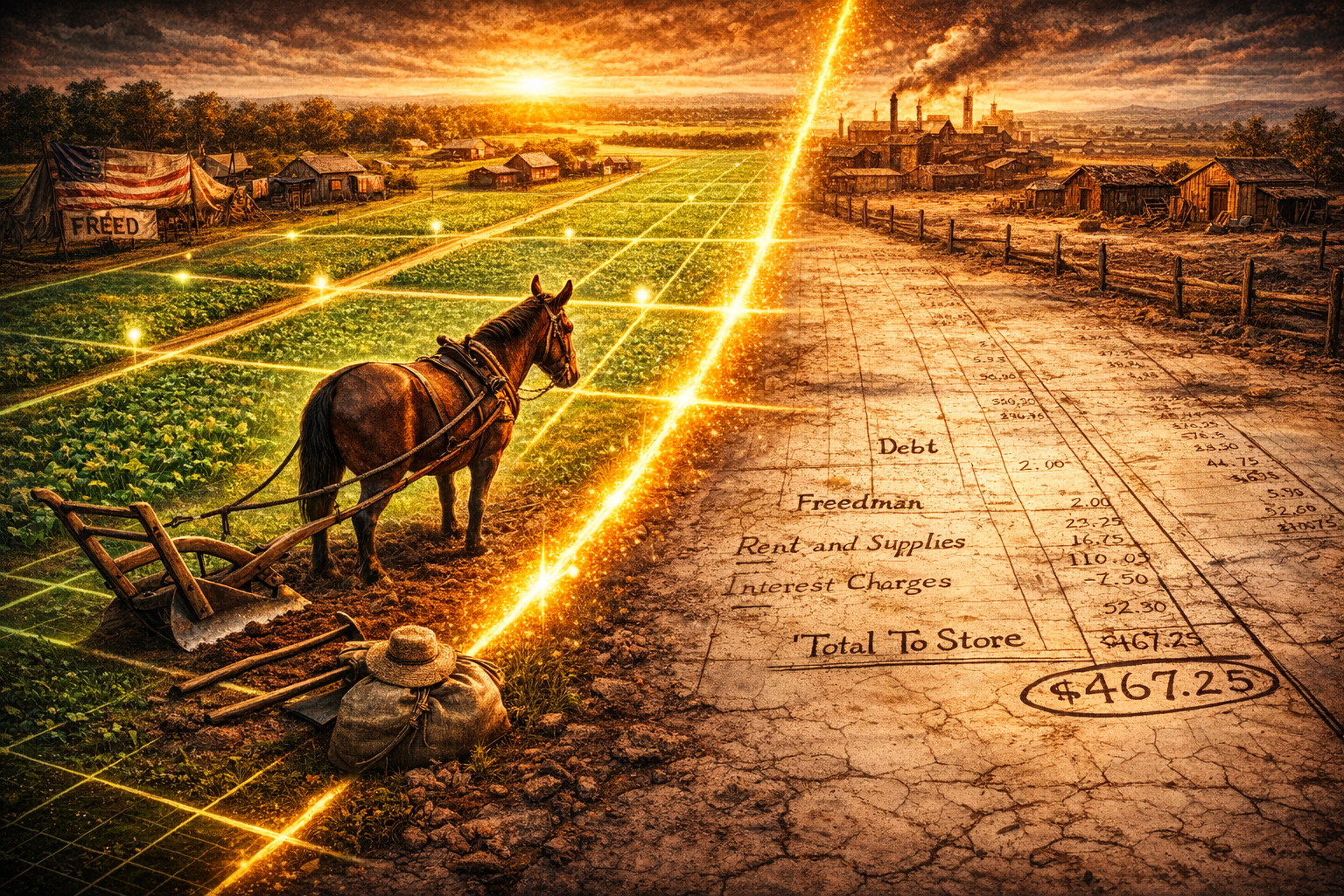
“Forty acres and a mule” is often dismissed as a slogan or a broken promise. But at its core, it was an economic proposal—one grounded in how wealth actually forms.
The idea wasn’t symbolic.
It was structural.
Understanding what 40 acres would have meant helps clarify why land access mattered so much after emancipation—and why its absence shaped inequality for generations.
In 1865, Union officials briefly explored redistributing confiscated Confederate land to formerly enslaved families.
The logic was straightforward:
Forty acres was not arbitrary. It reflected the minimum land needed for a family to farm independently.
The mule represented capital—the ability to work the land productively.
In the 19th century, land functioned as:
Families with land could:
Without land, freedom remained fragile.
Economic historians have estimated that distributing land to formerly enslaved families would have created a dramatically different wealth trajectory.
Even conservative projections suggest:
Compounded over generations, these effects would have reshaped wealth distribution in the U.S.
Instead of land redistribution, Black families were absorbed into systems like:
These systems extracted labor without creating assets.
Where land ownership builds equity, debt-based labor systems erase it.
Freedom without capital forced difficult choices.
Formerly enslaved families had to:
“Forty acres and a mule” wasn’t about reward—it was about viability.
The absence of land shaped:
Families that started with land passed down advantage.
Families that started without it had to rebuild from zero—repeatedly.
The economic logic behind 40 acres hasn’t disappeared.
Modern debates about:
all reflect the same question:
What does it take to create durable economic independence?
“Forty acres and a mule” shows that inequality wasn’t accidental.
A different economic path was considered—and rejected.
Understanding what land access would have meant helps explain why wealth gaps emerged so quickly after emancipation—and why they persist.
Library of Congress — Reconstruction & Land Policy
https://loc.gov/
National Archives — Freedmen’s Bureau Records
https://www.archives.gov/
Economic History Association — Wealth & Land
https://eh.net/
National Museum of African American History & Culture — Reconstruction
https://nmaahc.si.edu/