
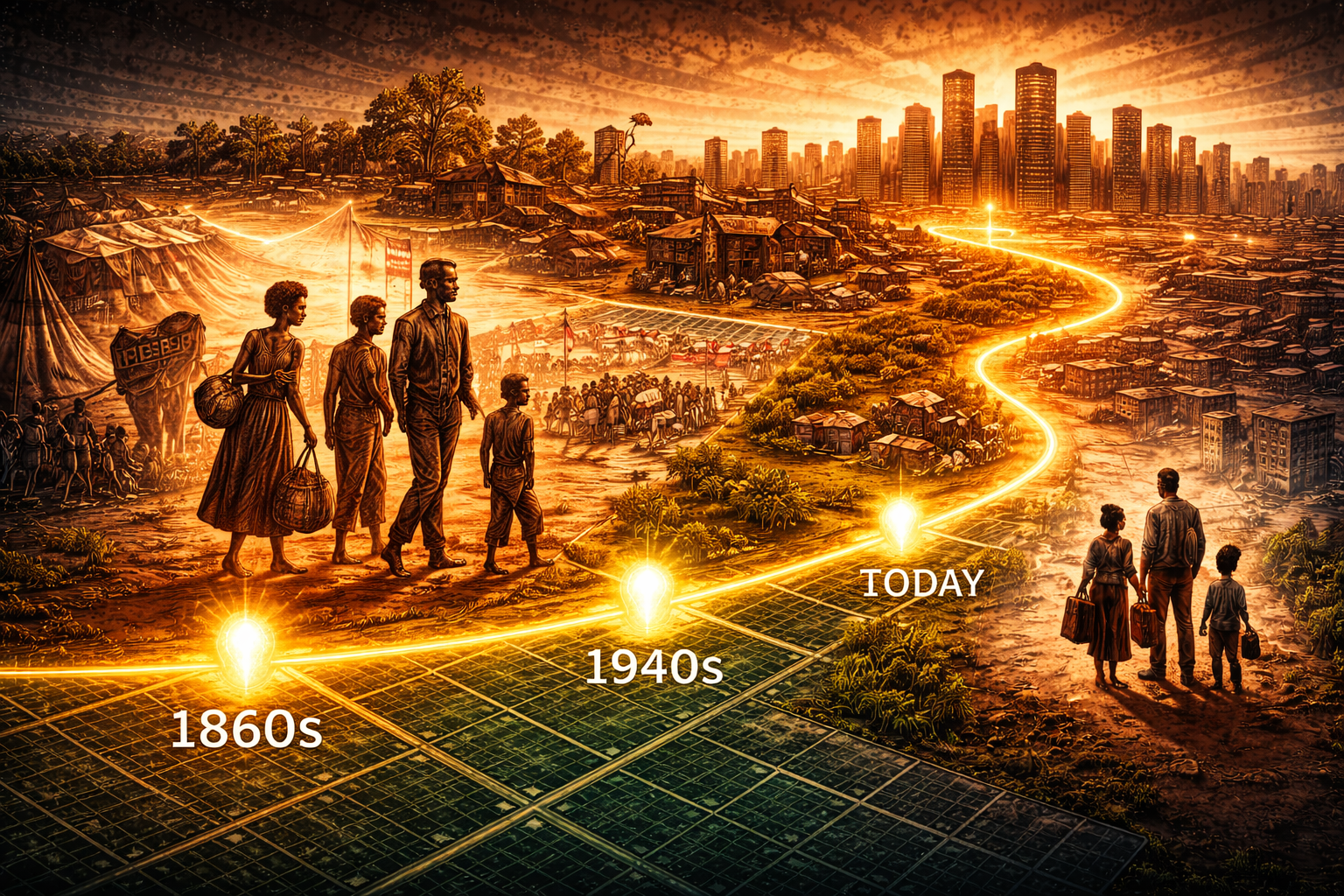
Reparations is often framed as a modern or controversial idea. In reality, it has been debated continuously since the end of slavery.
The question isn’t whether reparations are new.
It’s why the conversation never went away.
To understand that, you have to look at what freedom meant—and what it didn’t—after emancipation.
When slavery ended, formerly enslaved people faced a stark reality:
freedom without land, income, or protection.
During and after the Civil War, many Americans understood that emancipation alone was not enough. If people had been forced to labor for generations, then freedom required resources to build independent lives.
This idea wasn’t radical at the time—it was practical.
In 1865, Union officials briefly explored land redistribution.
Some formerly enslaved families were settled on confiscated Confederate land. The idea was simple:
land meant self-sufficiency.
But the policy was quickly reversed. Land was returned to former enslavers, and Black families were displaced—often violently.
The first large-scale reparations discussion ended not because it lacked logic, but because political will collapsed.
Reconstruction offered constitutional amendments and civil rights protections—but not economic repair.
Black Americans entered freedom:
At the same time, systems like sharecropping and convict leasing replaced slavery in practice, binding labor to debt and punishment.
Economic extraction continued—without ownership.
As the U.S. industrialized, disparities grew clearer.
White families built wealth through:
Black families were largely excluded from each stage.
By the early 20th century, activists began framing reparations not as compensation for slavery alone, but for compounded exclusion.
The debate evolved with the evidence.
Civil rights laws dismantled legal segregation—but did not redistribute accumulated advantage.
By the 1960s:
Reparations conversations resurfaced as a response to structural inequality—not individual harm.
Reparations remains debated because:
The debate isn’t about the past alone—it’s about how history shapes present conditions.
When gaps endure for centuries, explanations that ignore history fall short.
The term “reparations” has included many proposals:
The common thread is acknowledgment that harm was systemic—and repair must be as well.
The reparations debate survives because the conditions that created it were never fully addressed.
As long as:
the question will continue to resurface.
History doesn’t fade when its outcomes remain visible.
Understanding the reparations debate helps explain why inequality discussions often return to history.
It reframes the issue:
not as punishment,
but as repair.
Reparations has endured because it asks a fundamental question:
What does justice require after generations of unequal access?
National Museum of African American History & Culture — Reconstruction
https://nmaahc.si.edu/
Library of Congress — Freedmen & Reconstruction
https://loc.gov/
Brookings Institution — Wealth Inequality
https://www.brookings.edu/
Congressional Research Service — Reparations History
https://crsreports.congress.gov/