
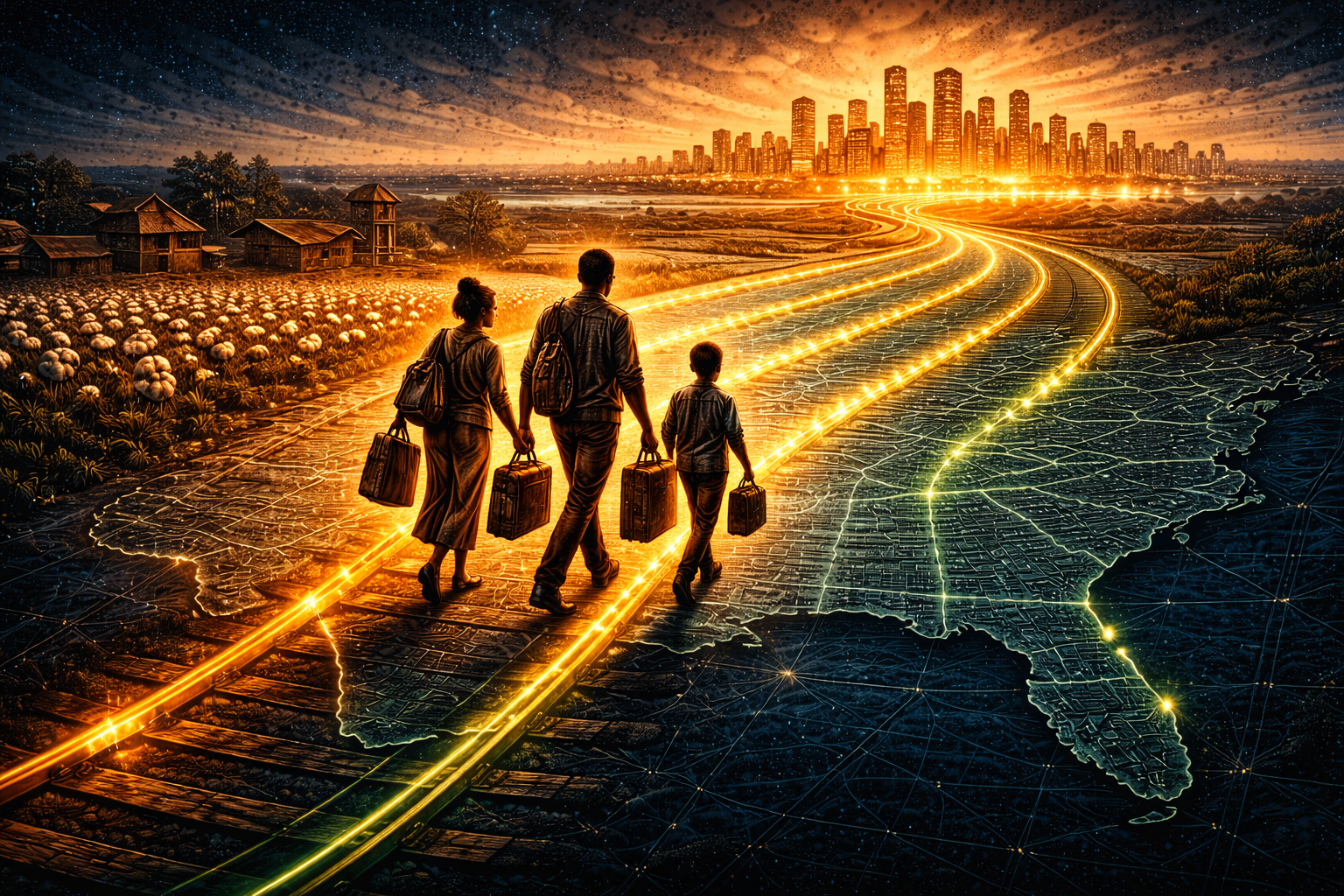
The Great Migration is often described as a search for opportunity—a hopeful movement from the rural South to the industrial North and West.
But for millions of Black Americans, migration wasn’t primarily about aspiration. It was about survival.
Between roughly 1916 and 1970, more than six million Black Americans left the South. They weren’t simply chasing better jobs. They were escaping systems that made economic stability nearly impossible to achieve—and often dangerous to pursue.
Seen this way, the Great Migration wasn’t just a cultural shift. It was one of the largest economic survival strategies in U.S. history.
Life in the post-Reconstruction South locked many Black families into systems that limited mobility and wealth.
Key pressures included:
For many families, remaining meant permanent economic precarity.
Migration became a rational response to a closed system.
Southern labor markets were structured to extract labor cheaply and prevent advancement.
When work cannot sustain life or dignity, leaving becomes an economic decision—not a gamble.
Northern and Western cities offered something the South largely did not: wage labor with cash pay.
Factories, railroads, meatpacking plants, shipyards, and steel mills needed workers—especially during World War I and World War II.
For migrants, industrial jobs meant:
The work was often dangerous and discriminatory, but it offered leverage that didn’t exist in agricultural debt systems.
Families didn’t move blindly.
They:
Churches, newspapers, and social networks acted as information systems long before the internet.
Migration was organized through community knowledge.
Black women played a critical role in the Great Migration.
Their labor:
Women also shaped where families settled, prioritizing schools, churches, and community ties alongside employment.
Migration carried real risks.
Migrants traded one set of constraints for another—but gained distance from the most rigid systems of the South.
Migration improved income for many families, but wealth accumulation remained uneven.
Still, migration created intergenerational shifts:
The gains were partial—but real.
The economic effects were national.
Migration:
Modern urban America cannot be understood without it.
The Great Migration shows that people respond logically to constrained systems.
When opportunity is blocked, movement becomes a tool.
When stability is denied, relocation becomes resistance.
When survival is at stake, migration is strategy.
Understanding the Great Migration this way challenges myths about passivity and reframes mobility as economic intelligence under pressure.
Library of Congress — Great Migration Collections
https://loc.gov/
National Museum of African American History & Culture — Great Migration
https://nmaahc.si.edu/
U.S. Census Bureau — Migration & Urban Change
https://www.census.gov/
Smithsonian National Museum of American History — Labor & Migration
https://americanhistory.si.edu/