
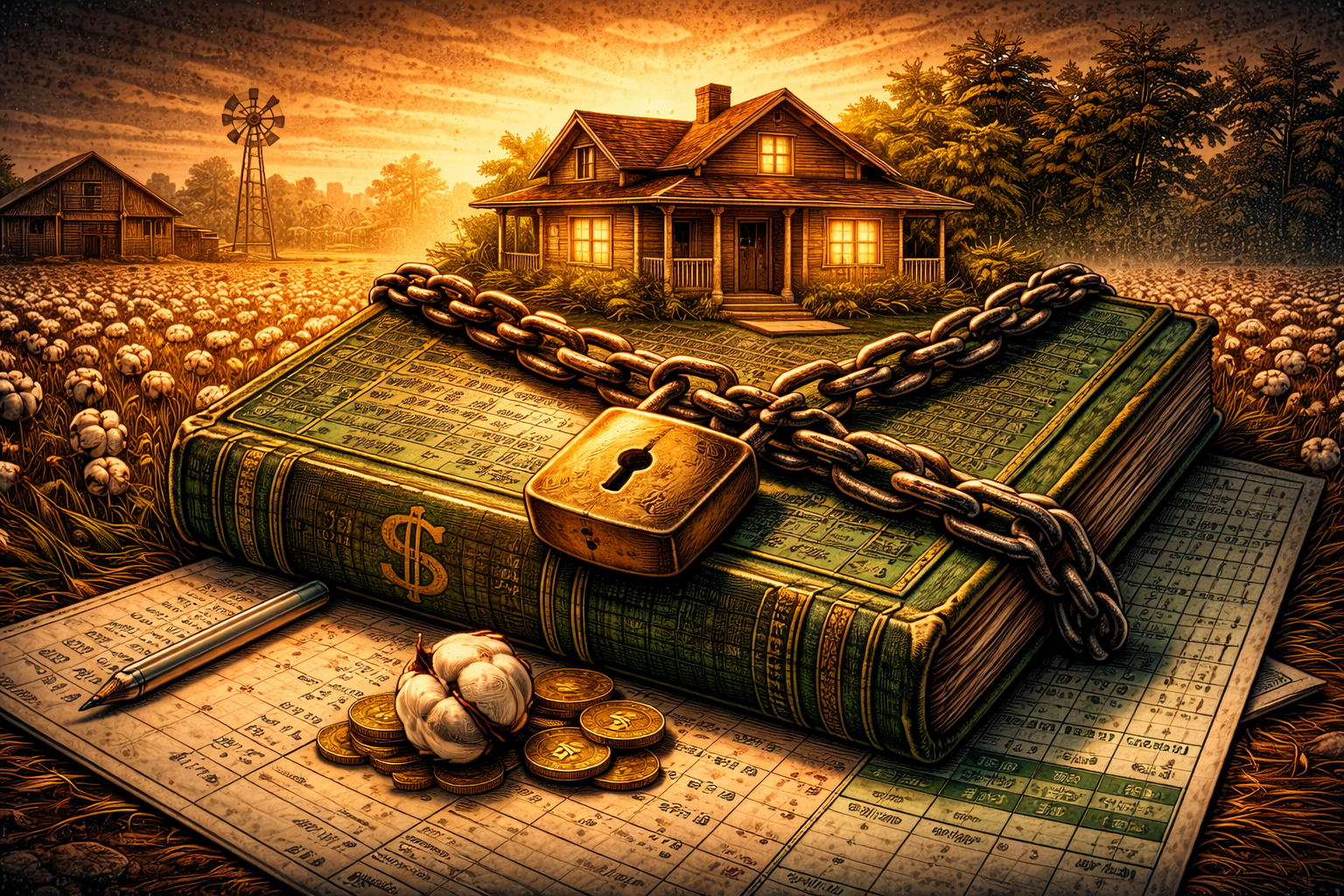
When slavery formally ended in the United States, freedom arrived without land, capital, or protection.
For millions of formerly enslaved people—and many poor White farmers—the question wasn’t whether they were free in theory. It was how they would survive in practice.
Sharecropping emerged as the answer. And while it wasn’t slavery by law, it reproduced many of the same economic controls through debt, land access, and coercion.
Understanding sharecropping helps explain how racial and class inequality persisted long after emancipation—and why land ownership became such a powerful dividing line in American history.
Sharecropping was a labor system in which farmers worked land they did not own in exchange for a share of the crops they produced.
Typically:
In practice, landowners controlled:
This imbalance shaped everything that followed.
After the Civil War:
Sharecropping filled the gap—not as a temporary solution, but as a durable system of control.
Most sharecroppers relied on crop-lien credit to survive between harvests.
They borrowed for:
At inflated prices, charged interest by landowners or local merchants.
At harvest time:
Many families never broke even.
Debt replaced chains.
Because debts were settled annually:
While sharecroppers were not legally owned, their economic freedom was tightly constrained.
Sharecropping existed across racial lines, but enforcement was unequal.
The system preserved racial hierarchy while appearing neutral.
The key difference between freedom and dependency was land.
Families who owned land could:
Sharecroppers could not.
When Black landownership did rise, it was often met with:
Land loss erased progress.
Sharecropping shaped:
By the early 20th century, millions were trapped in cycles that mirrored slavery’s economic outcomes without its legal status.
Sharecropping declined due to:
But its legacy did not disappear.
The wealth gap it created remained.
Sharecropping reveals a recurring pattern in American history:
When systems of exploitation are challenged, they are often replaced—not dismantled.
Freedom without access to land, credit, or protection is fragile.
Understanding sharecropping helps explain:
It also challenges the idea that inequality simply faded with time.
Library of Congress — Sharecropping & Reconstruction
https://loc.gov/
National Museum of African American History & Culture — Reconstruction
https://nmaahc.si.edu/
Economic History Association — Crop-Lien System
https://eh.net/
Smithsonian National Museum of American History — Agriculture & Labor
https://americanhistory.si.edu/