
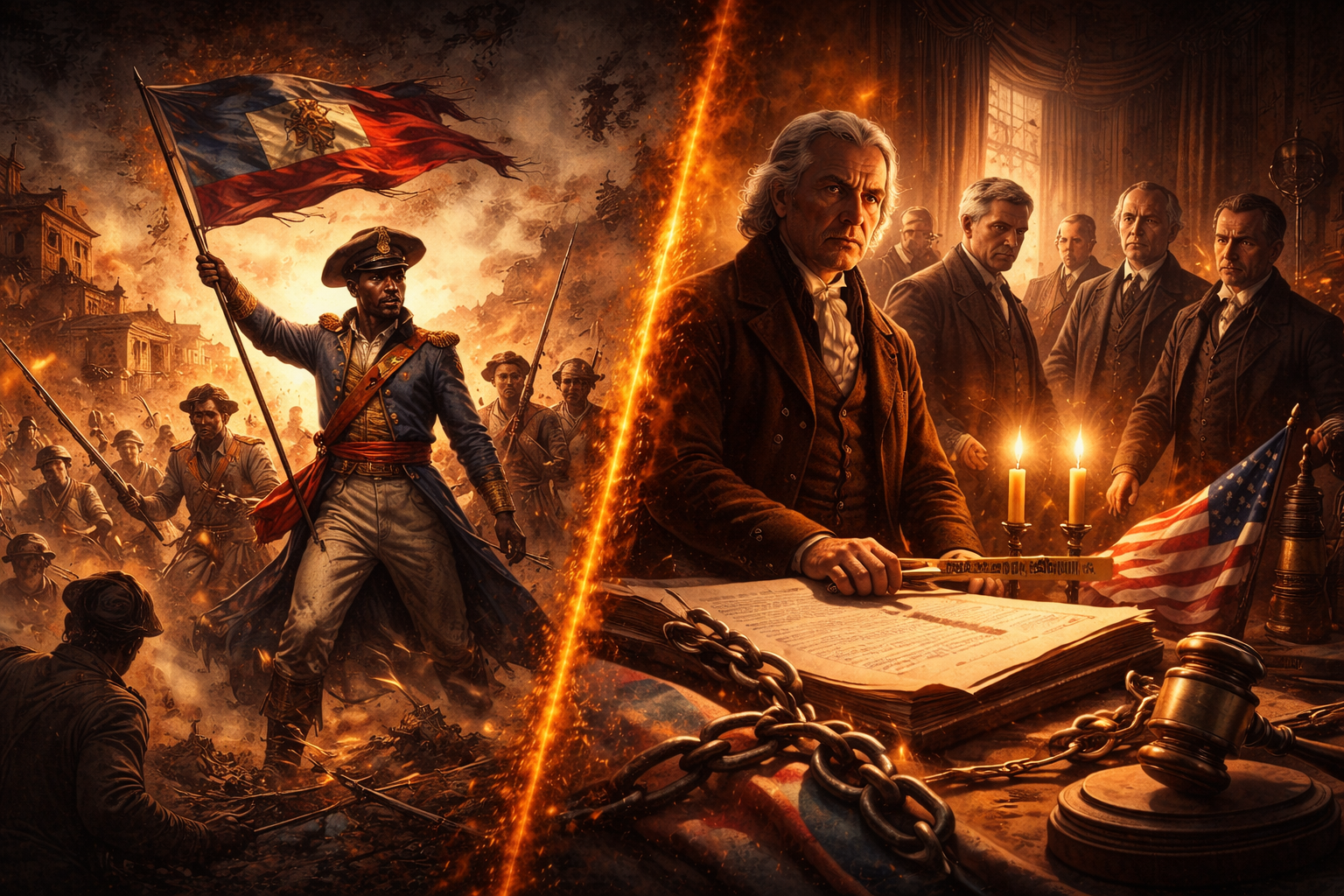
In the late eighteenth century, the United States was a young nation still defining itself. Its leaders spoke openly about liberty, independence, and self-government. At the same time, they were watching events unfold just beyond their borders that would profoundly unsettle those ideals.
In the French colony of Saint-Domingue, enslaved people revolted, defeated European powers, and founded the first Black republic in the modern world: Haiti.
The revolution succeeded. But its success created fear—fear that traveled across oceans, shaped laws, and quietly influenced American policy for generations.
The Haitian Revolution (1791–1804) was unprecedented.
Enslaved people not only rebelled; they organized, governed, negotiated, and ultimately secured independence. Haiti abolished slavery and asserted Black sovereignty in a world still structured around racial hierarchy and colonial rule.
For American leaders—many of whom enslaved people themselves—this posed a fundamental challenge.
If enslaved people could overthrow an empire and govern themselves, what did that mean for slavery in the United States? For citizenship? For racial order? For the meaning of freedom itself?
The revolution forced American policymakers to confront a contradiction they had long managed to contain: liberty proclaimed in theory versus liberty denied in practice.
American responses to Haiti were shaped less by diplomacy than by anxiety.
Rather than recognizing Haiti as a legitimate nation, the United States delayed formal recognition for decades. Trade restrictions, diplomatic isolation, and unofficial embargoes followed. These were not merely foreign policy decisions—they were domestic signals.
The message was clear: Black self-rule was dangerous, contagious, and to be contained.
This fear translated into policy at home. Southern states tightened controls on enslaved and free Black populations. Laws restricted gatherings, movement, and education. Ports imposed quarantines on Black sailors arriving from the Caribbean. States monitored news, correspondence, and travel linked to Haiti.
What began as reaction to a foreign revolution became a framework for internal governance.
The shadow of the Haitian Revolution fell unevenly.
Enslaved people were subjected to harsher surveillance and punishment, as authorities sought to prevent imitation or inspiration.
Free Black communities, especially in port cities, faced new restrictions. Their mobility was treated as a threat. Their political imagination was seen as dangerous.
Immigrants and refugees from Saint-Domingue—including both Black and white Haitians—encountered suspicion, exclusion, and inconsistent legal treatment depending on race and status.
White Americans were affected too, though differently. Fear reshaped public discourse, justified repression, and narrowed the boundaries of acceptable political thought. The revolution became something to be erased rather than examined.
The United States eventually recognized Haiti in 1862—during the Civil War, when slavery itself was under existential threat. But the patterns set earlier endured.
Haiti remained framed as unstable, dangerous, or illegitimate in American political culture. Interventions, occupations, and economic controls followed in the twentieth century, often justified as maintaining order.
Domestically, the logic born in the aftermath of Haiti—the idea that Black political autonomy required containment—continued to shape law, policing, and public policy.
The revolution’s success was never fully integrated into American civic memory. Its meaning was managed by omission.
The Haitian Revolution exposes how fear becomes policy.
It shows that laws are not shaped only by events within a nation’s borders, but by the examples nations choose to confront—or suppress. It also reveals how identity and belonging are defined not just by ideals, but by perceived threats to power.
Understanding this history helps explain:
This is not a story about inevitability. It is a story about choices—made early, reinforced often, and normalized over time.
The Haitian Revolution
U.S. Policy and Haiti
Race, Fear, and Law
The Haitian Revolution did not fail to shape American policy—it shaped it too well.
Its lessons were not embraced, but managed. Its implications were not debated, but buried beneath laws, restrictions, and silence.
Every Chapter Counts exists to bring those buried stories back into view—not to provoke guilt, but to restore context. When we understand how fear shaped policy in the past, we can better recognize when it does so again.