For generations, American Catholics faced a question that other citizens were rarely required to answer:
Could they be loyal to both their church and their country?
The question appeared in different forms. Catholic immigrants were accused of taking orders from the pope. Catholic schools were portrayed as threats to public education. Priests and convents became subjects of rumors and political cartoons. Catholic voters were described as a disciplined bloc rather than independent citizens. Candidates for public office were asked whether their religious allegiance would override the Constitution.
These suspicions did not remain private prejudice. They shaped riots, political parties, election campaigns, school policy, immigration debates, and constitutional arguments.
Anti-Catholicism was never separate from the larger history of American identity. It often overlapped with hostility toward Irish, German, Italian, Polish, Mexican, and other immigrant or culturally distinct communities. It drew strength from the assumption that the United States was not merely a country with a Protestant majority, but a fundamentally Protestant nation whose institutions and values belonged most naturally to native-born Protestants.
Catholics responded in different ways. Some built parishes, schools, charities, newspapers, unions, and political organizations. Some emphasized assimilation and patriotic loyalty. Others defended distinct languages, devotional practices, and community institutions. Catholics also disagreed among themselves over politics, class, race, education, and the proper relationship between church and state.
The history is therefore not a simple story of one unified Catholic community confronting one unified Protestant majority.
It is a history of how a religious majority’s customs could be treated as ordinary and American, while a minority’s customs were treated as foreign—and how that distinction became a way of deciding who truly belonged.
The Constitution prohibited a federal religious test for public office, and the First Amendment limited federal establishment of religion and protected religious exercise.
Those provisions were important. But constitutional language did not erase the religious culture inherited from the British colonies.
Most of the early United States was overwhelmingly Protestant. Political leaders and ordinary citizens often disagreed about which Protestant denominations should receive support, how churches should relate to government, and whether religious dissenters deserved equal treatment. Catholics remained a small and frequently mistrusted minority in much of the British colonial world.
Even after formal religious establishments declined, Protestant language, worship, moral assumptions, and Bible reading remained woven into many public institutions. Practices that appeared neutral to a Protestant majority could feel distinctly denominational to Catholics, Jews, nonbelievers, and members of smaller faiths.
Catholic history in what became the United States was also older and more geographically varied than the familiar story of European immigrants arriving in northeastern cities.
Spanish-speaking Catholics had established communities in Florida and the Southwest long before the United States existed. Catholics in Maryland lived through periods of toleration and political restriction. French Catholic communities developed along the Mississippi Valley and Gulf Coast. After 1848, Mexican Catholic communities in the Southwest came under U.S. rule through territorial conquest rather than immigration.
There was no single moment when Catholicism first arrived in America. What changed dramatically during the 19th century was its size, visibility, and political importance.
Large-scale Irish immigration transformed American religious life.
The famine beginning in the 1840s drove families from Ireland, but Irish migration had begun earlier and continued for generations. Between 1820 and 1860, Irish immigrants made up more than one-third of immigration to the United States. Many were Catholic, poor, and concentrated in growing cities where they competed for housing and work.
Religious prejudice mixed easily with economic resentment.
Irish immigrants were accused of lowering wages, crowding neighborhoods, increasing poverty, supporting urban political machines, and obeying priests rather than acting as independent citizens. Catholicism became a shorthand through which fears about immigration, class, cities, voting, and social change could be expressed.
The recurring claim was not simply that Catholic theology was wrong.
It was that Catholics could not become the right kind of Americans.
Anti-Catholic hostility produced physical attacks before it became the organizing principle of a major political party.
In 1831, a mob burned St. Mary’s Catholic Church in New York. In 1834, a mob destroyed an Ursuline convent and school near Boston after rumors circulated about women being confined there. In 1844, conflict involving immigration, politics, and Bible reading in Philadelphia’s public schools escalated into several days of violence. Catholic churches, homes, and schools were attacked, and 13 people were killed.
These episodes were not spontaneous expressions of theological disagreement.
Rumors, newspapers, public speakers, partisan organizers, and existing economic tensions helped create an atmosphere in which Catholic institutions could be imagined as secretive and dangerous.
A convent became evidence of female captivity. A parish became a foreign political outpost. A disagreement over which Bible children should read became an attack on American civilization.
Violence made those stories tangible. Burned churches and schools sent a message that Catholic presence in public life remained conditional.
The most durable anti-Catholic argument centered on the pope.
Critics claimed that Catholics owed political obedience to a foreign ruler and therefore could not exercise independent judgment as voters, officeholders, teachers, or public employees. Priests were portrayed as political commanders, Catholic voters as a controlled bloc, and the church hierarchy as a government operating inside the United States.
The argument allowed religious difference to be recast as a national-security problem.
A Protestant voter could belong to an international denomination without being treated as disloyal. A Catholic voter’s connection to Rome, however, was presented as evidence that religious authority would override civic obligation.
Political cartoons reinforced the claim. Bishops were depicted invading schools, priests controlling immigrants, and papal symbols stretching across American institutions. A Library of Congress cartoon from the 1850s portrayed Catholic immigration as the vehicle through which Rome might gain influence in the United States.
The images worked because they simplified a complex community into one threatening chain of command.
Catholics differed by national origin, class, region, political party, and relationship to church authority. Anti-Catholic politics treated those differences as irrelevant.
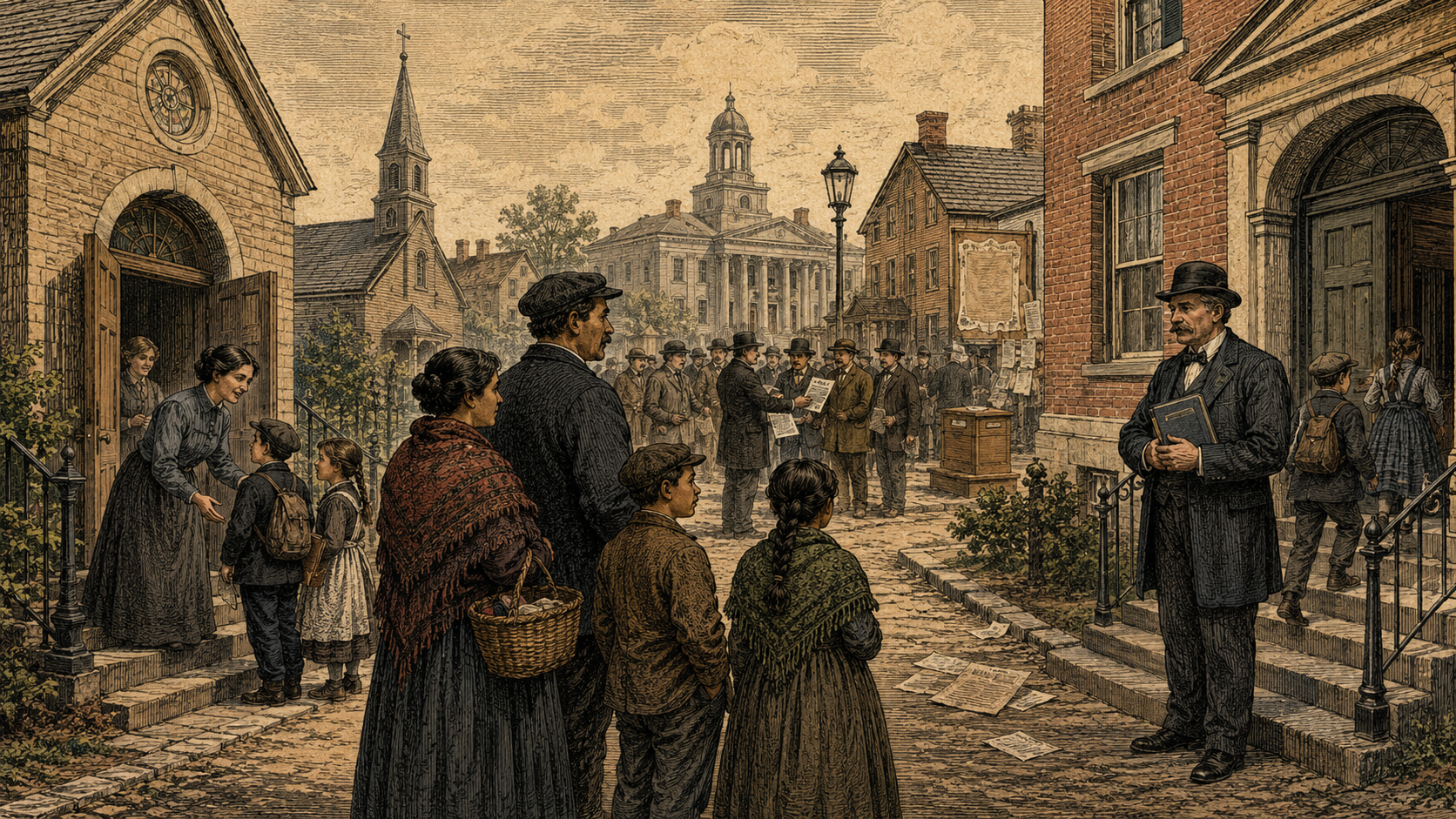
The public school became one of the most important battlegrounds.
Early common schools were often described as nonsectarian because they were not formally controlled by one Protestant denomination. But nonsectarian did not mean religiously neutral in the modern sense.
Schools frequently used the Protestant King James Bible, included prayer, and taught moral lessons shaped by majority Protestant culture. Catholic leaders objected that their children were being required to participate in religious instruction their church did not accept.
Catholic requests varied. Some families sought permission for children to be excused from Protestant Bible reading. Some church leaders wanted public support for Catholic schools. Others built independent parochial systems rather than rely on public institutions that they believed were Protestant in practice.
To many nativists, even a request for exemption looked like an attack on the Bible and the public school.
This was the contradiction at the center of the school conflict:
Disagreement over this arrangement contributed to the Philadelphia violence of 1844 and to decades of political conflict over school funding and religious instruction.
Catholic schools grew partly because Catholic communities wanted to preserve religious teaching. They also grew because many Catholic families did not trust public institutions to treat their children’s faith with respect.
Education became both a defense against exclusion and a new reason for outsiders to fear Catholic separation.
During the 1850s, anti-immigrant and anti-Catholic organizations formed a national political movement.
The best known became the American Party, commonly called the Know-Nothing Party because members of its secret organizations were expected to deny knowledge of their activities.
The movement argued that the country should be governed by native-born Protestants. It sought longer naturalization periods, restrictions on immigration, limits on foreign-born political power, and exclusion of Catholics from positions of influence.
A surviving 1854 membership questionnaire shows how closely the party connected citizenship, birthplace, religion, and political loyalty. Applicants were questioned about their ancestry, religious connections, and willingness to support the organization’s nativist program.
The Know-Nothings gained power because anti-Catholicism attached itself to wider political instability.
The established party system was weakening. Immigration was increasing. Cities were growing. Conflict over slavery was intensifying. Many voters distrusted political machines and feared that immigrants were being mobilized by urban party leaders.
Nativism offered a simple explanation: corrupt politicians, immigrant voters, and Catholic authorities were working together to take control of the country.
The movement did not replace the national conflict over slavery, and Know-Nothing coalitions differed by region. Some members opposed slavery, while others sought to avoid or suppress the issue. What held the movement together most clearly was the belief that native-born Protestant identity should carry greater political authority.
Abraham Lincoln, who opposed the movement, warned privately in 1855 that its logic narrowed the Declaration of Independence by excluding Black Americans, foreigners, and Catholics from its promise of equality.
The Know-Nothing Party declined as the slavery crisis reorganized national politics. The assumptions it promoted did not disappear with the party.
As Catholic school systems expanded, arguments over public funding intensified.
In 1875, Representative James G. Blaine proposed a federal constitutional amendment that would have prohibited public school funds from coming under the control of a religious sect. The proposal failed at the federal level, but many state constitutions adopted or already contained provisions limiting aid to sectarian institutions.
These provisions are often grouped together as “Blaine Amendments,” although their wording, dates, and historical origins differ.
The political context requires careful treatment.
There was a legitimate constitutional debate over whether government should finance religious instruction. Opposition to direct public funding of churches did not begin with 19th-century anti-Catholicism, and not every supporter of a no-aid provision was motivated by hostility toward Catholics.
At the same time, “sectarian” was frequently used in 19th-century political debate to mean Catholic. Public schools could retain Protestant practices while Catholic schools were classified as the institutions improperly mixing religion with education.
Anti-Catholic nativism was therefore part of the environment in which many school-funding restrictions developed, even though the purpose and history of each state provision must be examined separately. The disagreement remains visible in modern legal debates and in the different historical interpretations expressed by Supreme Court justices.
The larger mechanism extended beyond one failed amendment.
Majority religious practices were treated as civic culture. Minority religious institutions were labeled sectarian. That labeling affected which schools appeared public, which appeared foreign, and which could seek support from the state.
Catholic communities did not respond only through electoral politics.
They created an extensive institutional world:
These institutions helped families survive discrimination and preserve faith, language, and cultural practices.
They also made Catholic communities more visible and sometimes more separate from Protestant public life. Nativists then treated that separation as evidence that Catholics refused to assimilate.
The system became self-reinforcing.
Catholics built separate institutions because majority institutions were hostile. Their separate institutions were then cited as proof that Catholics were not fully American.
The targets of anti-Catholicism changed as immigration changed.
Irish Catholics were central to the nativism of the 1840s and 1850s. German Catholics also built distinct schools, parishes, and newspapers. Later immigrants from Italy, Poland, Slovakia, Lithuania, Croatia, and other parts of southern and eastern Europe expanded the cultural and linguistic diversity of American Catholicism.
Critics connected Catholic immigrants to urban poverty, alcohol, labor unrest, political machines, radicalism, and supposedly inferior national cultures.
The objection was often framed as religious, but it also carried racial and class assumptions.
European immigrant groups were not always regarded as equally white, equally civilized, or equally capable of self-government. Over generations, many were increasingly incorporated into American whiteness and political life. Their acceptance did not occur simply because religious prejudice faded. It also reflected changing racial boundaries, intermarriage, economic mobility, military service, political organization, and restrictions that reduced later immigration.
Mexican Catholics and other Latino Catholics followed a different historical path. Many lived in lands incorporated into the United States after war and territorial expansion. Their religious traditions predated U.S. rule, yet Anglo-American officials and religious leaders often treated them as culturally backward or insufficiently American.
Anti-Catholicism could therefore operate differently depending on who the Catholic person was.
Religion did not erase race, and shared religion did not guarantee equal treatment within Catholic institutions.
The revived Ku Klux Klan of the 1910s and 1920s expanded the definition of its enemies beyond the first Klan’s central campaign against Black freedom.
The second Klan remained committed to white supremacy. It also promoted a vision of native-born, white Protestant Americanism directed against Catholics, Jews, immigrants, and other groups portrayed as threats to the nation.
Klan organizers tailored their message to local prejudice. In some areas they emphasized opposition to Black political and social equality. Elsewhere they focused heavily on Catholic immigration, parochial schools, alcohol, or fear of papal influence.
A National Park Service historical study documents how Klan lecturers adapted their appeals to local targets and identifies Catholics as a central focus in parts of the country.
The Klan’s appeal was not limited to secret nighttime violence.
It operated through elections, newspapers, boycotts, churches, fraternal networks, public parades, and campaigns for control of school boards and local offices. It presented exclusion as respectable civic reform.
Its language of “100 percent Americanism” made religious identity a test of national authenticity.
The implied equation was clear:
Protestantism was American loyalty. Catholicism was divided loyalty.
In 1928, New York Governor Alfred E. Smith became the first Catholic presidential nominee of a major party.
Smith’s religion became one of the campaign’s defining issues.
Opponents circulated claims that a Catholic president would answer to the Vatican, undermine Protestant institutions, or bring church control into the federal government. Rumors imagined physical and political connections between Rome and Washington. Some attacks also drew on hostility toward Smith’s urban identity, immigrant supporters, opposition to Prohibition, and association with New York’s Democratic political organization.
Smith did not lose solely because he was Catholic. The country was prosperous under Republican leadership, regional party loyalties mattered, and his positions created opposition independent of religion.
But anti-Catholicism was unmistakably part of the campaign. The hostility showed that even a governor and major-party nominee could still be required to prove that his faith was compatible with constitutional government.
The election demonstrated how religious prejudice could work without a formal religious test.
The Constitution did not bar a Catholic from the presidency.
Voters and political organizations could still treat Catholic identity as a practical disqualification.
John F. Kennedy encountered the same fundamental suspicion during the 1960 presidential campaign.
Anti-Catholicism had weakened since 1928, but it remained politically significant. Critics again questioned whether a Catholic president would act independently of church authority.
Kennedy responded most famously in an address to Protestant ministers in Houston.
He argued that his public decisions would be governed by the Constitution and the national interest, not by instructions from Catholic officials. He also framed the issue as broader than his own candidacy: a country that allowed religious identity to become a political test could turn the same suspicion against another faith in the future.
The speech was effective partly because Kennedy accepted the burden of reassuring the majority.
That was progress and evidence of the remaining inequality at the same time.
A Protestant candidate was rarely asked to explain whether clergy or religious conviction would control every official decision. Kennedy had to establish that his Catholicism would remain appropriately private before many voters would consider him fully independent.
His election broke an important barrier. It did not erase the history that made the barrier possible.
Irish immigrants and their descendants were among the most visible targets of 19th-century anti-Catholicism.
They entered cities where housing was crowded, wages were low, and political competition was intense. Their Catholic identity was used to interpret nearly every aspect of their lives: poverty became evidence of cultural inferiority, voting became evidence of clerical control, and community organization became evidence of refusal to assimilate.
Later Catholic immigrants encountered similar suspicions shaped by their own languages, regions, occupations, and racial classification.
Italian Catholics might be portrayed as criminal or politically radical. Polish and other Slavic Catholics could be described as uneducated and unfit for democratic government. German Catholic schools and language institutions drew suspicion during periods of war and nationalism.
Children experienced these conflicts directly.
They could be disciplined for refusing Protestant Bible reading, pressured to hide their faith, or required to choose between a public school that did not respect Catholic practice and a parochial school their family had to support in addition to paying taxes.
Nuns occupied a particularly charged place in anti-Catholic imagination.
They were visible representatives of a church hierarchy and women living outside the dominant model of marriage and family life. Convents were described by critics as secretive spaces where women were confined, abused, or controlled.
Sensational stories could spread widely even when evidence was weak or absent.
This made women religious and the institutions they operated vulnerable to rumor and attack. The destruction of the Ursuline convent near Boston showed how quickly supposed concern for captive women could become violence against women, students, and a religious minority.
At the same time, women religious became central builders of Catholic institutional life. They staffed schools, hospitals, orphanages, and charities at a scale that made Catholic communities more resilient and more visible.
Latino Catholic history does not fit neatly into a European immigration narrative.
Spanish and Mexican Catholic communities existed in the Southwest before U.S. annexation. After the Treaty of Guadalupe Hidalgo, Mexican Catholics experienced political conquest, land loss, cultural displacement, and the disestablishment of institutions that had once held public authority.
Their Catholicism could be criticized by Anglo Protestants as foreign even though it had deeper roots in the region than the institutions doing the criticizing.
Latino Catholics also experienced prejudice within the Catholic Church. Some were segregated into separate parishes or treated as culturally inferior by European American clergy and parishioners.
This history complicates any claim that Catholic belonging created one equal community.
A person could face anti-Catholicism from outside the church and racial or ethnic exclusion within it.
Catholics were never politically or socially uniform.
Wealthy Catholics and poor Catholics did not experience prejudice in the same way. A prominent officeholder could answer accusations through newspapers and speeches. A domestic worker, miner, factory laborer, or newly arrived family had fewer resources.
Black Catholics faced anti-Black racism in the wider country and within Catholic institutions. Native people encountered Catholicism through histories that included missions, coercion, conversion, adaptation, community leadership, and resistance. Catholic organizations could advocate for immigrants and workers while also participating in segregation or paternalistic treatment of other communities.
This distinction matters because a history of religious exclusion can become misleading if it presents all Catholics only as victims.
Catholics could be excluded from American power while some Catholic individuals and institutions still participated in racial, colonial, or economic systems that harmed others.
The history of prejudice does not require turning a diverse community into an innocent or unified bloc.
Formal and cultural barriers to Catholic participation declined substantially during the 20th century.
Catholics entered universities, professions, suburban communities, elected office, the military, labor leadership, and national institutions in growing numbers. Kennedy’s election demonstrated that Catholic identity no longer operated as an absolute barrier to the presidency.
The change was real.
Catholicism is no longer generally treated as an inherently foreign religion in mainstream American political life. Catholic schools, hospitals, charities, universities, and civic organizations are long-established parts of the national landscape.
But acceptance did not mean that every old question disappeared.
Debates continued over whether a candidate’s faith should affect public judgment, whether Catholic institutions should receive public funds, and how religious doctrine should relate to law and public service.
The conflict over Catholic schools left a durable constitutional legacy.
Modern disputes do not reproduce the 1840s exactly. Public schools are no longer permitted to impose Protestant Bible reading as a religious exercise, and today’s religious-school cases involve a much more religiously diverse country.
Yet the old distinction between public, sectarian, and religious education remains important.
In Espinoza v. Montana Department of Revenue in 2020, the Supreme Court held that a state could not exclude schools from an otherwise available public-benefit program solely because of their religious status.
In Carson v. Makin in 2022, the Court held that Maine could not exclude religious schools from a tuition-assistance program that paid for students to attend other private schools in districts without public secondary schools.
Those decisions did not require every state to create private-school funding programs.
They established that when a state chooses to provide certain benefits to private institutions, excluding an otherwise eligible institution merely because it is religious can violate the Free Exercise Clause.
Supporters view this as protection against religious discrimination. Critics worry that it weakens the separation between public funding and religious instruction.
The continuing disagreement shows why the 19th-century history cannot be reduced to a simple slogan.
The country is still balancing two commitments:
The accusation that Catholics could not be fully loyal to the United States lost much of its political force.
The underlying structure of the accusation remains recognizable.
A minority religion is linked to a foreign place or authority. Its members are treated as a coordinated bloc. Their beliefs are assumed to override independent judgment. Ordinary religious practices are recast as evidence of political danger.
That pattern has been applied to different religious communities at different moments.
The histories are not interchangeable. Anti-Catholicism, antisemitism, anti-Mormonism, Islamophobia, and persecution of smaller religious groups each developed through distinct institutions and events.
The comparison lies in the mechanism: majority culture can mistake unfamiliar belief for divided loyalty.
Anti-Catholicism declined partly because Catholics demonstrated loyalty, built political influence, gained economic security, and became familiar neighbors and coworkers.
But that explanation can place too much responsibility on the targeted minority.
Catholics did not earn constitutional equality by proving that every stereotype was false. Religious freedom should not depend on whether a minority becomes culturally comfortable to the majority.
The deeper change occurred when more Americans accepted that religious difference did not need to disappear before citizenship could be complete.
That is the modern echo of the history.
The essential civic question is not whether a religious minority can prove it resembles the majority.
It is whether public institutions can make room for genuine difference without turning difference into evidence of disloyalty.
Anti-Catholicism reveals how national identity can operate beneath constitutional language.
The United States formally prohibited religious tests for federal office. Yet political culture repeatedly created informal tests.
Catholics were expected to prove that they could think independently, respect the Constitution, support public education, and place civic duty above religious command. These were reasonable expectations for every officeholder and citizen.
The inequality lay in assuming that Catholics were uniquely unlikely to meet them.
The public-school conflict reveals a related lesson.
Institutions controlled by a majority can understand themselves as neutral even when they reflect the majority’s customs. Protestant Bible reading could appear nonsectarian because Protestantism was culturally dominant. Catholic schools appeared sectarian because Catholic practice was visibly different.
Neutrality was not simply the absence of a formal church.
It depended on whose religion was visible and whose had become embedded in the ordinary workings of public life.
The history also complicates the idea of assimilation.
Catholic communities became more accepted partly by adopting English, moving into broader institutions, gaining economic security, and emphasizing national loyalty. They also changed the country by preserving parishes, schools, holidays, devotional practices, labor organizations, and ethnic communities.
They did not become American only by abandoning difference.
Their presence expanded the definition of what American life could include.
That expansion was incomplete and uneven. European Catholics gained access to whiteness and political power in ways that did not automatically extend to Black, Latino, Native, or Asian communities. Catholic institutions could resist one form of exclusion while participating in others.
That complexity makes the history more useful, not less.
Anti-Catholicism shows that religious freedom is not secured merely by declaring that everyone may believe privately.
It requires examining who may build institutions, attend school without religious coercion, hold office without a loyalty test, participate in public debate, and remain visibly different without being treated as foreign.
The fight over Catholic belonging was ultimately a fight over whether American identity would remain culturally narrow or become genuinely plural.
Anti-Catholicism is prejudice, discrimination, or organized hostility directed toward Catholics, Catholic institutions, or Catholic belief. In the United States, it frequently overlapped with hostility toward immigrants, urban workers, foreign languages, parochial schools, and supposed papal influence.
The Know-Nothings were members of the American Party and related secret nativist organizations that rose during the 1850s. They promoted native-born Protestant political power and sought to restrict immigration, naturalization, and Catholic influence.
Many early public schools included Protestant Bible reading and prayer while describing themselves as nonsectarian. Catholic families objected to Protestant religious instruction and created parochial schools, leading to conflicts over exemptions, curriculum, and public funding.
The Blaine Amendment was a proposed 1875 amendment to the U.S. Constitution that would have restricted public school funds from going to institutions controlled by religious sects. It failed federally, but the term is now commonly applied to various state constitutional no-aid provisions. Their histories differ, and scholars and courts continue to debate how closely each is connected to 19th-century anti-Catholicism.
No. Kennedy’s 1960 election broke a major political barrier and showed that a Catholic could win the presidency. It did not eliminate religious prejudice or settle continuing debates over religious identity, public office, education, and church-state relations.
Religious Conflict and Discrimination
Library of Congress
https://www.loc.gov/classroom-materials/immigration/irish/religious-conflict-and-discrimination/
A concise overview of anti-Irish and anti-Catholic hostility, including church burnings and the Philadelphia violence of 1844.
Examiner’s Questions for Admittance to the American—or Know-Nothing—Party
Library of Congress
https://www.loc.gov/item/mcc.062/
A primary-source artifact showing how the Know-Nothing movement connected religion, ancestry, citizenship, and political loyalty.
Lincoln on the Know-Nothing Party
National Park Service
https://www.nps.gov/liho/learn/historyculture/knownothingparty.htm
Provides Lincoln’s 1855 response to the Know-Nothings and useful context on the party’s anti-immigrant politics.
American Latino Theme Study: Religion
National Park Service
https://www.nps.gov/articles/latinothemereligion.htm
Expands the history beyond European immigration by tracing the older roots and changing experiences of Latino Catholic communities.
John F. Kennedy and Religion
John F. Kennedy Presidential Library and Museum
https://www.jfklibrary.org/learn/about-jfk/jfk-in-history/john-f-kennedy-and-religion
Explains the anti-Catholic politics surrounding Alfred E. Smith and Kennedy and the continuing loyalty question in the 1960 election.
Address to the Greater Houston Ministerial Association
John F. Kennedy Presidential Library and Museum
https://www.jfklibrary.org/archives/other-resources/john-f-kennedy-speeches/houston-tx-19600912-houston-ministerial-association
The transcript of Kennedy’s major campaign address on Catholic identity, church-state separation, and public office.