
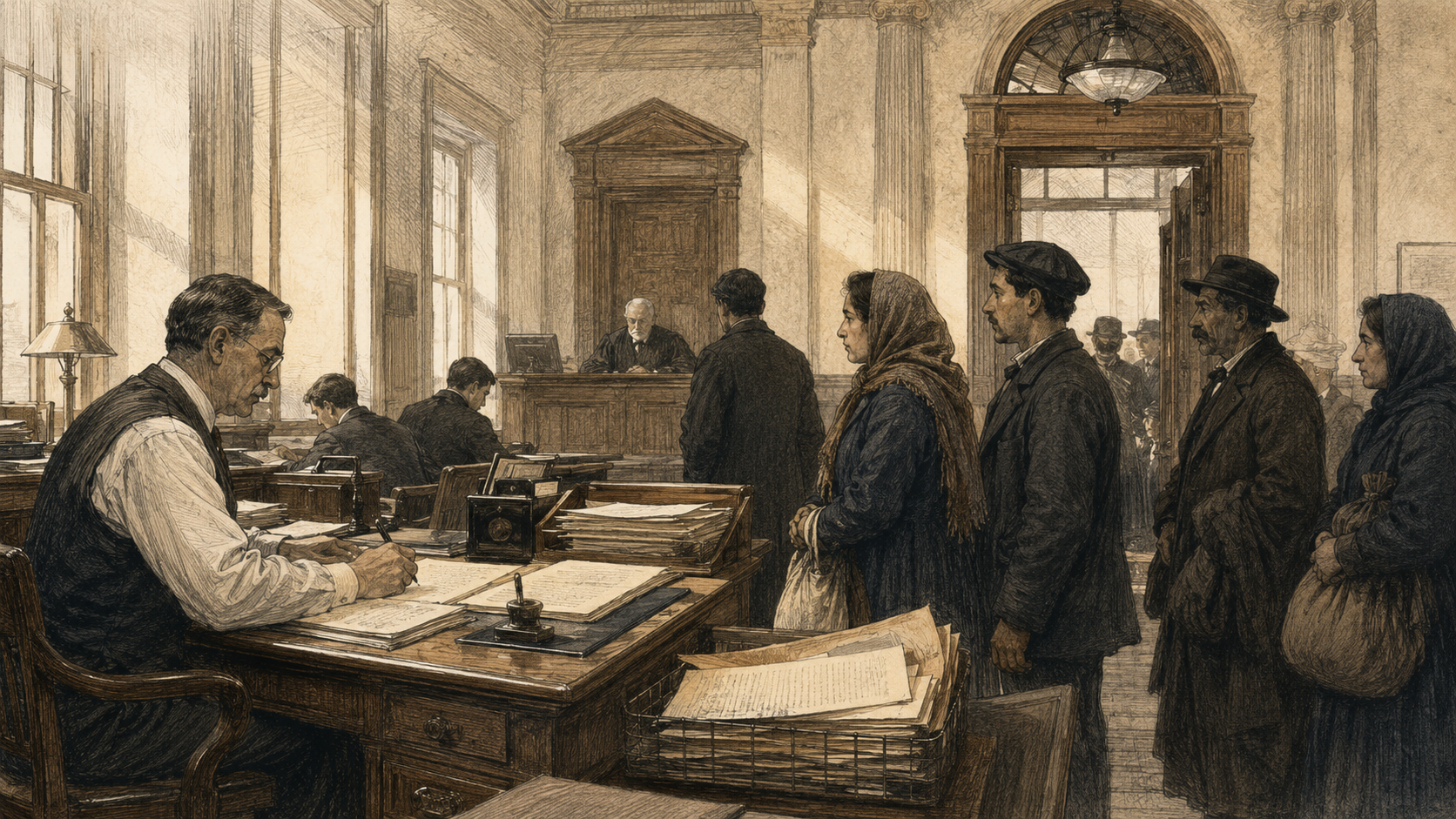
Citizenship sounds like a legal status.
It is. But in American history, it has also been a boundary line: a way of deciding who could belong fully, who could own certain kinds of property, who could vote, who could travel more securely, who could petition for family members, and who could claim protection from the country they lived in.
For much of U.S. history, naturalized citizenship was not open to everyone.
The first federal naturalization law, passed in 1790, limited naturalization to “free white” immigrants of good character. That phrase did enormous work. It did not merely set a paperwork requirement. It tied the legal path to citizenship to race.
Over time, Congress and the courts had to decide what “white” meant. Was it skin color? Ancestry? Science? Common opinion? National origin? Assimilation? Religion? Language? Culture?
Those questions were not abstract. They shaped real lives. Immigrants who had lived in the United States for decades could be told they were still outside the national family. People who worked, paid taxes, raised children, served in the military, or built communities could still be denied naturalization because the law did not recognize them as racially eligible.
Naturalization law shows how citizenship was built not only through ideals, but through exclusions.
It asks a hard but important question:
Who got to become American by law, and who had to prove they belonged to a category the law was designed to protect?
The Constitution gave Congress power to create a uniform rule of naturalization. That meant the new federal government could decide how foreign-born people became U.S. citizens.
In 1790, Congress passed the first naturalization law. It allowed certain immigrants to become citizens after meeting residency and character requirements. But it also included a racial restriction: the applicant had to be a “free white” person.
That phrase reflected the racial order of the early republic.
The United States was founded in a world shaped by slavery, Indigenous dispossession, colonial expansion, property restrictions, gender hierarchy, and assumptions that political membership belonged mainly to white men. Citizenship, voting, land ownership, jury service, and officeholding were not identical rights, and they varied by state. But naturalization mattered because it created the federal path by which immigrants could enter the body politic.
The 1790 law did not define whiteness carefully. It assumed whiteness. That assumption was powerful because it placed the burden on everyone else. If a person was not considered white, the law did not have to explain much further. The door was simply not built for them.
The restriction remained central for generations.
In 1870, after the Civil War and the ratification of the Fourteenth Amendment, Congress expanded naturalization eligibility to “aliens of African nativity and to persons of African descent.” That was a significant Reconstruction-era change. It reflected the transformation brought by emancipation and the struggle to establish Black citizenship after slavery.
But the 1870 change did not create race-neutral naturalization. It expanded the category while preserving exclusion. White immigrants and people of African nativity or descent could naturalize. Many Asian immigrants could not. Native peoples occupied a separate and deeply complicated legal position shaped by tribal sovereignty, federal power, allotment, and citizenship laws that developed unevenly over time.
The result was a citizenship system that did not simply ask whether a person lived in the United States, followed the law, learned English, paid taxes, or intended to remain. It asked whether that person belonged to a legally favored racial category.
That is why naturalization became one of the places where the government turned race into paperwork.
The racial naturalization system worked through statutes, courts, immigration officials, local judges, federal agencies, and everyday documents.
It evolved over time, but several mechanisms stayed important.
The first mechanism was simple: naturalization law named whiteness as a condition of citizenship.
That meant racial classification was not just a social judgment. It became a legal requirement. A person’s eligibility could depend on how courts and officials understood racial identity.
For many European immigrants, this was not usually a courtroom problem. Irish, German, Italian, Jewish, Slavic, Greek, and other European immigrants often faced discrimination, nativism, religious prejudice, and questions about assimilation. But over time, most were treated as eligible for naturalization under the “white” category.
For many Asian immigrants, the situation was different. Chinese, Japanese, South Asian, Korean, Filipino, and other Asian immigrants often faced laws that treated them as outside the naturalization boundary.
This distinction mattered. Naturalization could affect property rights, legal security, voting access, family life, business ownership, and protection from deportation. Denying naturalization kept people permanently vulnerable even after years of residence.
Immigration restriction and naturalization restriction worked together.
The Chinese Exclusion Act of 1882 is a clear example. It barred most Chinese laborers from entering the United States and also directed courts not to admit Chinese immigrants to citizenship. This made Chinese immigrants legally excluded in two ways: entry was restricted, and naturalization was denied.
That pattern widened over time.
The United States built a larger Asian exclusion system through laws such as the Immigration Act of 1917, which created an Asiatic Barred Zone, and the Immigration Act of 1924, which used national origins quotas and excluded immigrants considered “aliens ineligible to citizenship.”
That phrase is important: “aliens ineligible to citizenship.”
It connected immigration policy to naturalization law. If a group was racially barred from citizenship, that status could then be used to restrict immigration, land ownership, and settlement.
In other words, the denial of naturalization did not stay in one legal box. It spread into other parts of life.
Because the law used racial language without a stable definition, courts became places where immigrants argued over the meaning of whiteness.
Naturalization petitions produced many racial prerequisite cases. Applicants from different backgrounds tried to show that they should be considered “white” under the law. Courts looked at skin color, ancestry, geography, common opinion, science, religion, language, and earlier decisions. The results were inconsistent because race itself was not a stable biological category. It was a social and legal construction being treated as if it were a clear rule.
Two Supreme Court cases show the contradiction especially well.
Takao Ozawa was born in Japan and had lived in the United States for many years. He graduated from school in California, lived in Hawaii, spoke English, raised his children in American schools, and argued that he had adopted American customs and values.
His case reached the Supreme Court in 1922.
Ozawa argued, in effect, that he should be eligible for naturalization. The Court disagreed. It held that the naturalization laws still limited eligibility to “free white persons” and people of African nativity or descent. The Court reasoned that “white person” referred to race, not individual character or assimilation.
That decision showed that assimilation was not enough. A person could live an American life and still be denied the legal status of American citizenship if the Court placed them outside the racial category the statute protected.
One year later, the Supreme Court decided United States v. Bhagat Singh Thind.
Bhagat Singh Thind was born in India, served in the U.S. Army during World War I, and was granted citizenship by a district court before the federal government challenged it. His argument relied partly on racial science of the time: if Indians from his background were classified as Aryan or Caucasian by some authorities, then he should qualify as white under the logic used in Ozawa.
The Court again said no.
In Ozawa, the Court had leaned toward the idea that white meant Caucasian. In Thind, the Court said that “free white persons” should be understood according to common speech and popular understanding, not technical racial science. Under that reasoning, Thind was not considered white for naturalization purposes.
The contradiction is the lesson.
When scientific classification excluded Japanese immigrants, the Court used science-like reasoning. When scientific classification might have included a South Asian applicant, the Court shifted toward “common understanding.” The boundary moved in whatever way preserved exclusion.
This is how whiteness operated as a legal category. It could appear objective, but it was flexible enough to protect power.
Being barred from naturalization did not only affect symbolic belonging.
It could affect land ownership. Several states passed alien land laws that restricted property ownership by people who were ineligible for citizenship. These laws especially targeted Japanese immigrants and other Asian communities. If federal law said a person could not naturalize, state law could use that status to limit ownership and economic stability.
It could affect family security. A naturalized citizen often had more legal tools to petition for relatives, travel, and claim protection.
It could affect voting. In many places, citizenship was tied to the right to vote, serve on juries, or hold public office.
It could affect dignity. People who had built lives in the United States were repeatedly told that contribution did not equal belonging.
This is why naturalization law belonged to everyday life. It shaped what people could build, protect, and pass on.
The racial naturalization system affected many communities, but not in identical ways.
Asian immigrants were among those most directly harmed. Chinese immigrants faced exclusion from immigration and naturalization beginning in the late 19th century. Japanese immigrants built families and businesses while being denied the ability to naturalize. South Asian immigrants faced contradictory racial reasoning in court. Filipino immigrants lived under the complications of U.S. empire, colonial status, migration, and later exclusion. Korean and other Asian immigrants also navigated a system that treated Asian identity as a barrier to full membership.
Black immigrants and people of African descent were affected differently. The 1870 expansion allowed naturalization for people of African nativity or descent, which mattered. But that did not mean Black citizenship was secure in practice. Reconstruction rights were attacked through violence, Jim Crow, voting restrictions, segregation, and unequal enforcement. Legal eligibility did not automatically create full protection.
Indigenous peoples were affected through a separate legal history. Native Nations had sovereign political relationships with the United States. Citizenship for Native people was not simply a matter of naturalization in the immigrant sense. Federal Indian policy, treaties, allotment, military service, and the Indian Citizenship Act of 1924 all shaped Native citizenship in different ways. This article centers immigrant naturalization, but it is important not to collapse Native citizenship into the same framework.
Mexican and Mexican American communities also experienced complex citizenship questions after territorial conquest. The Treaty of Guadalupe Hidalgo promised certain citizenship protections after the U.S.-Mexico War, but land claims, racial classification, language, local discrimination, and violence shaped whether those promises were respected. Many people were legally citizens while still treated as outsiders.
European immigrants were affected by nativism, religious prejudice, labor exploitation, and shifting ideas of acceptability. Catholics, Jews, Southern Europeans, Eastern Europeans, and others faced suspicion and discrimination. But most European immigrants were not barred from naturalization by the racial prerequisite in the same way Asian immigrants were. Over time, many became incorporated into American whiteness.
Women experienced naturalization law through gendered rules as well as racial rules. For long periods, a woman’s citizenship could be tied to her husband’s status. Marriage could affect citizenship in ways that did not apply equally to men. For women in racially excluded communities, gender and race could combine to make legal status especially fragile.
The system did not harm everyone in the same way. But it taught a consistent lesson: citizenship was not only about residence or loyalty. It was also about how the law classified the person asking to belong.
The explicit racial bars to naturalization are gone.
The Immigration and Nationality Act of 1952 eliminated race as a basis for naturalization eligibility, even while preserving other restrictive parts of the immigration system, including the national origins quota structure that favored some regions over others. Later reforms, especially in 1965, changed the immigration system further.
That matters. The law today is not the same as the law of 1790, 1882, 1922, or 1923.
But the history still matters because it shows how legal categories can shape belonging long after the words change.
Citizenship debates still often turn on questions of identity, loyalty, documentation, language, family, national origin, religion, security, and perceived assimilability. The old racial prerequisite is gone, but the habit of asking who is “really” American has not disappeared.
The history also helps explain why paperwork can feel different depending on the community involved. For some families, naturalization records are documents of arrival and inclusion. For others, immigration and citizenship records preserve interrogation, exclusion, surveillance, or denial.
It also helps explain why courts matter. Judges did not merely apply a neutral definition of race. They helped construct one. In Ozawa and Thind, the Supreme Court revealed that whiteness was not a stable scientific fact waiting to be discovered. It was a legal boundary maintained through interpretation.
That lesson reaches beyond naturalization.
Whenever law relies on categories that seem obvious, history asks us to look again. Who created the category? Who benefits from it? Who has to prove they fit? Who is excluded when the definition changes?
Naturalization and the law of whiteness show that citizenship has never been only a passport or certificate. It has been a mirror of how the country defined its national family.
This history matters because citizenship is one of the deepest forms of belonging a country can recognize.
To be a citizen is not only to hold a document. It is to stand inside a legal relationship with the nation. It affects protection, participation, movement, voting, family unity, property, employment, and security.
For generations, U.S. law tied that relationship to whiteness.
That does not mean every white immigrant had an easy path. Many faced poverty, prejudice, dangerous work, language barriers, and hostility. But the law still gave most of them an avenue that many nonwhite immigrants did not have.
The racial naturalization system shows how inequality can be built into a door before anyone approaches it. The question is not only whether someone met the requirements. The question is who was allowed to try.
That is the lesson.
When citizenship is racially defined, belonging becomes conditional by design. People can work, serve, pay taxes, raise children, build communities, and still be told they are outside the legal imagination of the nation.
Studying this history helps us understand that American identity was not only shaped by ideals of liberty and equality. It was also shaped by statutes, courtrooms, clerks, categories, and exclusions.
The law of whiteness did not simply describe who Americans were.
It helped decide who could become one.
The Naturalization Act of 1790 was the first federal law establishing a process for immigrants to become U.S. citizens. It limited naturalization to “free white” persons of good character who met residency requirements.
For much of U.S. history, naturalization eligibility was restricted by race. The law treated whiteness as a requirement for most immigrants seeking citizenship, later adding eligibility for people of African nativity or African descent while continuing to exclude many Asian immigrants.
In 1922, the Supreme Court ruled that Takao Ozawa, a Japanese immigrant who had lived in the United States for many years, was not eligible for naturalization because he was not considered white under the naturalization laws.
In 1923, the Supreme Court ruled that Bhagat Singh Thind, an Indian immigrant and U.S. Army veteran, was not eligible for naturalization. The Court rejected his argument that he qualified as white under racial classifications that treated some Indians as Caucasian or Aryan.
Race as a basis for naturalization eligibility was eliminated by the Immigration and Nationality Act of 1952. However, immigration law still contained other restrictive systems, including national origins quotas, until later reforms.
U.S. Capitol Visitor Center — H.R. 40, Naturalization Bill, March 4, 1790
https://www.visitthecapitol.gov/artifact/h-r-40-naturalization-bill-march-4-1790
A useful source on the first federal naturalization bill and how the early United States limited naturalization to white immigrants.
National Archives DocsTeach — Naturalization Act of 1790
https://docsteach.org/document/naturalization-act-of-1790/
A primary-source teaching page that shows the 1790 naturalization language and its “free white person” requirement.
National Archives — Race, Nationality, and Reality
https://www.archives.gov/publications/prologue/2002/summer/immigration-law-1
A strong source on racial prerequisite cases, the 1870 expansion to people of African nativity or descent, and the relationship between Chinese exclusion and naturalization.
Justia U.S. Supreme Court Center — Ozawa v. United States
https://supreme.justia.com/cases/federal/us/260/178/
A direct source for the 1922 Supreme Court decision that denied naturalization to Takao Ozawa.
Justia U.S. Supreme Court Center — United States v. Bhagat Singh Thind
https://supreme.justia.com/cases/federal/us/261/204/
A direct source for the 1923 Supreme Court decision that interpreted “free white persons” through popular racial understanding rather than scientific classification.
Densho Encyclopedia — Immigration Act of 1952
https://encyclopedia.densho.org/Immigration_Act_of_1952/
A useful source on the 1952 law, including its elimination of race as a basis for naturalization and its continuing restrictions.