
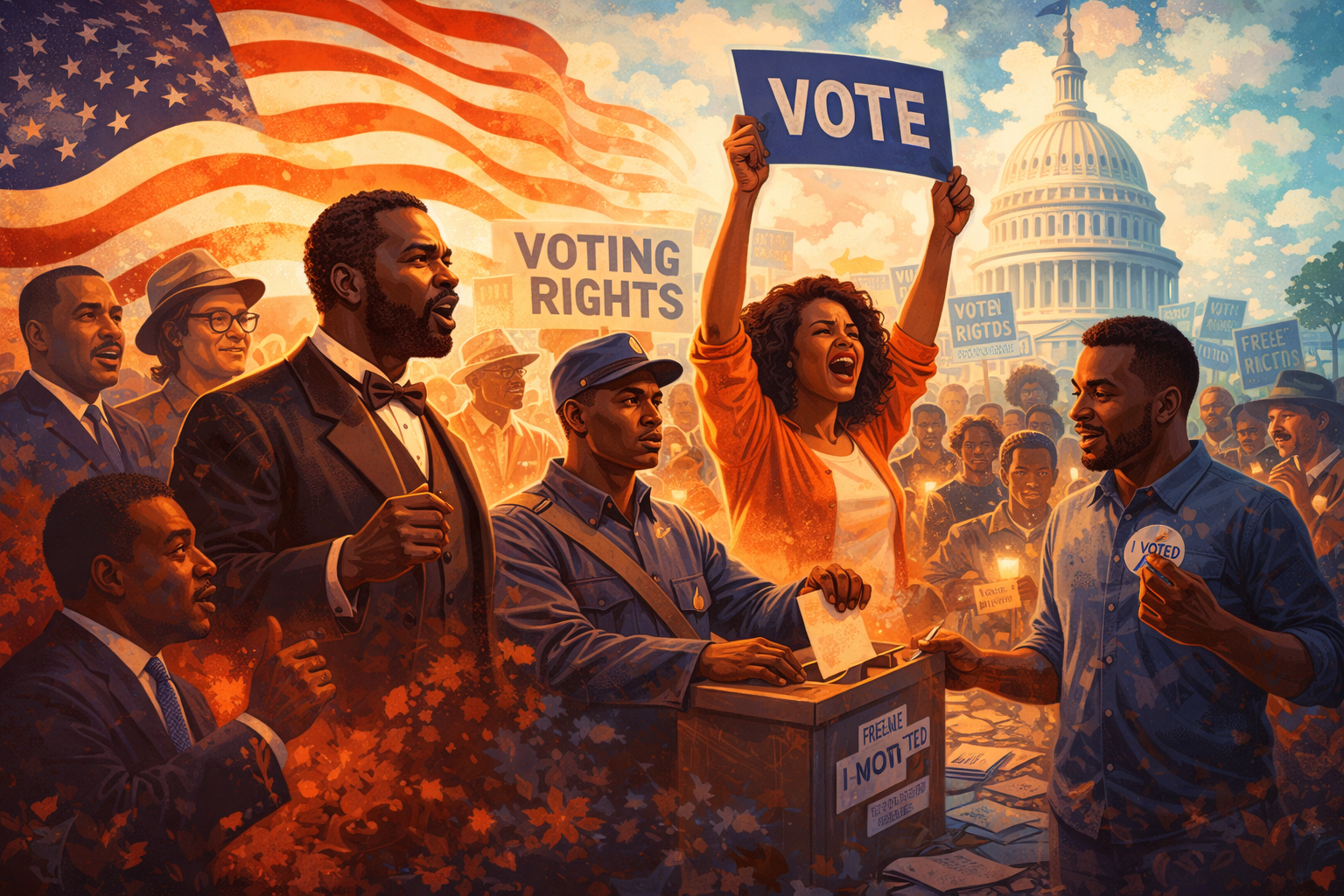
American democracy is often described as something that was created and then defended.
Historically, it has been something that was expanded.
From the nation’s founding onward, the boundaries of who could participate—who could vote, hold office, organize, and be represented—were narrow and contested. Again and again, those boundaries widened not through consensus, but through struggle.
Black Americans have been central to that expansion. Not as a side story, but as a driving force.
At the founding of the United States, democratic participation was restricted by design. Voting rights were typically limited to white men with property. Enslaved people were excluded entirely. Free Black people faced legal and informal barriers even where voting was technically permitted.
This was not an oversight. It reflected prevailing assumptions about who was considered capable of self-government and whose interests democracy was meant to serve.
From the start, Black Americans understood democracy not as a settled system, but as an unfinished one—defined as much by exclusion as by promise.
Each major expansion of democratic participation in the United States has been accompanied by Black political organizing—and by backlash.
After the Civil War, Black Americans voted, held office, and helped write new state constitutions. This brief period of multiracial democracy was followed by systematic retrenchment: new laws, intimidation, and violence designed to narrow the electorate again.
In the twentieth century, Black Americans organized to dismantle legal segregation and voter suppression. Their efforts reshaped constitutional law and electoral access—but those gains were repeatedly met with new restrictions framed as administrative, neutral, or necessary for “order.”
Democracy expanded not in a straight line, but through cycles of inclusion and contraction.
Black Americans bore the greatest cost of exclusion and the greatest burden of expansion.
Voting often came with risk: job loss, harassment, violence, or worse. Political participation required collective protection—churches, community organizations, and networks that could absorb retaliation.
Other groups also benefited from these expansions. Immigrants, women, working-class white Americans, and young voters gained access to democratic participation through reforms Black Americans helped secure.
The impact was broad. The cost was not evenly shared.
Today, debates over democracy often focus on procedure—registration rules, district boundaries, eligibility requirements. These are framed as technical questions, separate from history.
But the patterns persist.
Changes to voting access continue to follow lines of power and threat perception. Communities that organize effectively are often met with new constraints. Participation is expanded in principle, then managed in practice.
Understanding Black Americans’ role in expanding democracy helps explain why access remains contested—and why neutrality in language does not guarantee neutrality in outcome.
Democracy in the United States did not grow because exclusion became inconvenient. It grew because people who were excluded insisted on participation.
Black Americans did not simply seek inclusion for themselves. They helped redefine what democracy meant—broadening the electorate, strengthening civil rights, and reshaping representation.
Recognizing this history challenges a common narrative: that democracy naturally progresses on its own. Instead, it reveals democracy as something built, defended, and expanded through sustained civic effort.
Democracy and Voting Rights
Reconstruction and Democratic Expansion
Civil Rights and Political Participation
Black Americans have been central to every meaningful expansion of American democracy—not because they were granted power willingly, but because they organized to claim it.
Every Chapter Counts tells these stories to restore context, not to claim ownership of democracy, but to recognize how it has been shaped.
When we understand who carried the burden of expansion, we better understand what democracy requires to endure.