When the Civil War ended, freedom arrived before stability.
Millions of formerly enslaved people were no longer legally owned, but that did not mean they suddenly had land, wages, schools, legal protection, reunited families, or safe communities. Freedom had to be made practical. It had to be defended in courts, workplaces, classrooms, hospitals, and local offices. It had to survive in places where many former enslavers wanted the old order restored as quickly as possible.
That is where the Freedmen’s Bureau entered the story.
Its official name was the Bureau of Refugees, Freedmen, and Abandoned Lands. Created by Congress in 1865, it was one of the first major federal attempts to help formerly enslaved people move from slavery into citizenship. The Bureau did not remake the country on its own. It was underfunded, opposed, limited in time, and often inconsistent from place to place. But it still gives us a clear window into one of the central questions of Reconstruction:
What does freedom require after generations of forced labor, family separation, legal exclusion, and organized violence?
The Freedmen’s Bureau was created on March 3, 1865, just weeks before the Civil War ended.
The country was facing an enormous transition. Slavery had structured the Southern economy, local courts, family life, labor systems, land ownership, policing, and political power. When slavery collapsed, the question was not simply whether formerly enslaved people were “free.” The harder question was what freedom would mean in practice.
Formerly enslaved people were seeking several things at once:
The Bureau was placed inside the War Department, partly because the Army already had a presence across the defeated Confederacy. That mattered. In many communities, federal authority was the only institution with enough power to challenge local systems that had been built around slavery.
The Bureau served formerly enslaved people, but it also assisted poor white refugees and displaced people in the devastated South. Still, the central historical importance of the Bureau lies in its relationship to Black freedom. For the first time, the federal government was directly involved in helping millions of African Americans claim rights, build institutions, and document lives that slavery had tried to control or erase.
The Freedmen’s Bureau worked through field offices, agents, military personnel, teachers, superintendents, and local partnerships. Its work varied widely by state, county, staffing, local resistance, and the priorities of individual agents. In some places, it provided meaningful protection. In others, its reach was thin.
Its main work fell into several connected areas.
The war had destroyed farms, towns, transportation systems, and food supplies across much of the South. Many freedpeople had left plantations with little beyond what they could carry. Others were living in refugee camps, military zones, or temporary settlements.
The Bureau distributed rations, clothing, fuel, and medical aid. It operated hospitals and camps. This part of the work is sometimes described as charity, but it was more than that. Survival aid helped people bridge the dangerous gap between slavery and a new economic order.
Without food, shelter, or medical care, freedom could become a crisis almost immediately.
Education was one of the Bureau’s most important legacies.
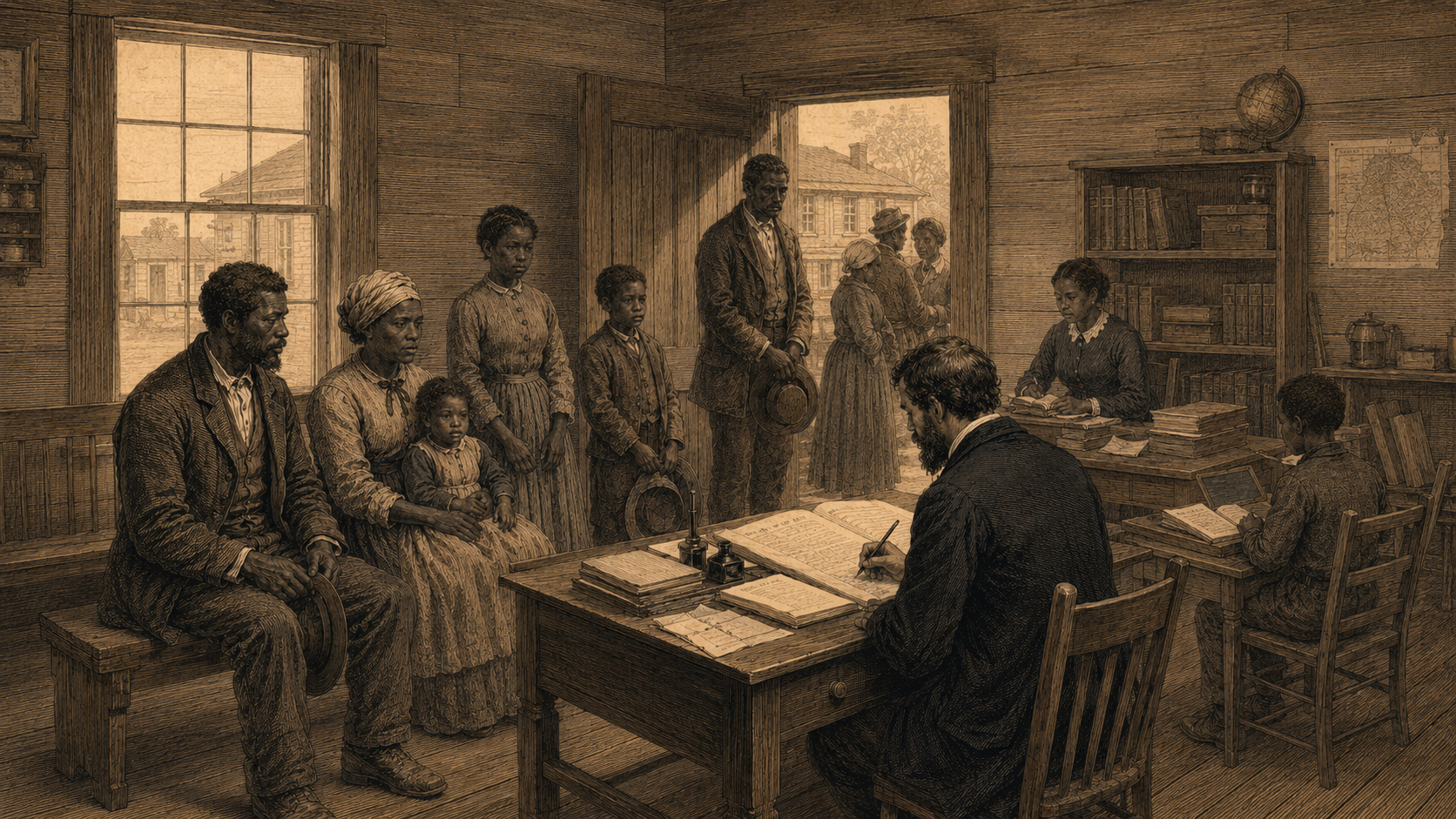
Formerly enslaved people had long been denied education by law, custom, and violence. After emancipation, Black communities moved quickly to create schools. Parents, churches, mutual aid networks, northern aid societies, Black teachers, and Bureau officials all played roles.
The Bureau did not create Black education by itself. Black communities wanted education and organized for it. But the Bureau helped support schools, coordinate teachers, provide funding in some cases, and connect local efforts to a broader institutional framework.
Education mattered because literacy changed what freedom could mean. It helped people read contracts, write letters, study the law, teach children, organize churches, build businesses, and participate in civic life.
After slavery, labor became one of the most contested parts of freedom.
Former enslavers still needed workers. Formerly enslaved people needed wages, land, mobility, and protection from coercion. The Bureau often witnessed or supervised labor contracts between freedpeople and employers.
The goal was to replace forced labor with paid labor. But this was difficult. Employers often tried to recreate plantation discipline through yearly contracts, debt, threats, or local courts. Many freedpeople wanted land of their own rather than continued dependency on former enslavers.
Bureau agents sometimes helped workers challenge unpaid wages or unfair terms. But agents also sometimes pressured freedpeople into contracts because federal officials feared unemployment, disorder, or dependency. This tension is important. The Bureau was both a protective institution and a labor-regulating institution.
That is one reason its history is complicated. It helped people claim wages, but it also operated inside a political world that wanted the Southern economy stabilized quickly.
Slavery had denied legal recognition to many Black family relationships. Couples formed marriages, raised children, and maintained kinship networks, but slave law treated enslaved people as property. Families could be separated by sale, estate settlement, punishment, or forced migration.
After emancipation, the Bureau helped legalize marriages, record family relationships, and sometimes provide transportation for people trying to reunite with relatives.
These records matter deeply. They show people rebuilding family life after a system that had made family separation profitable. Marriage registers, transportation requests, letters, and complaints are not just bureaucratic documents. They are evidence of people insisting that their relationships deserved recognition.
The Bureau also became a place where freedpeople brought complaints.
These complaints could involve unpaid wages, violence, child apprenticeship, stolen property, contract disputes, assaults, custody issues, or intimidation. In some areas, Bureau agents served as a bridge between Black communities and legal systems that had never treated them as full participants.
This legal work was fragile. Local courts were often hostile. Bureau agents had limited authority. Political support in Washington shifted. White resistance could be organized and violent.
Still, the idea was significant: freedom required more than a proclamation. It required a place where people could make claims and expect someone with authority to listen.
The Bureau’s full title included “Abandoned Lands” because land was central to Reconstruction.
Many freedpeople understood that land ownership would provide independence. Land meant food, income, family stability, bargaining power, and something to pass down. Without land, many families would be pushed back into working for former enslavers under new forms of dependency.
The original law allowed the Bureau to manage certain abandoned or confiscated lands. But large-scale land redistribution did not last. Much land was restored to former Confederate owners, and many Black families were left to negotiate labor contracts or enter sharecropping arrangements.
This was one of Reconstruction’s defining failures. Freedom without land made independence far more difficult.
The people most affected were formerly enslaved African Americans trying to build lives after generations of legal exclusion.
That included children entering school for the first time. It included adults seeking wages after lifetimes of forced labor. It included women trying to protect children from forced apprenticeship or exploitation. It included couples asking the law to recognize marriages that slavery had refused to honor. It included veterans seeking back pay or pensions. It included families searching for loved ones across states and counties.
The Bureau’s work also affected poor white Southerners who needed relief after the war. That matters because the postwar South was economically devastated across racial lines. But the conditions were not the same. Poor white people faced poverty and displacement; formerly enslaved Black people faced those hardships plus the legacy of enslavement, racial violence, legal exclusion, family separation, and efforts to force them back into dependent labor.
Black women were especially affected by the transition. They sought wages, family protection, education for children, legal marriage recognition, and relief from sexual and labor exploitation. They also navigated a labor system that often assumed Black women’s work remained available for white households and plantations.
Black children were also central to the Bureau’s records. Some were enrolled in schools. Others were caught in apprenticeship disputes, where white authorities or former enslavers tried to bind Black children to labor arrangements that looked far too much like slavery under another name.
The Bureau’s history reminds us that “freedpeople” were not an abstract group. They were parents, students, workers, veterans, widows, teachers, ministers, farmers, and children trying to turn legal freedom into daily life.
The Freedmen’s Bureau helps explain several later patterns in American history.
First, it shows that civil rights are difficult to protect without institutions. A right written on paper can be powerful, but people need schools, courts, offices, records, legal aid, transportation, and enforcement to make those rights real.
Second, it shows how quickly progress can be narrowed when political will fades. The Bureau operated in a period of intense conflict over Reconstruction. Its opponents argued over cost, race, federal power, labor, and the future of the South. As support weakened, many freedpeople were left to face hostile local systems with fewer protections.
Third, it helps explain why records matter. The Bureau created millions of documents: labor contracts, marriage records, school reports, hospital registers, ration lists, complaints, letters, and transportation requests. For many African American families, these records are among the first federal documents that name formerly enslaved ancestors.
That does not make the records perfect. They were produced by an institution with its own assumptions, limits, and power dynamics. But they remain essential because they preserve fragments of lives that slavery often refused to record fully.
Finally, the Bureau raises a question that still appears in public life: what does repair require after a system has caused long-term harm?
The answer is not simple. But the Bureau’s history suggests that repair is never only symbolic. It involves institutions, resources, enforcement, documentation, and time.
The Freedmen’s Bureau matters because it shows both the promise and limits of Reconstruction.
It was a remarkable experiment: a federal agency created to help people move from slavery toward citizenship. It supported schools, recorded marriages, witnessed contracts, distributed aid, helped families reconnect, and gave many freedpeople at least one place to bring complaints.
But it was also temporary, underfunded, politically contested, and often unable to overcome local resistance.
That combination is the lesson.
Freedom was not simply announced in 1865 and then naturally completed. It had to be built. It had to be defended. It had to be funded. It had to be enforced. Where those supports existed, Black communities built schools, families, churches, businesses, and political movements. Where those supports were withdrawn, older systems of control adapted.
The Freedmen’s Bureau does not tell a simple story of success or failure. It tells a more useful story: America briefly recognized that freedom required public responsibility, then struggled over how much responsibility the nation was willing to accept.
That struggle shaped Reconstruction. Its consequences lasted far beyond it.
The Freedmen’s Bureau was a federal agency created in 1865 to assist formerly enslaved people and refugees after the Civil War. It helped with relief, schools, labor contracts, legal issues, marriage records, family reunification, medical care, and abandoned lands.
It was one of the first major federal efforts to help formerly enslaved people move from slavery into citizenship. Its work showed that freedom required more than emancipation; it required institutions that could support rights in everyday life.
The Bureau had authority over some abandoned and confiscated lands, and land redistribution was briefly part of Reconstruction policy. But large-scale land redistribution did not last, and much land was returned to former Confederate owners. Many Black families were left without the land base they needed for economic independence.
The Bureau faced limited funding, political opposition, white resistance, and conflict over the role of the federal government in Reconstruction. It formally ended in 1872, though some functions related to veterans’ claims continued briefly through other offices.
They are among the most important sources for studying Reconstruction and African American family history. They include names, marriages, labor contracts, school reports, hospital records, complaints, and letters that help document lives often excluded or distorted by earlier records.
National Archives — The Freedmen’s Bureau
https://www.archives.gov/research/african-americans/freedmens-bureau
National Archives DocsTeach — The Freedmen’s Bureau
https://www.archives.gov/education/lessons/freedmen
U.S. Senate Historical Office — Freedmen’s Bureau Acts of 1865 and 1866
https://www.senate.gov/artandhistory/history/common/generic/FreedmensBureau.htm
National Museum of African American History and Culture — The Freedmen’s Bureau Records
https://nmaahc.si.edu/explore/initiatives/freedmens-bureau-records
National Museum of African American History and Culture — Freedmen’s Bureau Search Portal
https://nmaahc.si.edu/explore/freedmens-bureau
Freedmen and Southern Society Project, University of Maryland — Law Creating the Freedmen’s Bureau
https://www.freedmen.umd.edu/fbact.htm