When voting access is discussed, attention often centers on courts, legislatures, and national laws.
But much of the work that makes participation possible happens closer to the ground.
Across American history, local organizers have played a critical role in protecting voter access—especially during periods when formal safeguards were weak, unevenly enforced, or actively contested. Their work rarely makes headlines, but it has shaped who is able to participate and how consistently access is maintained.
Understanding this role helps explain why voting access is not sustained by law alone.
Local organizing around voting access predates many modern voting laws.
During Reconstruction and the Jim Crow era, Black communities relied on churches, mutual aid societies, and civic groups to share information, accompany voters, and respond collectively to intimidation. When formal protection was absent or unreliable, community networks filled the gap.
These efforts were not about expanding rights in theory. They were about making existing rights usable in practice.
The pattern repeated across regions and generations: when access was threatened locally, protection emerged locally.
Local organizers operate within—and around—formal systems.
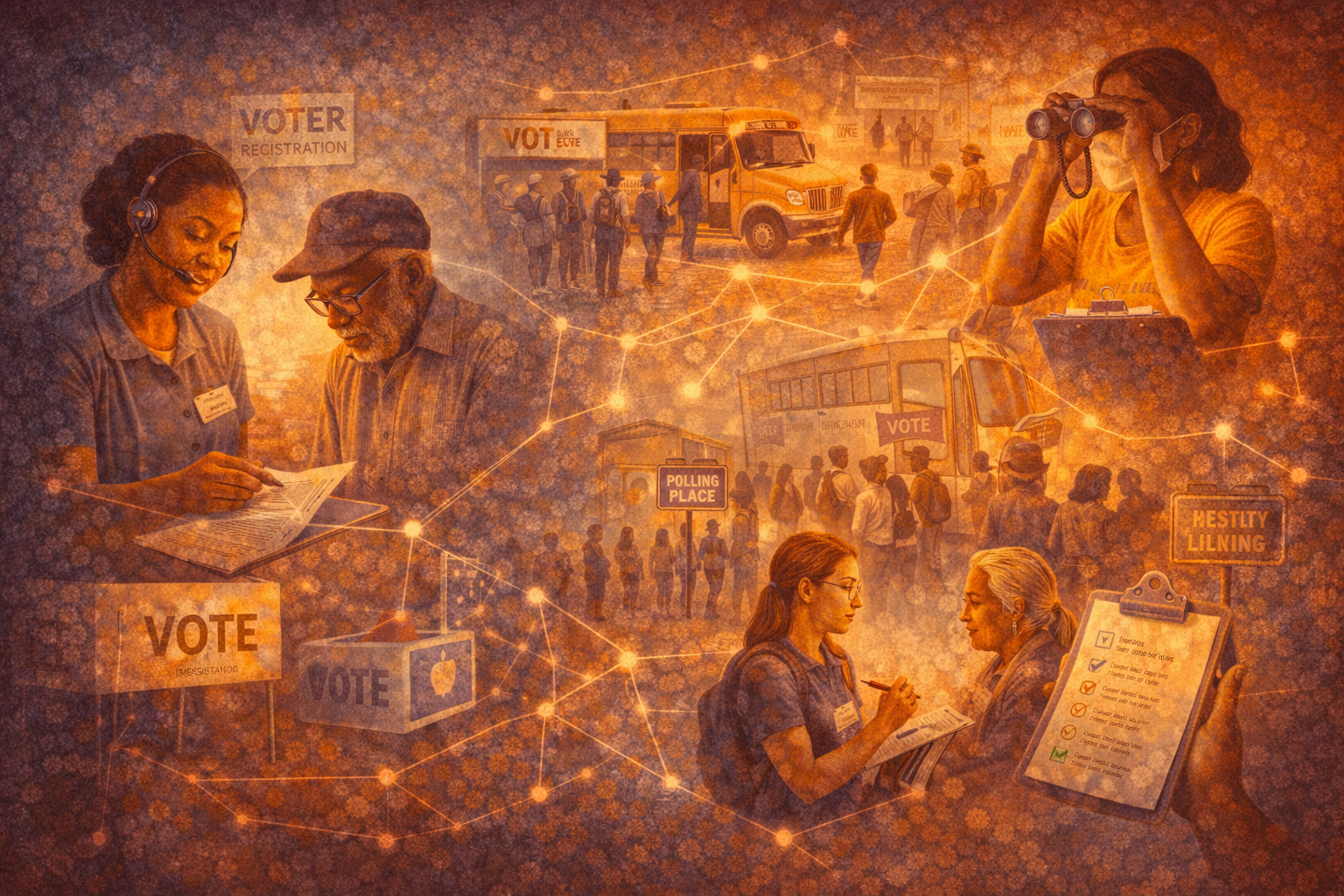
Their work often includes:
These activities do not replace law. They interact with it.
By reducing friction, providing information, and increasing visibility, organizers help ensure that procedural rules do not quietly become barriers.
Communities most affected by voting restrictions have also been most active in protecting access.
Black Americans developed extensive local organizing traditions rooted in churches, schools, and civic associations.
Immigrant communities often rely on language-access organizers and community-based groups to navigate registration and ballot processes.
Rural and low-income communities have organized around transportation, polling access, and administrative complexity.
Students and young voters have built networks to respond to changing eligibility and residency rules.
The common factor is proximity: those closest to the barriers are often closest to the solutions.
Even with federal and state protections in place, access can vary by location.
Polling site changes, equipment shortages, registration errors, and administrative confusion often occur locally. Legal remedies may take time. Elections do not pause.
Local organizers provide immediacy. They respond in real time, often with limited resources, adapting to conditions as they arise.
Their role has become especially visible during periods of rapid rule changes or heightened administrative complexity—when access depends as much on navigation as on eligibility.
Local organizing reveals an important truth about democracy: access is sustained through practice, not just policy.
Laws define rights. Institutions enforce them unevenly. Communities absorb the difference.
Recognizing the role of local organizers helps explain why voting access has persisted even during periods of retrenchment—and why participation often reflects local capacity as much as national law.
Local organizers protect voter access not by changing laws, but by making participation possible under the laws that exist.
Every Chapter Counts examines these roles to understand how democracy functions day to day—not only through institutions, but through people responding to conditions where they live.
Access is not abstract. It is maintained locally, one election at a time.