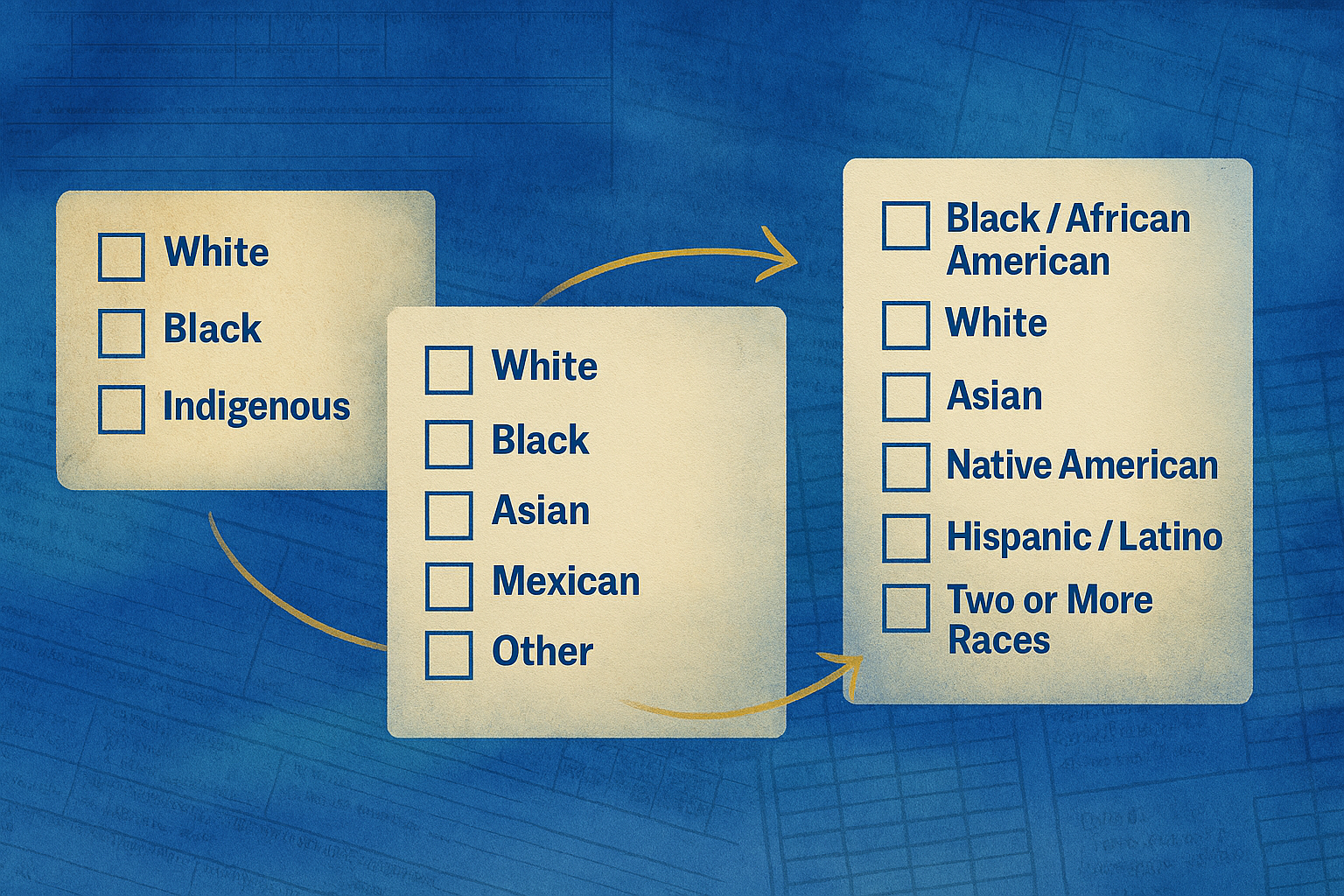
One of the biggest myths in American history is the idea that racial categories have always been fixed. But if you look at the historical record, you find something very different: the categories changed constantly.
“White,” “Black,” “Mulatto,” “Colored,” “Indian,” “Asian,” “Mexican,” “Quadroon,” “Octoroon,” “Brown,” “Other,” “Hispanic,” “Latino,” “Middle Eastern,” “North African,” “Two or More Races” — none of these categories existed all at once, and none of them stayed the same.
Instead, America kept redrawing the lines depending on the politics, the economy, the census, and the fears of the moment.
When you zoom out, something powerful becomes clear: racial categories weren’t discovered — they were negotiated. Designed. Revised. Rewritten.
And that story reveals a lot about how identity has been shaped in America.
Early on, racial lines were not as rigid. Colonists described people by nation, religion, or status — not fixed racial identity. “White” didn’t solidify until labor systems demanded clearer categories.
As slavery expanded, lawmakers invented increasingly sharp divisions. New terms appeared:
The point wasn’t accuracy — it was control.
Some states rewrote the categories again, enforcing the “one-drop rule” and redefining who counted as “white.” People with very distant African ancestry were reclassified without their consent.
The census removed “Mulatto” and folded more people into the category “Black,” tightening boundaries even further.
Italians, Irish, Jews, and Eastern Europeans — once considered separate or “in-between” — were absorbed into “white,” a category that expanded over time.
Meanwhile, Asian American categories split and re-formed:
“Hispanic” appeared as an ethnicity, not a race — but many people’s lived experiences didn’t fit those boxes neatly.
For the first time, Americans could officially identify as multiracial — acknowledging identities that had always existed but had never been counted.
People from MENA countries have been categorized as “white” for decades, but the census is re-evaluating this, and the lines are shifting yet again.
Spoiler: almost everyone.
Census changes, one-drop laws, and shifting terminology reshaped identity, legal rights, and community boundaries.
Federal and state governments repeatedly altered definitions of “Indian,” “Native,” or “tribal citizen,” impacting land rights, sovereignty, and census recognition.
Irish, Jewish, Italian, Arab, Mexican, Puerto Rican, Caribbean, and Asian migrants were all classified differently depending on the era — often with major consequences.
They were the most disrupted: siblings classified differently, families split across categories, identities erased or reassigned for legal convenience.
“Whiteness” expanded in ways that often benefited some Europeans while excluding others for decades.
These shifts weren’t random — they were built around economics, politics, and power.
Even though the categories keep changing, the habits built around them linger:
Today’s categories might be more flexible — but the structures built on old ones can be surprisingly stubborn.
Understanding how racial categories shifted helps us see that:
Seeing the history clearly lets us understand today’s debates without confusion — and without falling into myths that have been used to divide people for centuries.
Smithsonian – Race: Are We So Different?
https://www.nmaahc.si.edu/
Library of Congress – Racial Categories in U.S. Records
https://www.loc.gov/
Census Bureau – Race and Ethnicity History
https://www.census.gov/
National Archives – Changing Racial Definitions
https://www.archives.gov/
PBS – Race: The Power of an Illusion
https://www.pbs.org/race/