
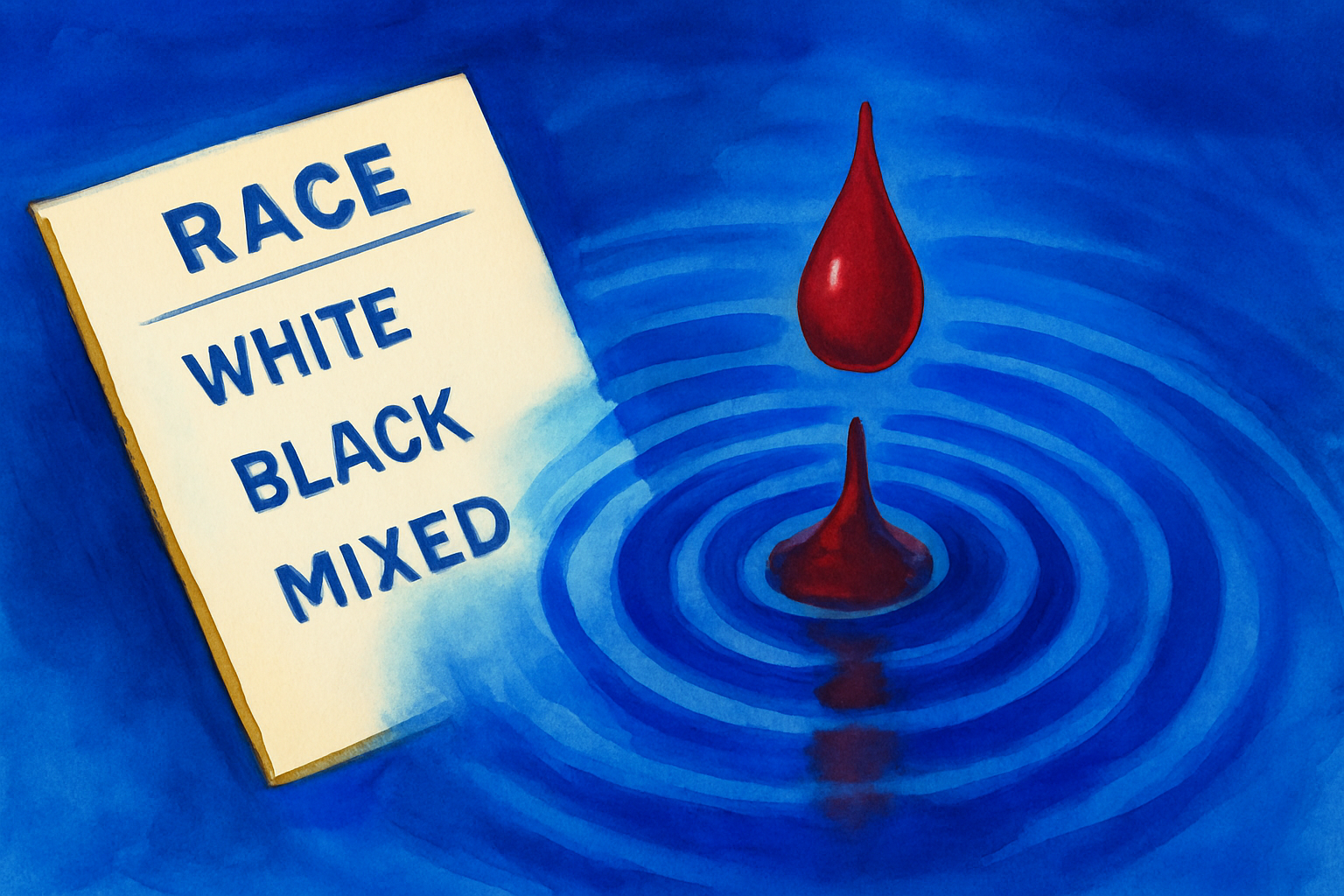
It’s wild to think that something as personal and complex as racial identity could be shaped by a rule as simple as this: if you had even one ancestor of African descent — just “one drop” — you were legally considered Black.
That idea feels arbitrary now because it always was. But it became one of the most powerful racial classifications in American history. It shaped families, communities, opportunity, belonging, and even how people understood themselves.
What makes the One-Drop Rule so important to understand is how it shows the difference between biology and power. This wasn’t a scientific idea. It wasn’t a cultural tradition. It wasn’t something people naturally believed. It was a rule created on purpose to maintain a rigid racial hierarchy at a time when that hierarchy was under pressure.
And once you see how something that fragile became so influential, you start to understand why racial identity in America works the way it does today.
The idea didn’t appear all at once. It grew out of earlier lineage laws — like the 1662 statute that tied a child’s status to the mother — and became sharper over the 1800s and early 1900s.
Here’s why it took shape:
As Black, Indigenous, and White communities interacted — by choice, by force, and through centuries of complicated relationships — racial lines blurred. Lawmakers wanted clarity for the sake of segregation and social control.
If people with one Black parent or grandparent could argue they were “white enough” to claim freedom or rights, the system cracked.
When the old system fell, the One-Drop Rule became a legal tool to preserve racial hierarchy in schools, neighborhoods, voting, and marriage.
They argued that any African ancestry “tainted” whiteness — a belief with no scientific basis, but enormous political force.
The One-Drop Rule wasn’t about who people were. It was about who people in power needed them to be.
The rule expanded the category of “Blackness” to include anyone with African ancestry — often forcing people into an identity the state defined for them.
People within the same household could be assigned different racial classifications depending on appearance or paperwork.
Identity became bureaucratic, and families with connections across cultures found themselves split across rigid categories.
If a rival or neighbor wanted to undermine someone socially or economically, accusations about ancestry could be weaponized. The stakes were high.
European immigrants eventually became part of “whiteness,” but the One-Drop Rule defined where the outer boundary of whiteness stopped.
The rule fed directly into segregation, voting restrictions, marriage laws, medical access, and even how census data was collected.
It shaped a world where identity wasn’t something personal — it was something assigned.
The One-Drop Rule influenced:
It even affected how families told their own histories.
Some hid ancestry. Others reclaimed it. Many were never given the chance to choose.
Even though the rule isn’t written into law anymore, its effects remain:
Understanding the One-Drop Rule doesn’t just explain the past.
It reveals how identity, belonging, and opportunity were shaped not by biology — but by power.
Library of Virginia — Racial Integrity Acts & Classification Laws
https://www.lva.virginia.gov/
Smithsonian National Museum of African American History — Racial Construction Resources
https://nmaahc.si.edu/
National Archives — Census Categories Over Time
https://www.archives.gov/research/census
PBS — Race: The Power of an Illusion
https://www.pbs.org/race/
UNC Digital Collections — Racial Legislation
https://dc.lib.unc.edu/