
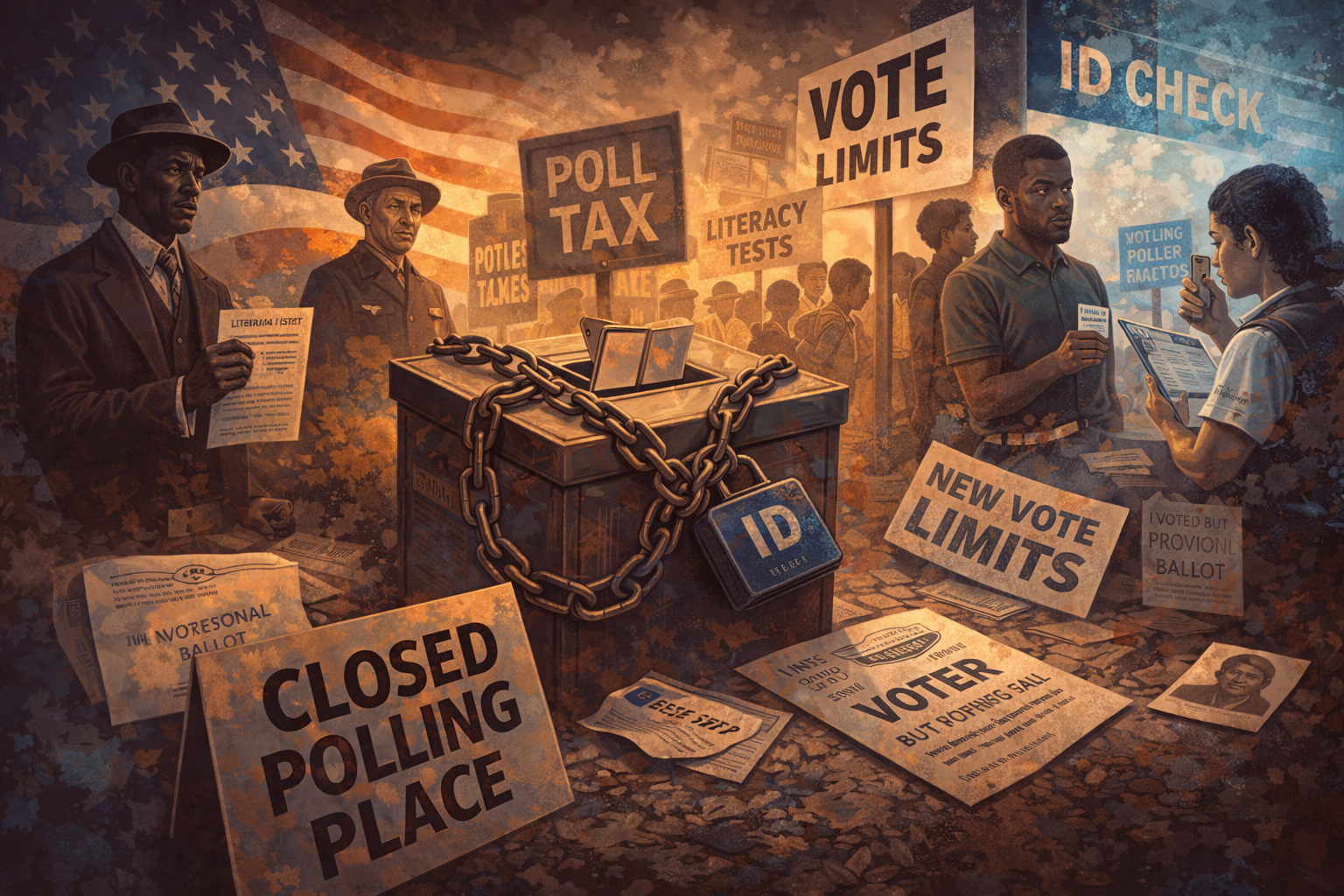
Voting rights in the United States are often discussed as a story of progress—expanded over time through amendments, court decisions, and legislation.
But alongside that expansion runs another, quieter story: restriction.
Across generations, voting rights have been narrowed, reshaped, and constrained through changing mechanisms. The methods evolved. The language softened. The effects remained durable.
Understanding this pattern requires looking not at any single law, but at how restriction adapts when exclusion becomes politically unacceptable.
From the nation’s founding, voting was restricted by design. Eligibility rules tied participation to race, gender, property ownership, and status. These limits reflected beliefs about who was fit to govern and whose interests democracy was meant to serve.
As formal exclusions were challenged, restriction did not disappear. It changed form.
After the Civil War, constitutional amendments expanded voting rights in principle. In practice, states responded with new tools—poll taxes, literacy tests, grandfather clauses, and intimidation—that achieved exclusion without explicitly naming it.
Restriction was not a failure of democracy. It was a method used to manage it.
Over time, the most visible restrictions became politically untenable. Laws could no longer openly exclude based on race.
Restriction shifted into administrative terrain.
Requirements around registration, identification, residency, district boundaries, and election timing became the new levers. These rules were framed as neutral safeguards—protecting integrity, efficiency, or order.
But their effects were not neutral.
Each generation of restrictions followed a similar pattern:
The vocabulary changed. The logic endured.
Restrictions have consistently fallen hardest on communities that rely most on accessible voting systems.
Black Americans experienced repeated cycles of expansion followed by retrenchment, often within a single generation.
Immigrants and language minorities faced barriers tied to documentation, literacy, and procedural complexity.
Low-income and working-class voters were affected by requirements that assumed flexible work schedules, reliable transportation, or stable housing.
Young voters and the elderly encountered restrictions tied to registration rules, ID requirements, and polling access.
The effects overlapped. Restriction compounded across race, class, age, and geography.
Today, voting restrictions are rarely framed as denial. They are framed as management.
Debates center on:
These concerns are not new. What is new is the technical sophistication of restriction—rules that appear modest in isolation but accumulate into meaningful barriers.
Because the restrictions are procedural, their effects are harder to see. Participation declines quietly. The system appears intact.
This history explains why voting rights remain contested even after landmark expansions.
It clarifies why progress is often followed by new constraints, and why rights secured in law require constant defense in practice.
Most importantly, it challenges a common assumption: that democracy naturally broadens over time. In reality, expansion has always been met with adaptation.
Democracy does not only erode through dramatic reversals. It can narrow through administration.
Voting Rights History
Legal Frameworks
Voting rights in the United States have never been static. They have been expanded, restricted, redefined, and defended—generation after generation.
Every Chapter Counts examines these patterns not to suggest inevitability, but to restore clarity. When we understand how restriction adapts, we are better equipped to recognize it.
Democracy depends not only on who is allowed to vote, but on how easily participation is sustained.