Some forms of exclusion are loud. Others are technical.
After the Civil War, the United States formally expanded voting rights. Constitutional amendments barred discrimination based on race. On paper, the electorate widened.
In practice, new barriers emerged—ones that claimed neutrality while reproducing exclusion.
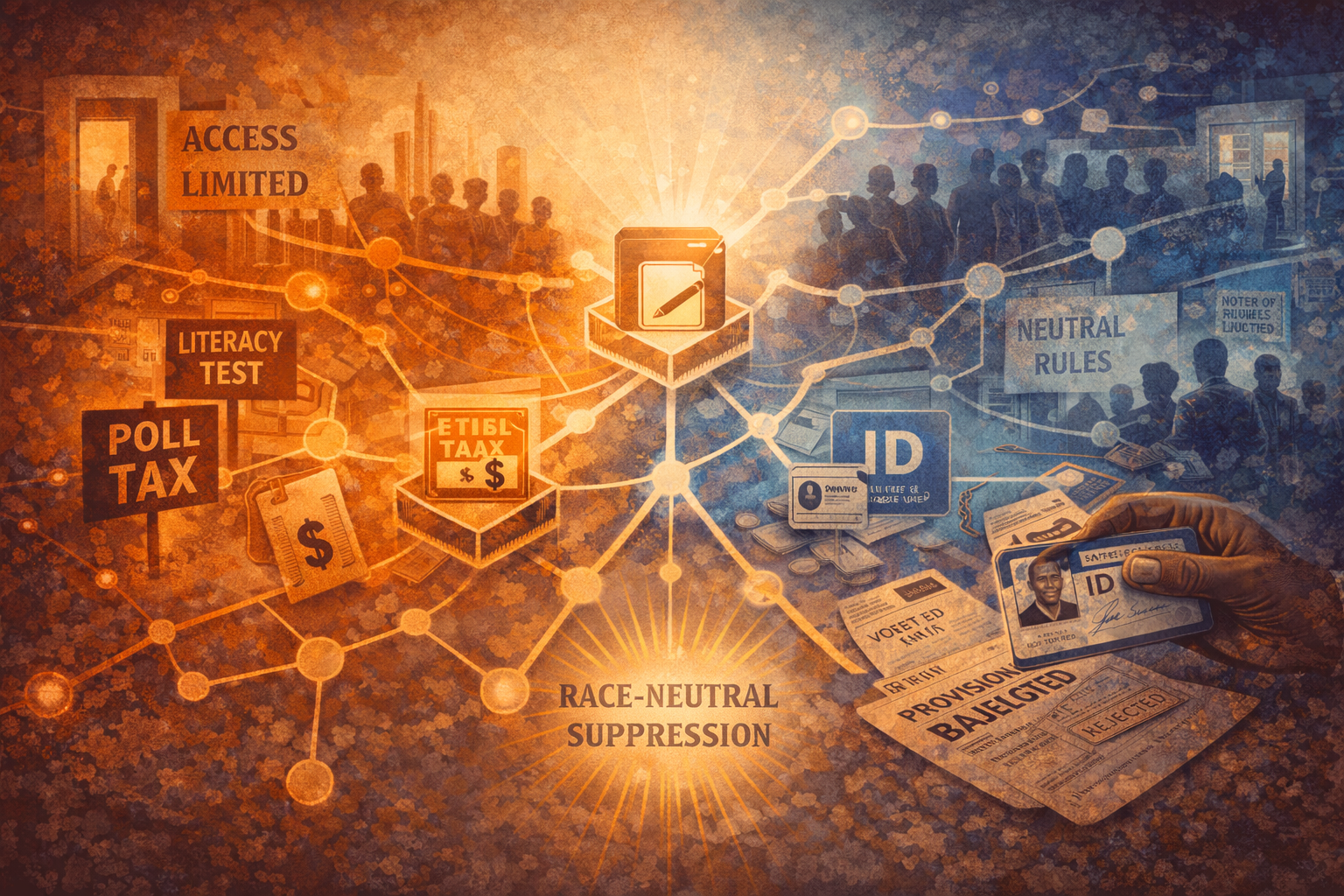
Literacy tests and poll taxes were among the most effective of these tools. They did not name race. They did not announce exclusion. But they reshaped who could participate in democracy for generations.
In the late nineteenth and early twentieth centuries, states seeking to limit Black political power faced a problem.
Openly racial voting restrictions were increasingly vulnerable to legal challenge. At the same time, expanding Black participation threatened existing political control.
The solution was indirect exclusion.
Literacy tests required prospective voters to demonstrate reading comprehension, constitutional knowledge, or interpretive skill. Poll taxes required payment—sometimes cumulative—before a ballot could be cast.
These requirements appeared reasonable. Literacy and financial contribution were framed as markers of civic responsibility.
Their application, however, was anything but neutral.
The effectiveness of these tools lay in how they were administered.
Literacy tests were often graded subjectively. White voters could be passed with minimal scrutiny. Black voters were asked obscure or impossible questions. The same answer could pass one voter and fail another.
Poll taxes disproportionately affected people with limited income, unstable employment, or generational poverty. In some states, unpaid taxes accumulated across years, creating barriers that could not be overcome quickly.
Together, these systems transformed discretion into exclusion.
They did not deny rights outright. They filtered them.
Black Americans were the primary targets of these measures. Literacy tests and poll taxes were explicitly designed to suppress Black voting without violating the letter of the law.
Poor white voters were also affected, particularly in rural areas, though exemptions and selective enforcement often softened the impact for politically aligned groups.
Immigrants and language minorities faced barriers tied to language proficiency and cultural familiarity, further narrowing participation.
Women, newly enfranchised in the early twentieth century, encountered overlapping obstacles that delayed meaningful access to the ballot.
The systems worked because they concentrated exclusion where it mattered most.
Literacy tests and poll taxes were eventually banned through federal action and court decisions. But the logic behind them did not disappear.
The idea that voting access should be conditioned on administrative hurdles persists. Modern restrictions are often justified as neutral safeguards—focused on integrity, competence, or efficiency.
What history shows is that neutrality in language does not guarantee neutrality in outcome.
Rules that rely on discretion, cost, or complexity consistently produce unequal participation, especially when layered on existing disparities.
This history helps explain why voting rights debates often focus on process rather than exclusion.
It shows how suppression adapts when overt discrimination becomes unacceptable. And it clarifies why rights secured in theory can remain fragile in practice.
Democracy is not only shaped by who is excluded, but by how exclusion is disguised.
Voting Restrictions
Legal History
Literacy tests and poll taxes were not historical accidents. They were deliberate systems designed to limit participation while appearing fair.
Every Chapter Counts examines these mechanisms to restore clarity—not to collapse history into slogans, but to understand how suppression evolves.
When we recognize how exclusion adapts, we are better equipped to evaluate the rules we inherit.