
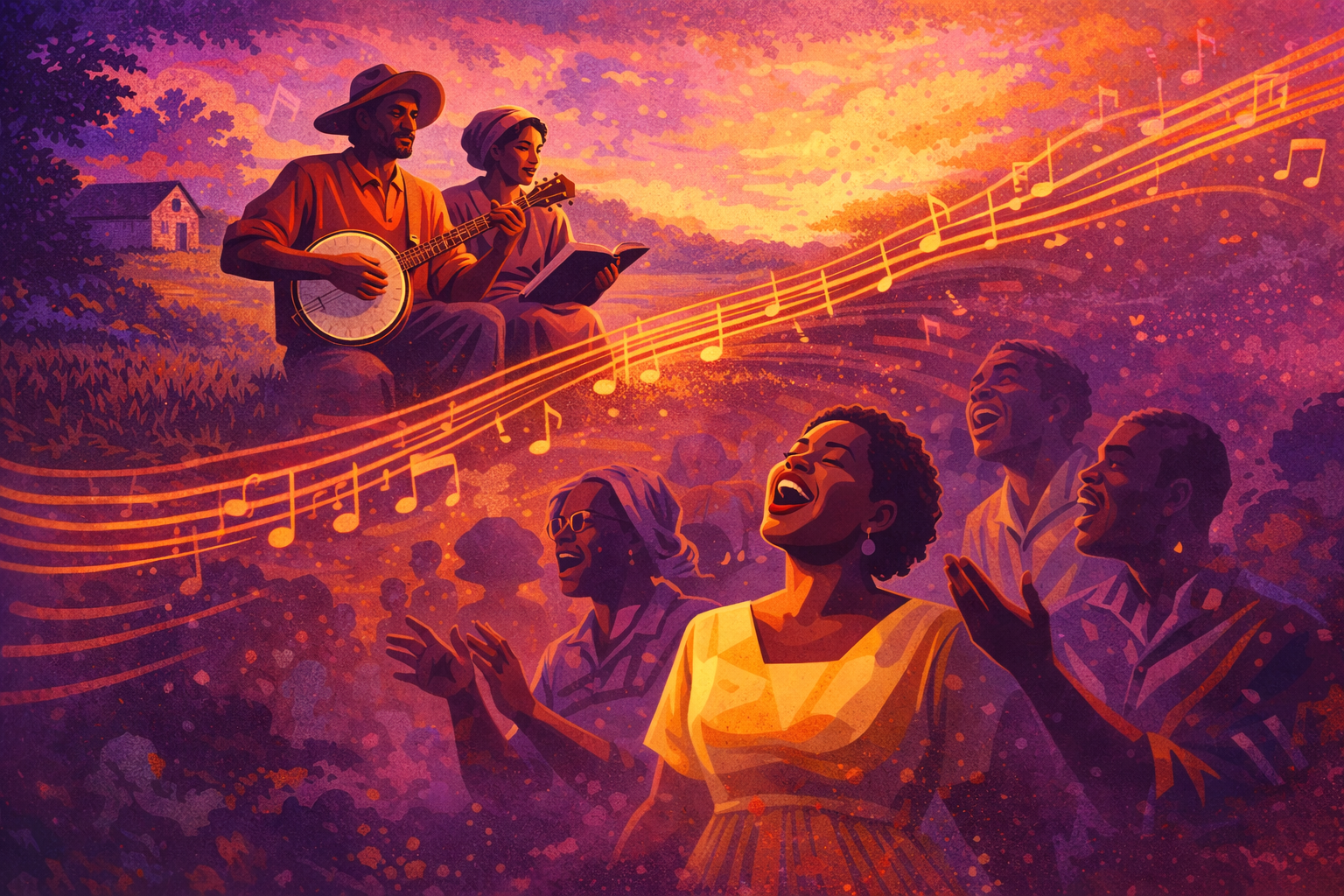
Long before the United States had a national music industry, radio stations, or record labels, songs were already circulating across plantations, fields, rivers, and churches. These songs did not belong to concert halls or formal stages. They traveled by voice, memory, and repetition.
Many of these songs are now known as spirituals. They are often treated as a religious genre or a precursor to gospel music. But historically, spirituals functioned as something broader and more foundational: one of America’s earliest forms of folk music.
Understanding spirituals this way helps clarify not only their cultural importance, but how American music itself developed—informally, collectively, and under conditions of constraint.
Spirituals emerged during slavery, created by enslaved Africans and their descendants in the United States.
They drew on multiple sources:
Unlike written hymnals, spirituals were learned and shared orally. Lyrics shifted across regions and generations. Melodies adapted to different rhythms of labor and worship. No single version was authoritative.
This flexibility was not accidental. In a world where literacy was restricted and gatherings were monitored, oral music became a durable way to carry meaning, memory, and belief.
Spirituals operated within—and around—systems of control.
Slaveholders often encouraged religious instruction, believing it promoted obedience. Singing was sometimes permitted during work or worship as a means of regulation or morale management.
At the same time, spirituals allowed enslaved people to:
Songs could function simultaneously as worship, emotional release, historical record, and quiet commentary on freedom and survival.
Because they were not formally documented, spirituals circulated horizontally rather than institutionally. Their authority came from use, not authorship.
Spirituals were created and sustained primarily by enslaved Black communities, but their influence extended outward.
Enslaved people used these songs to:
After emancipation, spirituals were collected, arranged, and performed for broader audiences—often by Black choirs and educators seeking to preserve the music and assert cultural dignity.
At the same time, these performances introduced tensions around ownership, interpretation, and commercialization that would reappear in later musical genres.
The structure of spirituals—call-and-response, repetition, improvisation, emotional intensity—shaped nearly every major American musical form that followed.
Elements of spirituals can be heard in:
Even when the religious context fades, the musical architecture remains.
Spirituals demonstrate that American folk traditions did not originate solely from rural ballads or European lineages. They developed through collective creation, oral transmission, and adaptation under pressure.
Recognizing spirituals as America’s first folk music reframes how cultural origins are understood.
It challenges the idea that folk music emerges only from freedom or pastoral simplicity. Instead, it shows how folk traditions can form under constraint—carrying memory, identity, and continuity when formal systems fail or exclude.
Spirituals remind us that culture does not wait for permission. It develops where people gather, adapt, and endure.
American Folklife Center — Library of Congress
https://www.loc.gov/programs/american-folklife-center/
Slave Narratives — U.S. National Archives
https://www.archives.gov/research/african-americans/slave-narratives
Jazz — PBS (Ken Burns)
https://www.pbs.org/kenburns/jazz/
African-American Music (Overview)
https://en.wikipedia.org/wiki/African-American_music
Spirituals were not written to last. They were sung to survive.
Yet they endure—carrying the outlines of a shared past into the present. Listening to them as folk music allows us to hear not just belief or sorrow, but the early foundations of American culture itself.
Every Chapter Counts traces these beginnings to better understand how culture forms—and why it still matters.