
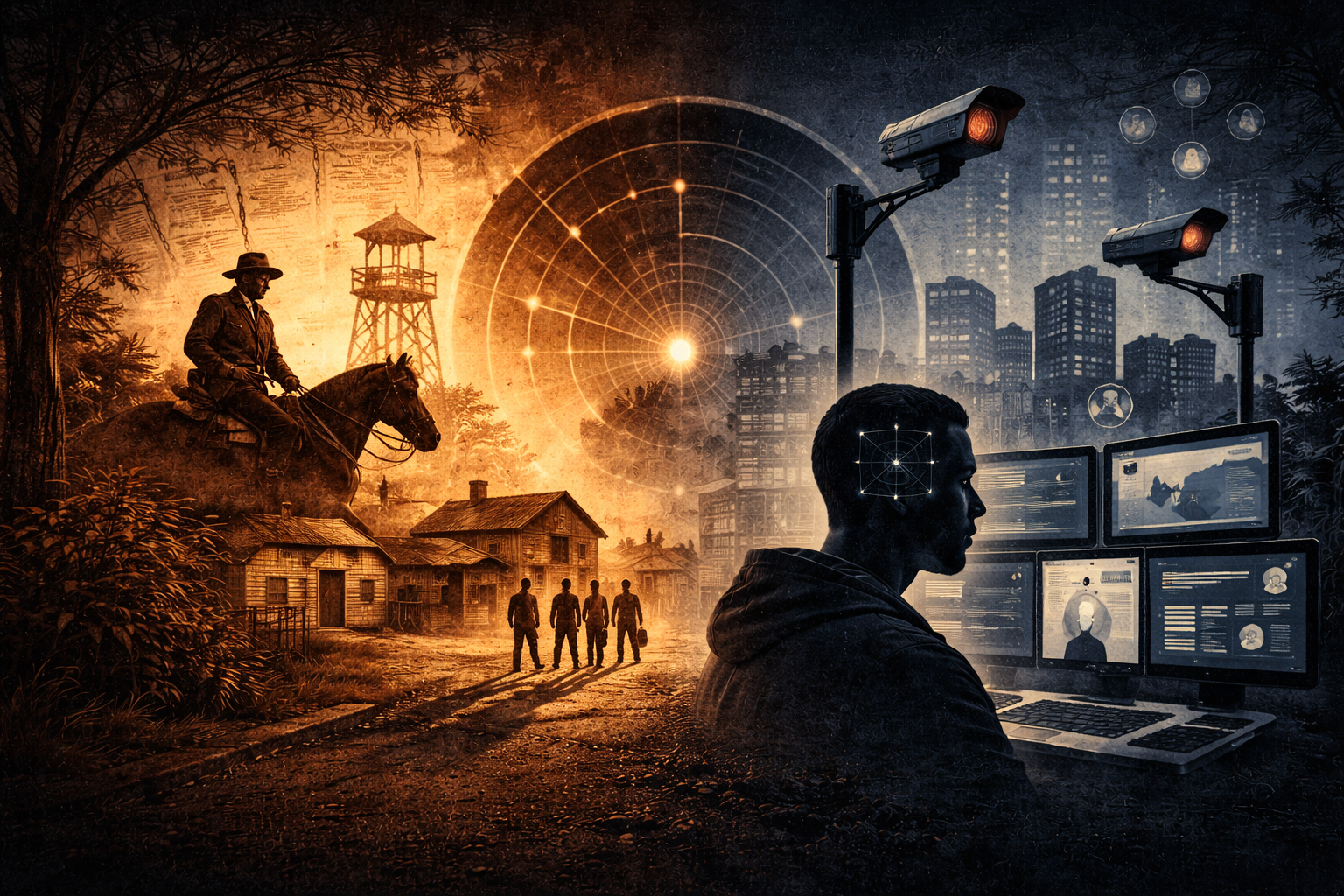
Surveillance is a familiar part of modern life. Cameras line city streets. Apps collect location data. Algorithms flag certain patterns as risky or suspicious. These systems are often described as neutral tools—designed for safety, efficiency, or public order.
But surveillance did not begin with technology. Long before digital systems existed, monitoring was used to manage movement, behavior, and access to opportunity. And from the beginning, it was applied unevenly.
To understand why modern surveillance feels concentrated in particular places and communities, we need to look at how systems of monitoring first took shape—and who they were built to watch.
In early American history, surveillance was embedded in law and social structure.
Slave codes required constant oversight of enslaved people’s movement, labor, and behavior. Written passes were often needed to travel. Patrols were authorized to stop, question, and punish based on suspicion alone. Surveillance was not about preventing crime as we understand it today—it was about enforcing a social order built on control.
These systems benefited enslavers and local authorities by protecting labor, discouraging resistance, and reinforcing racial hierarchy. Monitoring was considered normal because freedom itself was conditional. Some people were assumed to require oversight; others were presumed trustworthy by default.
Surveillance functioned collectively. Entire communities were treated as potential risk, not because of individual actions, but because of group identity.
Emancipation ended slavery, but it did not end surveillance. Instead, the logic adapted.
Black Codes and vagrancy laws criminalized everyday behavior, allowing authorities to continue monitoring mobility and labor. Segregation later formalized where people could live, work, and gather—boundaries enforced through observation and policing.
As the twentieth century progressed, surveillance became institutional rather than overt. Record-keeping expanded. Policing professionalized. Data replaced discretion in name, if not in effect. Language shifted—from control to prevention, from order to safety.
What changed most was visibility. Surveillance moved from the obvious to the embedded. It became part of bureaucratic routine, making unequal monitoring appear natural rather than chosen.
The effects of surveillance were shaped by overlapping forces.
Black communities experienced sustained monitoring across generations. Immigrant communities were often surveilled during moments of national fear or economic stress. Poor and working-class neighborhoods—across racial lines—were more visible to authorities than wealthier areas. Political organizers, labor movements, and civil rights groups were monitored regardless of race.
Women, young people, and families encountered surveillance through schools, welfare systems, and housing oversight. Rural and urban communities experienced different forms, but similar assumptions.
These were not isolated outcomes. They followed patterns established earlier—about who required supervision and who was entitled to privacy.
Today, surveillance is frequently digital.
Predictive policing software, facial recognition, social media monitoring, and inter-agency data sharing extend observation in ways that are often invisible to those being observed. These tools are commonly described as objective because they rely on data.
But data reflects history.
When earlier policing focused more heavily on certain neighborhoods or populations, the records produced from those choices trained modern systems to look in the same places. Algorithms don’t remove bias; they often encode it.
Social media adds another layer. Online expression, networks, and language can be monitored without context, sometimes reinforcing assumptions about threat or intent. The technology is new. The underlying logic is not.
Understanding the history of surveillance helps explain why trust in monitoring institutions varies so widely. It clarifies why claims of neutrality can feel disconnected from lived experience.
It also explains why disparities persist even when systems are formally race-neutral. Surveillance does not begin fresh with each generation. It builds on inherited patterns of attention and suspicion.
Civic understanding requires recognizing how systems meant to protect can also constrain—and how those effects accumulate quietly over time.
Surveillance intersects with housing, labor, education, policing, and technology—often reinforcing patterns created elsewhere.
To explore how monitoring systems developed and how they continue to affect different communities, consider these resources:
Surveillance is often framed as an inevitable feature of modern life. But when we understand its deeper roots, we can see it more clearly—as a system shaped by choices, incentives, and history.
Every Chapter Counts exists to surface those histories—not to assign blame, but to build shared understanding. When we recognize how yesterday’s systems shape today’s “normal,” we gain the tools to think more carefully about the future we are building together.