
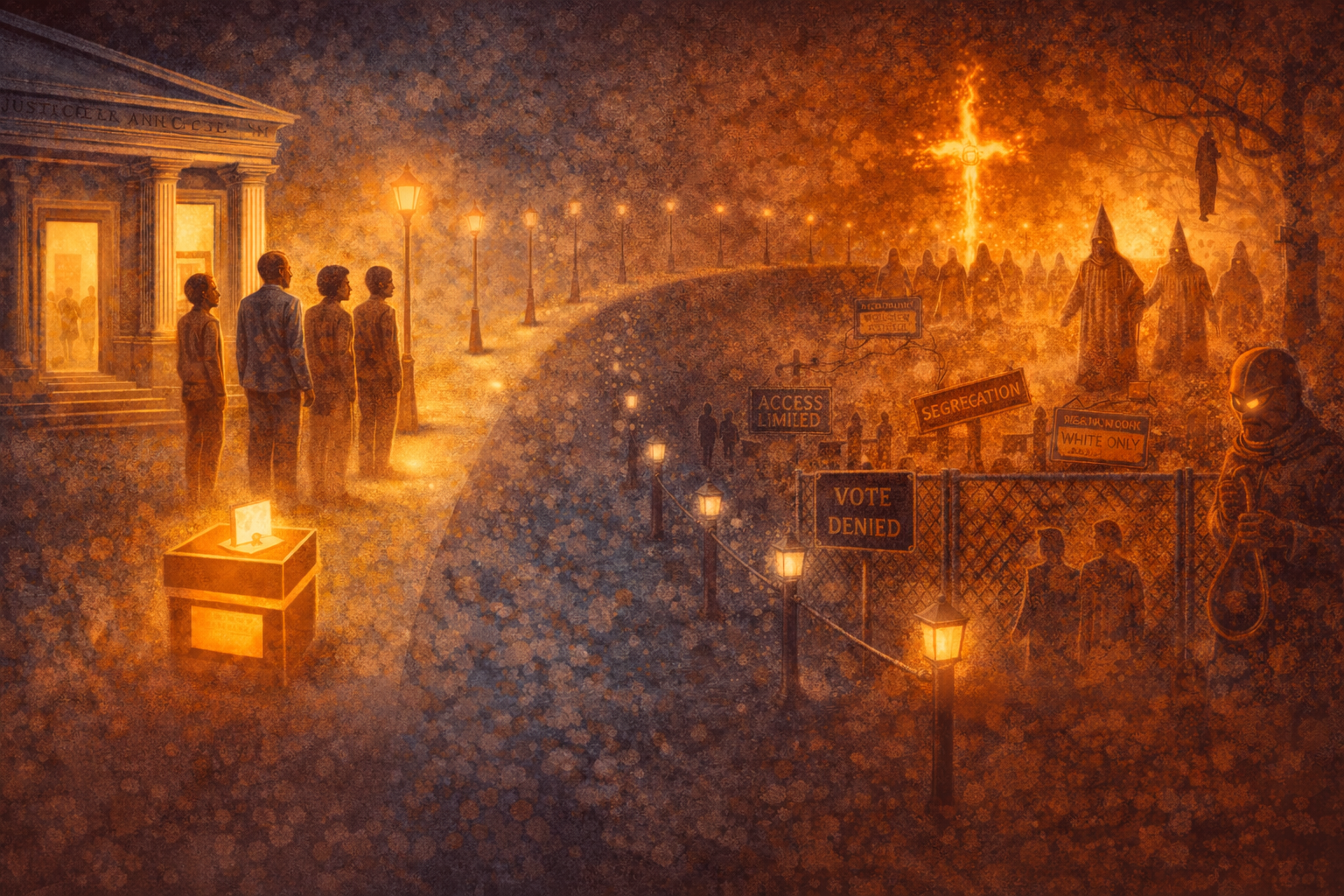
American democracy is often described as a story of expansion—rights broadened, participation widened, equality extended over time.
But history does not move in a straight line.
In the late nineteenth and early twentieth centuries, the United States entered a period historians often call the Nadir of race relations—a time when democratic gains made after the Civil War were systematically reversed.
This was not a moment of confusion or drift. It was a period of deliberate retrenchment, when democracy narrowed by design.
After the Civil War, the United States experienced a brief but transformative expansion of democracy.
Black Americans voted, held public office, served on juries, and helped shape new state governments. Federal law and constitutional amendments backed these changes.
But these gains were fragile.
As Reconstruction ended, federal enforcement receded. Political alliances shifted. White supremacist violence increased. And states began rebuilding systems that preserved power while complying, in appearance, with constitutional law.
The Nadir did not emerge from chaos. It emerged from recalibration.
Democracy did not collapse openly during this period. It was narrowed quietly.
States implemented:
At the same time, extralegal violence—including lynching—reinforced political exclusion by terrorizing communities into silence.
These systems worked together. Law provided legitimacy. Violence enforced compliance. Democracy remained on paper while participation collapsed in practice.
Black Americans bore the primary burden of democratic regression. Political participation dropped sharply across the South. Representation disappeared. Legal protections eroded.
Poor white voters were also affected by poll taxes and literacy tests, though exemptions and selective enforcement often limited the impact.
Immigrants and ethnic minorities faced increasing suspicion and exclusion, particularly as national identity narrowed.
The effects were not evenly distributed—but they were intentional.
The Nadir shaped American institutions long after it ended.
It normalized:
Many twentieth-century civil rights struggles were not about creating new rights, but about reclaiming ones that had already existed—and been stripped away.
Understanding the Nadir explains why later expansions required extraordinary effort and federal intervention.
The Nadir challenges the assumption that democracy naturally improves with time.
It shows that regression is possible, durable, and often legal. It reveals how systems adapt to preserve power when overt exclusion becomes untenable.
Most importantly, it underscores a central lesson: democracy is not self-sustaining.
Without protection and enforcement, gains can be reversed—even after they appear secure.
The Nadir of race relations was not an aberration. It was a choice—made through law, violence, and withdrawal of protection.
Every Chapter Counts examines this period not to dwell on loss, but to clarify how democracy can recede when vigilance fades.
Understanding regression is essential to recognizing what sustains progress.