
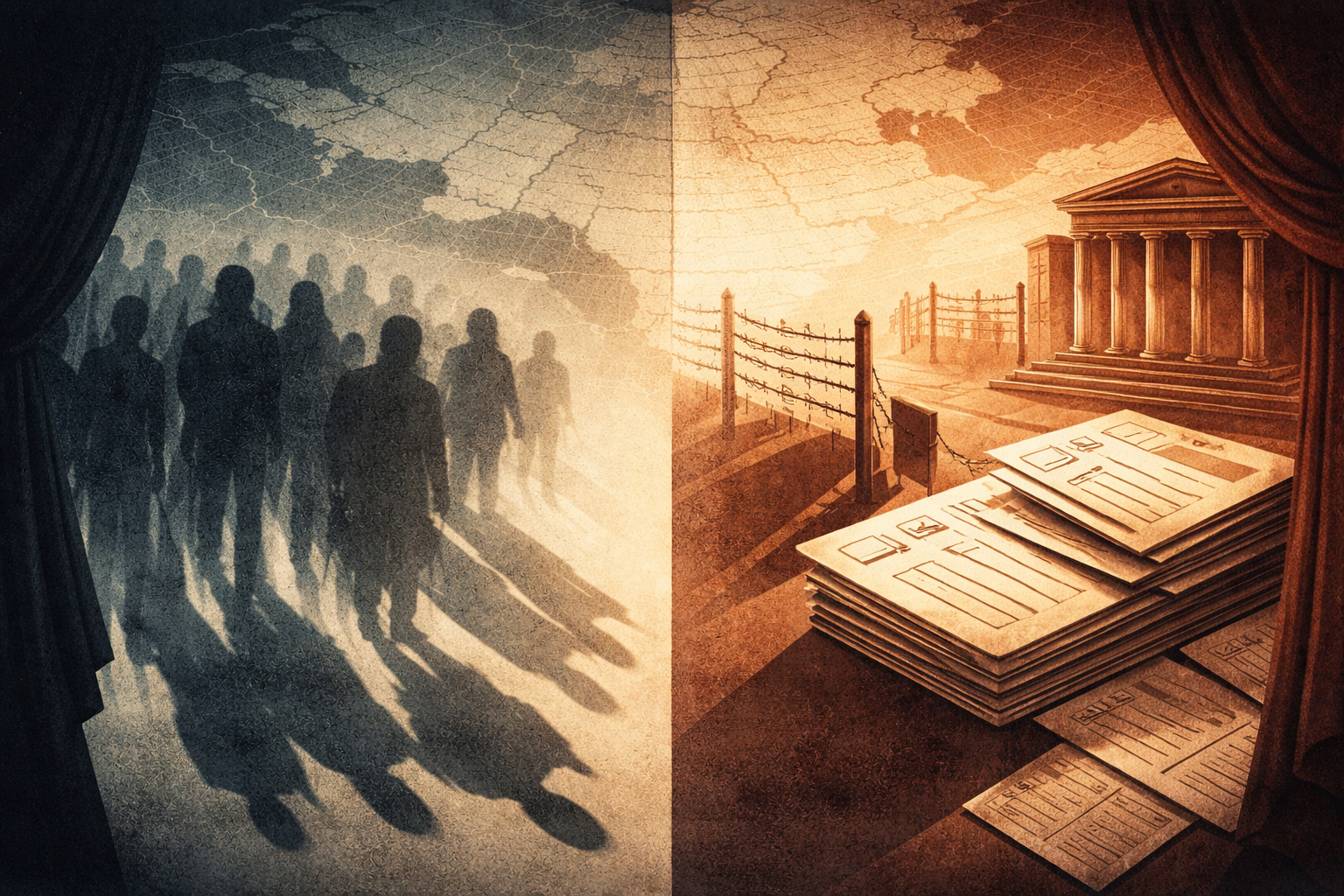
Fear has always shaped public decision-making. But it does not operate as a single force.
Across American history, policy responses to social change tend to arise from two distinct kinds of fear. One is fear of loss—of power, status, or control. The other is fear of disorder—of chaos, instability, or breakdown. These fears often overlap, but they function differently, producing different kinds of laws, narratives, and institutional responses.
Understanding the distinction helps explain why moments of change can generate restrictive rules even when violence is rare, and why those rules often persist long after the original crisis has passed.
Fear has never been evenly distributed in American society.
From the nation’s earliest years, governing institutions developed amid anxieties about rebellion, fragmentation, and the maintenance of hierarchy. Questions about who could own property, vote, organize, or move freely were shaped by concerns about control and predictability.
Fear of loss emerged when dominant groups sensed erosion of authority—political, economic, or cultural. Fear of disorder appeared when social change was framed as a threat to stability itself. Both were treated as legitimate grounds for intervention.
The two fears tend to generate different policy patterns.
Fear of loss often leads to restrictive policies: limits on access, eligibility, or participation. These rules aim to preserve existing arrangements by narrowing who can benefit from them.
Fear of disorder tends to produce control policies: surveillance, enforcement, and regulation. These measures are justified as necessary for safety or order, even when the underlying concern is uncertainty rather than violence.
Over time, responses harden. What begins as a temporary reaction becomes standardized practice, embedded in law and administration. The fear fades; the structure remains.
Public memory tends to frame fear-driven policies as:
This framing emphasizes intent rather than effect. It centers stated goals while minimizing how fear shaped scope, targets, and duration.
Less examined is how fear:
Fear-based policy rarely announces itself as fear. Instead, it is translated into administrative language—rules, procedures, standards—that appear detached from emotion even as they are powered by it.
Communities already positioned as “risky,” “unfamiliar,” or “unpredictable” have historically borne the greatest burden of fear-driven policy.
Racial minorities, immigrants, labor organizers, political dissenters, and the poor were repeatedly framed as sources of disorder or threats to stability. Policies aimed at managing fear constrained these groups most tightly, regardless of individual behavior.
Meanwhile, those experiencing fear of loss often saw their anxieties validated and translated into durable protections.
Contemporary debates about security, regulation, and governance continue to reflect these two fears.
When policy emphasizes restriction, it often signals fear of losing advantage or authority. When it emphasizes monitoring and enforcement, it often signals fear of disorder—even when actual risk is low.
Recognizing which fear is at work clarifies why certain solutions are chosen and why others are dismissed as unrealistic.
Fear is not inherently illegitimate. But unexamined fear produces durable consequences.
Understanding how fear becomes policy helps explain why inequality can persist without explicit intent, why emergency measures become permanent, and why reforms often trigger backlash rather than resolution.
Historical clarity allows societies to distinguish between necessary caution and reflexive containment.
Risk — Stanford Encyclopedia of Philosophy
A foundational explanation of how risk, uncertainty, and judgment operate in collective decision-making and institutional design.
https://plato.stanford.edu/entries/risk/
“The War on Fear” — UCLA Bruin Political Review
Explores how fear narratives shape modern policy choices and public tolerance for restriction.
https://bruinpoliticalreview.org/articles?post-slug=war-on-fear
Fear has always played a role in shaping public life. The question is not whether fear exists—but whether it is examined, named, and understood.
Every Chapter Counts approaches history to clarify how emotions become structures, and how understanding them expands the space for more deliberate choices.